Contents
History & cultureBY TELLBY8 sections · numbered as on the map01 Orientation
Welcome to the ancient village of Somanathapura, located along the peaceful banks of the Kaveri River in the Mysuru district of Karnataka, India. You are standing before the extraordinary Chennakesava Temple, one of the most exquisite masterpieces of thirteenth century Hoysala architecture. This sacred monument was consecrated in approximately twelve fifty eight CE during the reign of the Hoysala monarch King Narasimha the Third. Its creation was commissioned and funded by his high ranking commander and general, Somanatha Dandanayaka. General Somanatha established a prosperous Agrahara land grant dedicated to learned scholars and constructed this grand Vaishnava temple as the spiritual heart of the new settlement, which naturally took its patron's name, Somanathapura.
Please direct your attention toward the eastern main entrance gate, known as the Mahadvara. Standing proudly in front of this entrance is a tall stone pillar known as the Stambha. In ancient times, this majestic pillar was crowned with a sculpture of Garuda, the sacred mythical eagle and celestial vehicle of Lord Vishnu, though that figure has regrettably disappeared over the centuries. As you step closer to the entrance porch, observe the smooth pillars supporting the structure. These were carved from a specialized greenish grey soapstone known technically as chloritic schist. This remarkable stone is remarkably soft when freshly quarried, allowing medieval sculptors to scrape and carve astonishingly intricate details into its surface. Upon prolonged exposure to the atmosphere, the stone gradually hardens, preserving its fine artwork through the ages. Because chloritic schist was not naturally available in the immediate vicinity of Somanathapura, it had to be imported from distant regions of Southern India, demonstrating the immense resources and ambition invested in this project.
To the left side of the entrance porch, you will discover four vertical soapstone inscription slabs carved in the style of traditional hero stones. The upper sections of these slabs are richly decorated with sacred Hindu iconography along with miniature relief sculptures depicting the three presiding deities of the temple, namely Keshava, Janardhana, and Venugopala. The Old Kannada inscriptions etched into these stone panels provide invaluable historical documentation. They record the original consecration of the temple complex in twelve fifty eight CE and detail subsequent major repair campaigns conducted during the Vijayanagara Empire in the years fourteen ninety seven CE and fifteen fifty CE. These stone records stand as enduring historical testimonies to the foundation, patronage, and multi era preservation of this architectural marvel. Now, let us proceed through the entrance gate into the spacious outer courtyard of the temple complex.
02 Walled Courtyard Corridor and Sixty-Four Small Shrines
As you step past the eastern Mahadvara entrance into the main courtyard, you find yourself inside a vast, enclosed rectangular space framed by a perimeter pillared corridor known as the Prakara. This enclosing veranda is not merely a boundary wall, but an integral architectural masterpiece composed of a series of small, exquisitely proportioned perimeter shrines. In total, this courtyard corridor houses sixty four small individual shrine cells. …
03 Star-Shaped Jagati Platform and Lower Wall Friezes
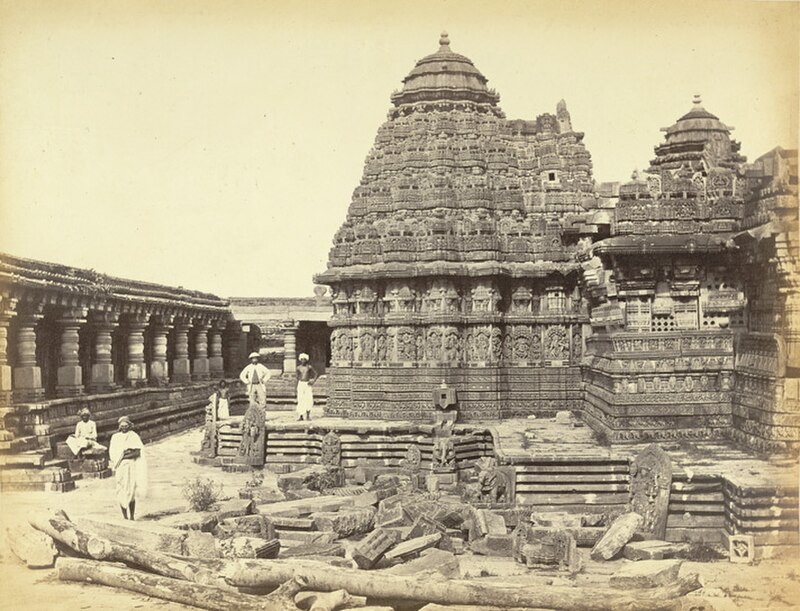
Standing in the central courtyard, your eyes are immediately drawn to the elevated main temple structure resting upon a magnificent stone plinth known as the Jagati. Raised approximately three feet above the ground, this stellate platform symbolizes the transition from the material world into the sacred divine realm. Access to the Jagati is gained via stone steps located at its eastern end. …
04 Upper Wall Sculptures and Star-Shaped Vimana Towers
Directing your gaze above the lower narrative friezes toward the mid and upper levels of the outer temple wall, you enter a realm of extraordinary artistic refinement. Stacked directly above the mythic narrative bands are continuous horizontal registers depicting Makaras, mythical aquatic creatures combining features of various animals, followed by a radiant band containing nearly two hundred finely detailed peacock carvings. …
05 Navaranga Sabha Mandapa and Lathe-Turned Pillars
Stepping through the eastern entrance doorway into the interior of the main temple, you leave behind the bright outdoor sunlight and enter the atmospheric sanctuary of the Navaranga Sabha Mandapa. While the entrance originally lacked a wooden door, the Archaeological Survey of India has added a protective wooden door to safeguard the interior artwork. …
06 South Sanctum: Venugopala Krishna Shrine
Moving into the southern section of the Navaranga hall, you arrive at the doorway of the first sanctum, dedicated to Venugopala Krishna. Framing the entrance are two sculpted guardian deities, Bhadra and Subhadra, standing as Dvarapalas to protect the holy chamber. The decorative lintel above the entrance features a relief of Venugopala, while the ceiling canopy overhead displays a thirteenth century carving of Lakshminarayana seated in the peaceful Sukhasana yoga posture alongside Garuda,…
07 North and West Sanctums: Janardhana and Keshava Shrines
After exploring the southern sanctuary, cross the Navaranga hall to examine the northern shrine located directly opposite. Similar to the southern sanctuary, the entrance to the northern shrine is guarded by two tall Dvarapala sculptures depicting Bhadra and Subhadra. The outer lintel above the entrance displays a relief of Janardhana, another major form of Lord Vishnu, while the ceiling canopy overhead showcases a carving of Lakshminarayana. …
08 Closing
As you stand once more in the peaceful courtyard and look upon the majestic towers of the Chennakesava Temple, you can appreciate the profound historical journey this monument has endured over the centuries. Consecrated during the golden age of the Hoysala Empire in the thirteenth century, this temple survived catastrophic destruction during the fourteenth century military campaigns launched by the Delhi Sultanate. Yet, the monument refused to crumble into obscurity. …