 Photo Wikimedia Commons
Contents
History & cultureBY TELLBY8 sections · numbered as on the map01 Orientation
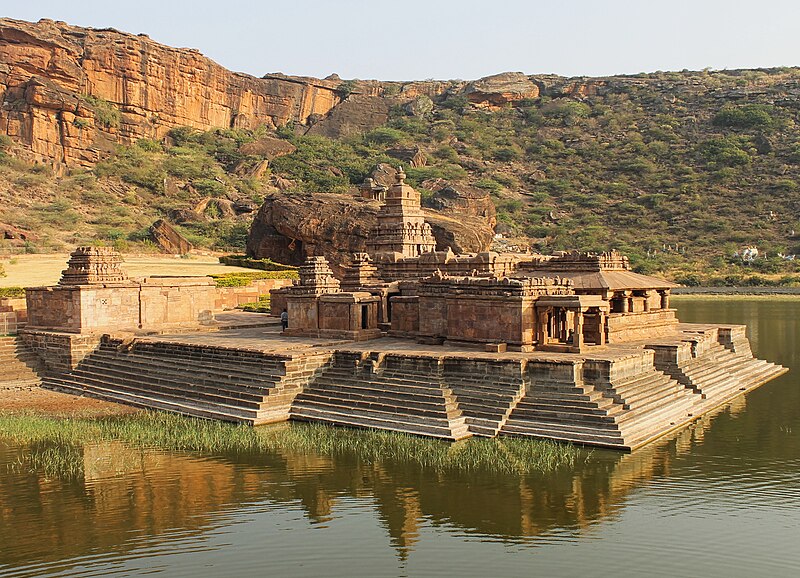
Welcome to the entrance of the Bhutanatha Group of Temples, beautifully situated along the eastern bank of Agastya Lake in Badami, historically known as Vatapi, within the Bagalkot district of Karnataka, India. As you stand before this breathtaking landscape, you are looking at one of the most remarkable architectural achievements of the Chalukya Dynasty, which ruled over vast areas of southern and central India between the sixth and twelfth centuries. The Early Chalukyas, also known as the Badami Chalukyas, established their capital at Vatapi and created an extraordinary tradition of stone architecture from the sixth to eighth centuries. Later, between the eleventh and twelfth centuries, the Western Chalukyas of Kalyani continued this grand legacy, constructing sophisticated shrines that further enriched this sacred site. Set against the dramatic backdrop of red sandstone cliffs enclosing the Malaprabha River valley, this temple complex presents a harmonious blend of human artistry and raw natural beauty. Long before these stone temples were erected, this region carried deep spiritual importance. Nearby prehistoric rock shelters at Sidilephadi, ancient rock paintings at Ranganatha Gudda, and numerous megalithic dolmens throughout the valley reveal that this geological basin served as an ancient memorial landscape for millennia. The Chalukyan rulers built upon this sacred tradition, becoming passionate patrons of art, trade, and culture. Their rule introduced a golden age that established the unique Chalukyan architectural tradition, representing a synthesis of the northern Indian Nagara style and the southern Indian Dravida style, laying the groundwork for what scholars identify as the Vesara tradition. Here around Agastya Lake, two distinct subgroups of temples coexist in total visual harmony. The East Bhutanatha main group, constructed primarily between the seventh and eighth centuries under the Badami Chalukyas, exemplifies the early development of the southern Dravida tradition. In contrast, the North Bhutanatha group, also known as the Mallikarjuna group, was erected on the northern bank during the eleventh and twelfth centuries, showcasing the refined Phamsana Nagara style favored by the Kalyani Chalukyas. Most of these sacred structures were dedicated to Lord Shiva, reflecting the deep devotion of the royal court and the local community. As we walk together along the shimmering water, you will discover how ancient artisans transformed solid rock into intricate pillar halls, sacred sanctums, and elaborate relief carvings. Let us step forward into this timeless realm where history, faith, and architecture converge.
02 Exterior and Stepped Ghat of the Main Bhutanatha Temple
You are now standing before the magnificent main shrine of the East Bhutanatha group, proudly positioned at the water edge on the eastern side of Agastya Lake. Erected between 700 and 725 CE, during the early eighth century under the reign of the Badami Chalukyas, this is the oldest and largest structure within the entire complex. …
03 Inside the Gudha-Mandapa of the Main Temple
Step inside the main temple to explore the cool and serene interior of the hall known as the gudha mandapa. This closed central assembly hall served as a transitional sacred space where devotees gathered in silent contemplation before approaching the inner sanctum. As your eyes adjust to the ambient interior light, you will immediately notice the four massive stone pillars standing prominently at the center of the hall, bearing the immense weight of the flat stone roof. …
04 Shrine Doorway Sculptures and the Sanctum Sanctorum
From the central hall, let us move toward the most sacred threshold of the temple, the doorway leading into the garbhagriya, or inner sanctum. Positioned at the base of the doorway columns are two beautiful reliefs depicting sacred river goddesses. On the right side at the foot of the doorframe, you can see Goddess Ganga standing atop her mythical aquatic mount, the makara. On the left side, Goddess Yamuna is depicted riding her mount, the tortoise. …
05 Four Shaiva Architectural Reliefs on the Eastern Boulders
Leaving the main shrine behind, let us step a few paces to the east, where a massive natural sandstone boulder rises from the ground. Carved directly into the vertical face of this rock formation are four highly unusual and historically significant Shaiva architectural reliefs. Executed during the late seventh or early eighth century, these reliefs are not merely decorative patterns, but detailed architectural impressions depicting four distinct structural styles of Shiva sanctums, each…
06 The Northern Small Shrine and Lingayat Transition
Now let us walk to the small shrine situated directly to the north of the main Bhutanatha temple. Though modest in size, this structure offers a fascinating window into the complex religious transformations that took place in Badami over the centuries. In 1923, the distinguished archaeologist Henry Cousens carefully examined the layout and architectural remnants of this small shrine. …
07 Mallikarjuna Group on the North Bank of Agastya Lake
Leaving the main eastern group, let us make our way to the northern bank of Agastya Lake to explore the Mallikarjuna group of temples, also known as the North Bhutanatha group. Constructed during the eleventh and twelfth centuries under the patronage of the Kalyani Chalukyas, also referred to as the Western Chalukyas, this group represents a distinct architectural epoch. …
08 Closing
As we arrive at the scenic lakeview viewpoint, let us pause to take in the breathtaking panorama of the entire Bhutanatha group of temples set against the tranquil waters of Agastya Lake. As the sun begins its late afternoon descent, the dramatic red sandstone cliffs enclosing Badami cast a golden glow upon the ancient shrines, creating a magnificent reflection upon the mirror like surface of the lake. …