Contents
History & cultureBY TELLBY7 sections · numbered as on the map01 Orientation
Welcome to the sacred grounds of the Airavatesvara Temple, located in the historic heritage town of Darasuram within the Kumbakonam region of Tamil Nadu, South India. Constructed during the twelfth century by the vision of Chola Emperor Rajaraja II, who ruled the empire between 1146 and 1172 AD, this monumental stone sanctuary stands as an extraordinary testament to the artistic maturity and architectural sophistication of the Chola Dynasty. While his imperial predecessors established massive architectural landmarks in their capital city of Gangaikonda Cholapuram and Thanjavur—most notably Emperor Rajaraja I who built the monumental Brihadeeswara Temple at Thanjavur and Emperor Rajendra I who erected the grand temple at Gangaikonda Cholapuram—Emperor Rajaraja II spent the majority of his reign in the secondary royal capital of Ayirattali, also known in classical inscriptions as Pazhaiyarai or Rajarajapuri. Within Darasuram, a prominent urban suburb of this secondary capital, the emperor commissioned this grand sanctuary dedicated to Lord Shiva. Although smaller in physical scale than its two famous predecessor temples, Airavatesvara surpasses them in the unbelievable density of its stone ornamentation, delicate relief carvings, and structural refinement. Recognizing its extraordinary cultural significance and unbroken tradition of worship, UNESCO designated this temple as a World Heritage Site, joining Thanjavur and Gangaikonda Cholapuram under the collective title of the Great Living Chola Temples.
The very name of the sanctuary, Airavatesvara, preserves a deeply moving legend from ancient Hindu mythology. According to sacred tradition, Airavata, the divine white elephant who served as the magnificent mount of Lord Indra, unintentionally offended the short-tempered Sage Durvasa and received a devastating curse. The curse stripped the celestial elephant of his radiant white skin, causing him immense grief and suffering. Seeking redemption, Airavata journeyed to this hallowed spot and offered profound prayers to Lord Shiva. Upon dipping his body into the temple's sacred water tank, the curse was instantly shattered, and his pristine white complexion was completely restored. In everlasting memory of this divine healing, the sanctuary was named Airavatesvara, meaning the Supreme Lord of Airavata.
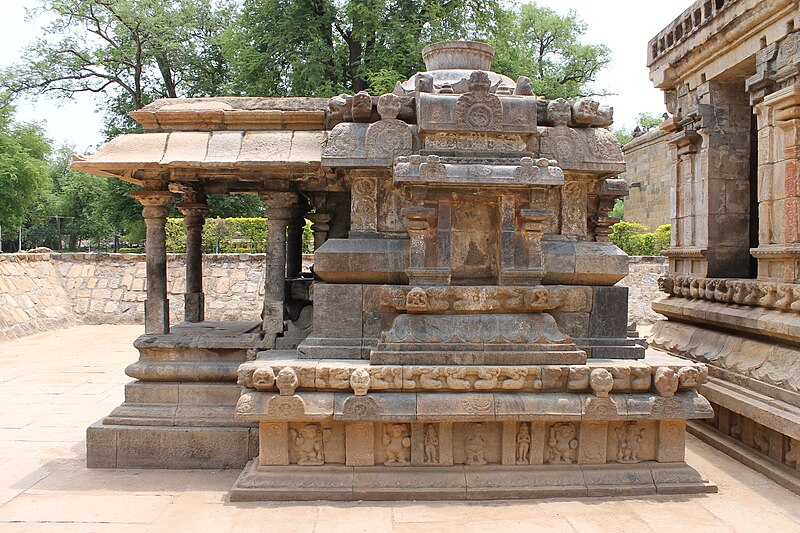
As you step into the sanctuary today, you stand within a beautifully preserved inner courtyard measuring 107 meters in length and 70 meters in width. At the center of this enclosure rises the inner sanctum's majestic vimana tower, reaching a height of 24 meters above the ground with flawless geometric symmetry. Inscriptions reveal that the original complex was vastly larger, once featuring seven processional streets and seven nested courtyards, though time and historical conflicts reduced it to this central shrine. Today, our walking route will take us to the sacred Yamatheertham tank, the chariot-shaped front pavilion, the acoustic singing steps, and the astonishing micro-carvings around the sanctum base. Please step forward with reverence as we begin exploring this Chola masterpiece.
02 Yamatheertham and the Cauvery Water Channel
Did you know that Lord Yama, the formidable God of Death himself, was forced to travel to this very water tank seeking desperate salvation from an agonizing, burning curse? Even the terrifying sovereign of the underworld, who holds absolute dominion over mortal destinies, had to bow in total humility before the divine grace of Lord Shiva at this sacred site. Please turn your gaze directly toward the sacred water tank and its connected stone channel stretching out before you. …
03 Rajagambhira Thirumandapam Chariot Hall
Can you believe that this entire grand front hall was intentionally constructed not as a static building, but as a colossal, horse-drawn royal chariot sculpted entirely out of solid granite, complete with functional stone wheels? In the twelfth century, Chola master builders pushed the boundaries of stone architecture by designing the frontal assembly hall as a magnificent processional vehicle frozen in time. …
04 Acoustic Marvel of the Singing Steps
Is it possible for cold, solid granite stone to sing clear musical notes when tapped or walked upon? The master sculptors of the twelfth-century Chola Empire accomplished precisely that, fusing acoustic physics with stone carving to create one of the most astonishing musical marvels of the ancient world. Please direct your eyes downward toward the flight of seven carved balustraded steps leading up to the Balipeetham sacrificial altar. …
05 Friezes of the 63 Nayanmars and Micro-Carvings
Would you believe that over 4,000 three-dimensional miniature sculptures, some carved within a space smaller than a single square inch, cover the exterior walls of this sanctum in breathtaking detail? While earlier Chola temples relied primarily on colossal architecture to convey spiritual awe, the Airavatesvara Temple stands as an extraordinary gallery of micro-sculpture, showcasing precision craftsmanship that challenges human comprehension. …
06 Periya Nayaki Amman Goddess Shrine
Did you know that this sanctuary marks a revolutionary turning point in South Indian temple architecture by introducing a completely independent shrine dedicated exclusively to the Supreme Goddess? In earlier Chola temple complexes, the divine consort occupied a secondary niche within the main sanctuary. Here at Darasuram, however, female divinity was elevated to equal architectural prominence. …
07 Closing
As our audio tour comes to a gentle close, take a quiet moment to look around the surviving courtyard of the Airavatesvara Temple and reflect on the extraordinary journey we have shared today. Classical temple inscriptions record that this complex was once immensely vast, featuring seven nested courtyards and seven grand processional streets known as sapta veedhis. …