 Photo Wikimedia Commons
Contents
History & cultureBY TELLBY8 sections · numbered as on the map01 Orientation
Welcome to the Piprahwa Archaeological Site, a deeply sacred land imbued with the living historical presence of Gautama Buddha and his own Shakya clan. Located in the Siddharthnagar district of Uttar Pradesh State in India, this serene sanctuary rests peacefully in the rural plain beneath the foothills of the Himalayas. Positioned merely nine miles, or fourteen kilometers, southwest from Lumbini in Nepal, the world-famous UNESCO World Heritage site recognized as the birthplace of the Buddha, Piprahwa lies at the very heart of the historical homeland of the ancient Shakyas. As you gaze across the peaceful countryside today, you can see wide agricultural fields where the famous Kalanamak rice, a unique traditional scented and spicy variety, is cultivated. Amidst this gentle rural breeze rests the profound memory of humanity's greatest spiritual teacher preserved across twenty-five centuries. Around 480 BCE, following the cremation of Gautama Buddha at Kusinara, a tense dispute erupted regarding the distribution of his corporal relics. The Mallas of Kusinara initially refused to share the sacred remains, prompting the wise Brahmin Dona to intervene and urge all parties to avoid conflict, bloodshed, and war. Under Dona's guidance, the bodily relics were divided equally among eight sovereign kingdoms so that stupas could rise far and wide across the land. The Buddha's own Shakya kinsmen received their rightful share and reverently carried the holy bone fragments back to their ancestral homeland. Here at Piprahwa, they erected an earthen mound stupa beside a major crossroads, fulfilling the explicit instructions left by the Buddha during his final days. Over the succeeding centuries, as Buddhism declined in India following foreign invasions and religious transformations, many ancient shrines were destroyed or lost to memory. Yet, hidden beneath dense vegetation and thick soil, the original Shakya stupa at Piprahwa remained remarkably undisturbed for over two millennia. Today, you stand directly upon the hallowed ground where the actual bone relics of Gautama Buddha were deposited by his loving family. Please take a moment to absorb the timeless serenity of this plain as we begin our walk through the ancient red bricks and monastic ruins to uncover the wondrous archaeological revelations preserved within this sacred earth.
02 제1구역: 피프라화 대스투파 — 2500년 세월의 축적
Standing directly before you now is the magnificent red-brick monument known as the Great Stupa of Piprahwa. Featuring a massive base and layered architectural contours, this stupa is not a single construction, but a complex sanctuary that evolved across three distinct historical epochs spanning hundreds of years. …
03 제2구역: 1898년 페페의 발굴 터 — 석조 궤와 명문 사리함의 발견
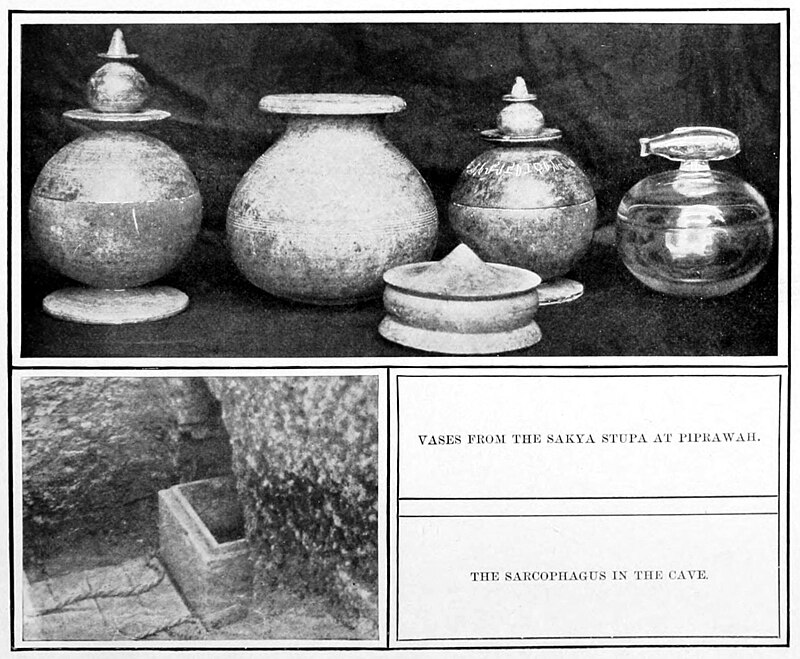
As you move closer toward the central upper section of the stupa, you will see the visible trench remaining from the world-famous excavation of 1898. This is the exact location where William Claxton Peppé, a British colonial engineer and local estate manager, made one of the most remarkable discoveries in Asian archaeology. …
04 제3구역: 슈리바스타바 발굴 피트 — B.C. 5세기 진신사리의 완전한 증명
Located at the southwestern base of the stupa, this deep excavation pit marks the site of a monumental archaeological breakthrough achieved in the 1970s by Dr. K. M. Srivastava of the Archaeological Survey of India. Following Peppé's initial discovery in 1898, some scholars had debated whether the inscribed urn and jewels dated primarily to the Mauryan era of Emperor Ashoka in the third century BCE, leaving open the question of whether the original fifth-century BCE Shakya deposit still existed…
05 제4구역: 동쪽 수도원 유적 — 승가 공동체의 숨결
Walking just east of the Great Stupa, you enter the extensive ruins of an ancient brick monastic complex known as the Eastern Monastery. Measuring 45.1 meters by 41.1 meters, this impressive quadrangular complex is the largest architectural structure at the site after the stupa itself. The ruins reveal a classic Buddhist monastic layout, featuring a spacious central open courtyard surrounded by more than thirty individual monk cells built with carefully laid red bricks. …
06 제5구역: 가원리아 언덕 유적지 — 고대 카필라바스투 왕성의 흔적
A short walk adjacent to the Piprahwa stupa brings you to the elevated mound of Ganwaria. Together with Piprahwa, the Ganwaria mound forms an integrated urban and monastic archaeological complex that represents the residential heart of ancient Kapilavastu. Systematic excavations at Ganwaria uncovered extensive ancient residential structures, shrine bases, structural complexes, coins, terracottas, and domestic pottery. …
07 제6구역: 카필라바스투 유적 박물관 현장 — 세계로 전해진 평화의 유산
As you transition toward the Kapilavastu Museum and exhibition complex within the site, you enter a space dedicated to preserving the story of these discoveries and their global spiritual impact. When William Peppé excavated the Great Stupa in 1898, the British administration claimed the finds under the Indian Treasure Trove Act of 1878. …
08 Closing
As we conclude our audio tour of Piprahwa, take a moment to stand near the Great Stupa and feel the gentle breeze sweeping across these ancient plains. Today, we have walked through twenty-five centuries of profound history, exploring the sacred stupa erected by the Shakyas, the deep excavation pits, the brick monastic cells of the Sangha, and the historic residential mounds of Ganwaria. …