Contents
History & cultureBY TELLBY8 sections · numbered as on the map01 Orientation
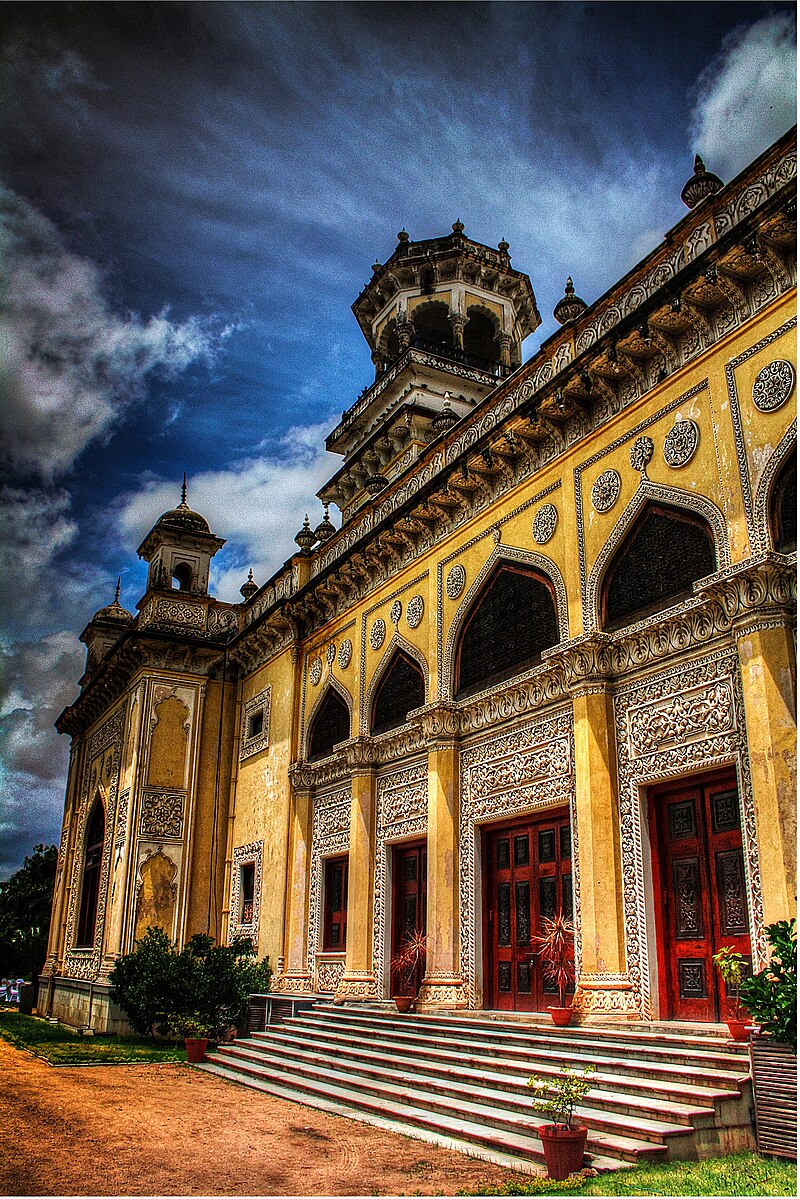
Welcome to Chowmahalla Palace, the majestic symbol of royal heritage and the historic seat of power of the Asaf Jahi dynasty in Hyderabad. As you step inside this magnificent complex, you are entering a space where the ruling Nizams once governed their vast sovereign state, administered imperial justice, and hosted grand diplomatic ceremonies. The name Chowmahalla derives its meaning from a rich linguistic synthesis of Urdu, Hindi, and Persian, where the word Chow or Chahar signifies the number four, and Mahal means palace. Thus, the name translates literally to Four Palaces, referencing the four elegant palatial structures built symmetrically around the grand southern courtyard, namely Aftab Mahal, Mehtab Mahal, Tahniyat Mahal, and Afzal Mahal. The historical origins of this imperial complex trace back to 1750, when Salabat Jung initiated initial construction on the grounds of an earlier Qutb Shahi palace complex near the iconic Charminar. Later, in 1769, Nizam Ali Khan, known as Asaf Jah II, formally ordered the expansion and creation of the four distinct palatial residences. The entire complex reached its complete architectural fruition between 1857 and 1869, during the reign of Afzal ad Dawlah, the Fifth Nizam. Originally spanning an expansive footprint of forty five acres, the complex gradually contracted to its present size of twelve acres over the decades due to urban densification and unlawful encroachments in the surrounding city fabric. Following the legislative abolition of royal privy purses in 1971 by the Indian government, the economic foundation supporting princely estates vanished almost overnight. The last Nizam of Hyderabad, once regarded as the wealthiest individual on earth, was forced to disband an astonishing court army of fourteen thousand royal servants, which had included thirty eight specialized attendants solely dedicated to dusting Belgian chandeliers and grinding fresh walnuts. As the royal court dispersed, the palace was virtually disused for nearly three decades, leaving its historic roofs, ornate plasterwork, and grand halls exposed to environmental decay. The fate of this architectural masterpiece transformed dramatically in the year 2000 through the visionary leadership of Princess Esra Jah. Shocked by the ruinous state of the Nizams historic properties, she assembled an extraordinary team of conservation architects, including Rahul Mehrotra, along with master artisans skilled in traditional lime mortar methods. Over five years of rigorous conservation, workers stabilized threatened foundations, restored granite arches, repaired terracotta balusters, and cataloged thousands of royal artifacts. In January 2005, Chowmahalla Palace was triumphantly inaugurated as a world class public museum. This monumental conservation initiative received international acclaim on March 15, 2010, when UNESCO representative Takahiko Makino presented Princess Esra with the prestigious UNESCO Asia Pacific Merit Award for Cultural Heritage Conservation. Today, under the continued ownership of the royal family led by Azmet Jah, Chowmahalla Palace serves as a cultural sanctuary. As you begin your tour, prepare to witness a harmonious synthesis of Mughal and Persian aesthetics paired with European neoclassical architecture, preserving the timeless spirit of Hyderabadi royalty.
02 The Khilafat Clock Tower: Timekeeper of the Kingdom
As you approach the western main gateway of the palace complex, your attention is immediately captured by an imposing architectural monument rising three storeys high into the sky. This is the historic Khilafat Clock Tower, a monumental gatehouse structure that has served as the grand entryway to Chowmahalla Palace for over two centuries. The architectural design of the tower presents an exemplary expression of royal Hyderabadi craftsmanship fused with classic Mughal stylistic traditions. …
03 Northern Courtyard, Bara Imam & Shishe-Alat: Reflections of Administration
Step into the serene and expansive openness of the Northern Courtyard, where a grand central pool and cascading fountain form the visual and acoustic heart of this magnificent outdoor quadrangle. The gentle, continuous sound of trickling water creates a tranquil ambient atmosphere that contrasts beautifully with the monumental architecture framing the perimeter. …
04 Khilwat Mubarak: The Heart of the Palace and Grand Durbar Hall
We now step into the absolute heart and spiritual epicenter of Chowmahalla Palace, the legendary Khilwat Mubarak. Revered by the people of Hyderabad as the ultimate seat of sovereign authority of the Asaf Jahi dynasty, this monumental grand hall is where the ruling Nizams exercised their supreme governance over the Deccan region. …
05 The Council Hall & Royal Archives: Sanctuary of Statecraft and Knowledge
Adjacent to the grand Durbar Hall of Khilwat Mubarak stands the historic Council Hall, a refined and dignified structure that played a pivotal role in the governance and intellectual traditions of Hyderabad State. While the main Durbar Hall was designed for massive public ceremonies and official imperial assemblies, the Council Hall provided a far more intimate and focused setting. …
06 Southern Courtyard, Aftab Mahal & Mehtab Mahal: Neoclassical Splendor and Royal Zenana
We now step into the Southern Courtyard, the oldest and most architecturally unified section of the Chowmahalla Palace complex. This serene quadrangle features four grand neoclassical palaces built symmetrically around a lush central lawn and a tranquil water pond. The soaring facades of these grand structures are defined by double height verandahs supported by classical European columns that reflect gracefully upon the quiet surface of the central water feature. …
07 Afzal Mahal & Tehniyat Mahal: Corinthian Majesty and Imperial Insignia
Continuing your exploration of the Southern Courtyard quadrangle, we arrive at the most ornate pair of palatial structures within the quartet, Afzal Mahal and Tehniyat Mahal. Unlike their Ionic counterparts, these two grand palaces feature soaring double height Corinthian columns, whose elaborate acanthus leaf capitals lend a dramatic sense of imperial power and ornate grandeur to their structural facades. …
08 Closing
As our audio tour of Chowmahalla Palace concludes, we invite you to visit the extraordinary vintage car pavilion located within the palace grounds. Here, you can admire a magnificent collection of historic automobiles that once belonged to the Nizams of Hyderabad, headlined by a flawlessly restored custom vintage Rolls Royce. …