 Photo Wikimedia Commons
Contents
History & cultureBY TELLBY7 sections · numbered as on the map01 Orientation
Welcome to the vast and breathtaking wilderness of the Kalahari Desert, located at the southern edge of the African continent. The land beneath your feet is South Africa's ninth UNESCO World Heritage Site, known as the Khomani Cultural Landscape. This is not merely a scenic desert reservation or a typical tourist destination. It is a living, sacred space that protects the ancient hunter-gatherer traditions of the indigenous San people, who have lived in profound harmony with this environment for millennia. Covering an immense area of over nine hundred thousand hectares, this heritage site forms part of the Kgalagadi Transfrontier Park and encompasses the entire Kalahari Gemsbok National Park, right along the international borders with Botswana and Namibia. Under the expansive desert sky, red sand dunes roll across the horizon interspersed with hardy shrubs. Across this landscape lie the dry riverbeds of the Nossob and Auob Rivers, which are legendary for flowing only once every hundred years. This semi-arid terrain is deeply intertwined with the story of human origin itself. The San people residing here descend directly from an ancient population that inhabited southern Africa one hundred fifty thousand years ago, representing one of the oldest genetic lineages of modern humanity. For tens of thousands of years, they developed an unparalleled understanding of desert fauna, animal behavior, and medicinal plant gathering. While researchers often use the term Khomani San, the local inhabitants living around Witdraai refer to themselves as Saasi or in their own language as Kabee, maintaining an enduring spiritual bond with the earth. Over the centuries, despite artificial borders and shift in everyday language toward Khoekhoegowap or Afrikaans, their profound ethnobotanical knowledge, cultural practices, and unique cosmological worldview remain unbroken. UNESCO inscribed this landscape precisely because it preserves an irreplaceable human tradition where culture and ecology are inextricably bound together. As you begin this audio tour, you will walk along red dunes and dry river valleys, retracing the footsteps of master trackers and community elders. Prepare to step into the deepest memory of human history and discover the timeless wisdom of the Kalahari. Please begin walking gently toward our first official stop at the red tracking dunes.
02 Reading the Sand at the Red Dunes
There exists a miraculous written language in this desert where a few faint indentations and subtle scratches imprinted on the red sand can reveal not only the exact species of an animal kilometers away, but also whether it paused to catch its breath after a sprint or sat surveying the surrounding plain. Look down at the gentle slope of the red sand dune stretching beneath your feet right now. …
03 The Historic Land Claim and Rebirth
In the year nineteen thirty-one, indigenous inhabitants were forcibly evicted from their ancestral home due to the establishment of the national park, scattering into impoverished settlements for decades, until a landmark agreement in March nineteen ninety-nine finally restored their beloved lands. Please direct your gaze toward the wooden signpost and the vast boundary line visible across the distant desert plain. …
04 Harmony and Community at!Xaus
Within the traditional society of the desert San, there are no kings, no chiefs, no governing institutions, and no taxes, maintaining a completely egalitarian social structure based entirely on equality and voluntary sharing for tens of thousands of years. Please lift your eyes and look toward the thatched roof of!Xaus Lodge nestling gently among the red dunes and surrounding sand valleys. …
05 The Resurrected Voice of N|u
In the late nineteen-seventies, linguists and academics confidently declared that an ancient aboriginal language was completely extinct, only for researchers to miraculously rediscover surviving native speakers in the remote corners of the Kalahari two decades later. Please direct your attention toward the circular stone seating area arranged beneath the shaded shelter. …
06 Weapons, Plants, and Crafts
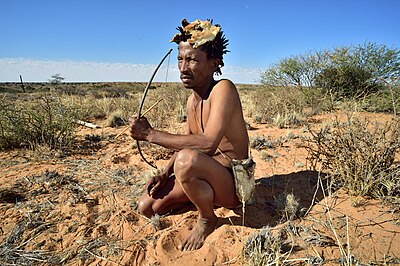
The traditional poisoned arrow used by San hunters was not designed to kill an animal instantly upon impact through brute force, but worked in tandem with incredible physical endurance to silently track the poisoned prey for hours across the sand. Please examine the slender wooden bow, poisoned arrows, and handcrafted items resting on the display table in front of you. …
07 Closing
Here at this magnificent lookout point where the vast horizon of the Kalahari Desert unfolds before your eyes, we conclude our audio guide tour. As you feel the gentle desert breeze and gaze out over the endless red sand dunes beneath the wide open sky, let us reflect once more on the moving words of master tracker Oom Jan Tities. …