 Photo Wikimedia Commons
Contents
History & cultureBY TELLBY7 sections · numbered as on the map01 Orientation
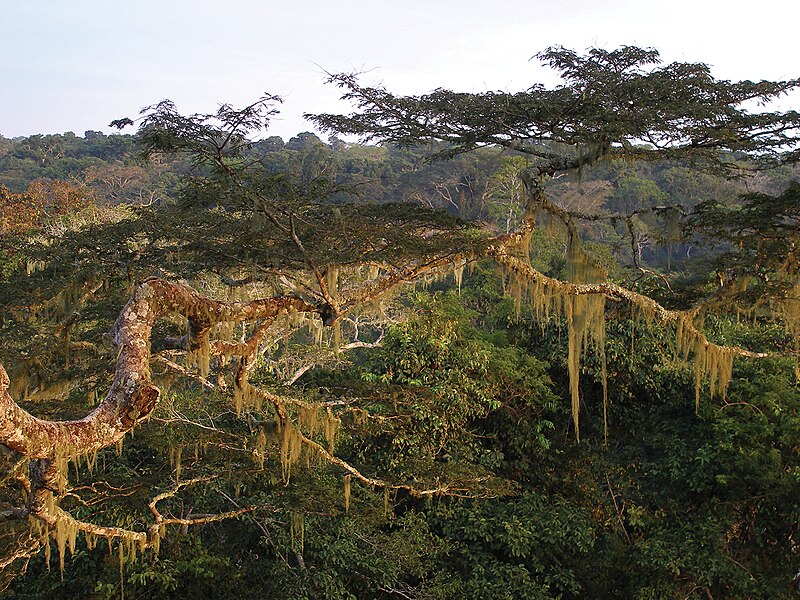
A very warm welcome to the heart of the dense and lush tropical rainforest in the southwestern region of the Central African Republic. Standing here today, you are immersed in Dzanga Ndoki National Park, a place where all sounds of modern civilization fade away, leaving only the rustling of dense leaves and the rhythmic breathing of untouched wilderness. This vast jungle is not merely a single national park within one country, but serves as the center of Central African conservation where a massive, verdant panorama seamlessly connects three nations into one continuous landscape. Together with Lobeke National Park in Cameroon and Nouabale Ndoki National Park in the Republic of the Congo, this protected realm forms the grand ecological unity known as the Sangha Trinational, providing an undamaged sanctuary for countless wild species. It represents a pristine stronghold of wild nature, isolated from the bustling modern world and operating strictly according to the ancient rhythms of the natural realm.
Our itinerary for today is carefully designed to guide you through the very essence of this extraordinary rainforest ecosystem. We begin our journey by visiting a seven meter high wooden observation platform that offers an unobstructed view over a vast sandy clearing hidden within the forest. From this vantage point, we will marvel at the rare spectacle of hundreds of forest elephants gathering in one place. We will then turn our attention toward the mineral rich mud inside shallow pools and the clear waters of the Dzanga stream traversing the sandy pan. Following that, we move along the green boundary line where the dense jungle meets the open clearing, observing the wildlife trails used by rare large mammals such as the red forest buffalo and the elusive bongo.
Next, we penetrate deeper into the cool shade beneath the thick forest canopy to reach the Bai Hokou primate research site. Here, where the forest ceiling blocks the harsh tropical sunlight, we will learn about the western lowland gorilla, which occurs at one of the highest population densities on Earth, and explore the dedicated long term research efforts conducted by passionate scientists. Finally, we arrive at the patrol post along the banks of the Sangha River, the vital lifeblood of this national park and the geographic meeting point of three nations. At this final spot, we will discover the inspiring story of local rangers and indigenous communities working side by side to safeguard this natural heritage against the persistent threats of poaching. Throughout this journey, you will experience firsthand how humanity and nature form a deep bond to sustain conservation across generations.
Before we set out on this remarkable ecological journey, take a moment to breathe deeply and listen to the profound acoustic vibrations of the ancient jungle. Within this dense forest, preserved for centuries away from destructive human development, lies a treasure trove of natural mysteries and vibrant life. Feel the damp earth beneath your boots and the fragrance of wild foliage floating in the humid air. Let us now take our first steps toward the Dzanga Bai observation platform, where the first great chapter of this wilderness unfolds before your eyes.
02 Dzanga Bai Observation Platform
In most tropical rainforests throughout Central Africa, observing African forest elephants in their natural habitat is extraordinarily difficult because they remain hidden within dense vegetation and thick vines, actively avoiding human encounters throughout their lives. Moving through the shadowed understory in virtual silence, their movements are obscured by the multi-layered canopy, making direct observation a rare privilege even for seasoned field biologists. …
03 Mineral Rich Soil and Dzanga Stream
The true motivation behind why forest elephants leave the protective canopy of the dense jungle to gather in this open, exposed clearing lies hidden within the very soil and water of these shallow pools. The leaves and fruits available in the surrounding rainforest do not provide sufficient quantities of essential minerals such as sodium, magnesium, and zinc, all of which are highly concentrated in the soil and water of Dzanga Bai. …
04 Forest Edge and Wildlife Trails
Dzanga Bai is far more than a sanctuary reserved exclusively for forest elephants, it serves as one of the most astonishing ecological crossroads on the African continent where rare rainforest megafauna converge. Large mammals that usually remain deeply hidden inside the dense jungle, such as the elusive bongo with its striking white stripes, the red forest buffalo, the giant forest hog, and the marsh-dwelling sitatunga, step out to the edge of this green forest line to consume vital minerals. …
05 Bai Hokou Primate Research Site
Dzanga Ndoki National Park stands as one of the most critical strongholds for western lowland gorillas on Earth, boasting an astonishing gorilla density of one point six individuals per square kilometer within the Dzanga sector. This pristine tropical forest canopy provides an undisturbed habitat where not only western lowland gorillas but also chimpanzees and numerous other primate species can thrive in high numbers. …
06 Sangha Riverbank and Patrol Post
The Sangha River serves as the grand waterway where the national borders of three countries, the Central African Republic, Cameroon, and the Republic of the Congo, converge into a single continuous landscape. It acts as the primary ecological blood vessel sustaining this immense rainforest ecosystem. Countless wildlife species migrate along its banks to drink, while the river supplies life giving hydration throughout the basin, allowing the rainforest to maintain its lush green vitality year…
07 Closing
As our audio guide exploration through the deep jungle and extraordinary clearings of Dzanga Ndoki National Park comes to a close, take a moment to reflect on the remarkable journey we have shared today. The setting sun now casts a soft golden glow across the high canopy of ancient mahogany trees and dense forest leaves. …