 Photo Wikimedia Commons
Contents
History & cultureBY TELLBY7 sections · numbered as on the map01 Orientation
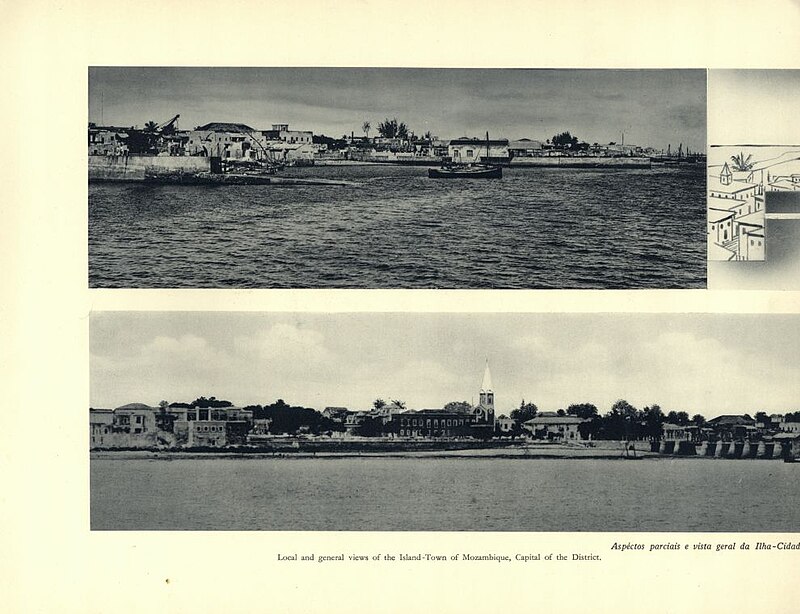
Welcome to the Island of Mozambique, a historic coral island floating peacefully off the northern coast of East Africa at the entrance to Mossuril Bay. Spanning roughly three kilometers in length and between three hundred and four hundred meters in width, this remarkable piece of land forms a small local archipelago alongside the nearby uninhabited sister islands of Goa and Sena. Recognized globally as a UNESCO World Heritage Site, the island served for centuries as a vital crossroads along the maritime trade routes linking Western Europe, East Africa, the Arabian Peninsula, and the Indian subcontinent. It stands as a living museum where Swahili, Arab, Persian, Indian, and European architectural styles and cultural traditions fused into a singular, harmonious urban environment.
The very name of the nation, Mozambique, finds its historical origin in this compact island. When Portuguese navigators including Vasco da Gama first arrived in the late fifteenth century, the settlement was an established Swahili commercial port governed by a local Muslim ruler named Sheik Mussa Bin Bique. The Portuguese adapted his name to designate the island, and over time, this title expanded to embrace the entire mainland country. Long before European arrival, Arab merchants had settled here as early as the tenth century, converting the port into a flourishing hub for trading gold, ivory, timber, and precious spices across the vast network of the Indian Ocean.
Geographically and culturally, the island is divided into two distinct urban realms. The northern half is occupied by Stone Town, built during the Portuguese colonial era using local coral limestone and lime mortar. Containing over four hundred historical structures, Stone Town served as the official seat of the Portuguese colonial government from fifteen hundred seven until eighteen ninety-eight, when the capital was relocated south to Lourenço Marques, now Maputo. Conversely, the southern half comprises Macuti Town, a dense residential quarter composed of over twelve hundred traditional African dwellings featuring thatched roofs woven from coconut palm leaves, where the local working population built their lives.
Our tour begins at the northern tip with the formidable Fort São Sebastião and the Chapel of Nossa Senhora do Baluarte, before winding through Stone Town to explore the Palace of São Paulo and the Old Hospital, and concluding among the vibrant streets of Macuti Town. As coastal breezes sweep through these historic pathways, prepare to uncover a profound story of human exchange and architectural synthesis. Enjoy your tour of the Island of Mozambique.
02 Fort São Sebastião
The imposing Fort São Sebastião stands as the largest stone military fortification in Southern Africa, remarkably constructed using heavy stone blocks that originally arrived as ship ballast aboard Portuguese trading vessels traveling from Europe. Please raise your eyes and examine the massive, weathered coral limestone walls and the bold artillery bastions projecting dramatically over the ocean waves. …
03 Chapel of Nossa Senhora do Baluarte
The Chapel of Nossa Senhora do Baluarte is celebrated as the oldest surviving European structure in the entire Southern Hemisphere and stands as the sole existing example of Manueline late-Gothic architecture in Mozambique. Please lift your eyes and examine the delicate decorative stone carvings, the twisted nautical rope motifs, and the elegant vaulted archway ornamenting the entry facade of this modest sanctuary. …
04 Palace and Chapel of São Paulo
The Palace and Chapel of São Paulo is a magnificent landmark in Stone Town that underwent a dramatic historical evolution, originally constructed in sixteen forty as a quiet Jesuit college and monastery before being transformed into the grand official residence of the Portuguese Governor-General. Please step into the center of the broad paved square and look directly at the striking crimson facade and stately arched entrance of the palace. …
05 Old Hospital of the Island of Mozambique
Erected in eighteen seventy-seven, the majestic Old Hospital of the Island of Mozambique is a grand neoclassical landmark designed in the style of a Greco-Roman temple, which held the distinction for many decades of being the largest and most advanced medical facility in Sub-Saharan Africa. Please direct your gaze toward the towering white facade and admire the elegant vertical columns supporting the monumental front entrance. …
06 Macuti Town
Macuti Town presents a compelling human contrast to Stone Town, having developed directly inside the hollowed-out quarry pits where coral limestone was originally excavated to build the northern stone palaces, featuring traditional African dwellings covered with thatched roofs woven from coconut palm leaves. Please look closely at the rows of low-slung roofs around you and observe the rich, layered texture of the dried palm fronds, known locally as macuti. …
07 Closing
Thank you for participating in this comprehensive audio guide tour of the Island of Mozambique. Together, we have traversed the entire length of this unique UNESCO World Heritage Site, starting at the northern rocky point with the imposing Fort São Sebastião and the Chapel of Nossa Senhora do Baluarte, continuing through the colonial center of Stone Town to explore the Palace of São Paulo and the Old Hospital, and concluding among the warm palm-thatched neighborhoods of Macuti Town. …