 Photo Wikimedia Commons
Contents
History & cultureBY TELLBY7 sections · numbered as on the map01 Orientation
Welcome to the Ruins of Jesus de Tavarangue, an unfinished paradise frozen in time where human history and untouched nature embrace in quiet, enduring harmony. Surrounded by lush subtropical foliage and serene rolling lawns in southern Paraguay, this sacred heritage site bears eloquent witness to one of the most remarkable social and cultural experiments in global civilization. Here, deep in the South American interior, the indigenous Guarani people and Jesuit missionaries built a peaceful, self-sufficient community centered around shared labor, spiritual faith, artistic mastery, and mutual respect. The reason this extraordinary site was inscribed on the UNESCO World Heritage list in nineteen ninety-three is both simple and profoundly moving. Leaving aside complex architectural terminology or rigid historical formulas, it was recognized because the unique way of life and astonishing architectural synthesis forged together by the Guarani people and Jesuit fathers remain preserved within the jungle with breathtaking authenticity. It represents a rare and peaceful dialogue between two distinct worlds that met not through colonial destruction, but through creative collaboration. The Jesuit reduction was far more than a mere religious outpost or a collection of stone structures. It functioned as a fully integrated, self-governing planned city where thousands of indigenous residents lived, farmed, studied European music, and practiced sophisticated craftsmanship in a highly organized and horizontal social system. The long and dramatic chronicle of this settlement began around sixteen eighty-five near the banks of the Monday River under the guidance of the Jesuit father Jeronimo Delfin. However, maintaining a peaceful existence in the wild frontier proved to be a formidable struggle. Frequent hostile attacks from neighboring tribes and the dangerous threat of slave traders seeking to capture the native population forced the community to uproot itself and relocate repeatedly across the region. After decades of perilous migrations, the settlement finally established its permanent home here in the fertile territory of Itapua around seventeen sixty. Having secured this tranquil landscape, the community set out to construct a monumental mission town featuring a massive stone church, a central plaza, educational facilities, communal housing, and vibrant agricultural orchards. Yet, just as their grand vision was taking physical shape, the relentless tides of European geopolitical conflict intervened, cutting their monumental efforts short. In seventeen sixty-seven, King Carlos the Third of Spain issued a sudden royal decree expelling all Jesuits from the Spanish empire, forcing the builders to abandon their work overnight. As you stand at the threshold of this sacred ground, step back in time and allow the peaceful atmosphere to surround you. Please walk slowly along the tranquil pathways as we embark together on a journey through the haunting beauty of an unfinished dream.
02 The Exotic Gateway where Spanish and Islamic Styles Meet
The standing presence of an Islamic Arabian style arch in the heart of a Jesuit reduction deep within the South American wilderness is a breathtaking revelation that leaves visitors utterly astonished. As you arrive at this historic threshold, please halt your steps and focus your eyes directly on the upper section of the monumental stone gateway standing before you. …
03 A Monumental Unfinished Temple Open to the Sky
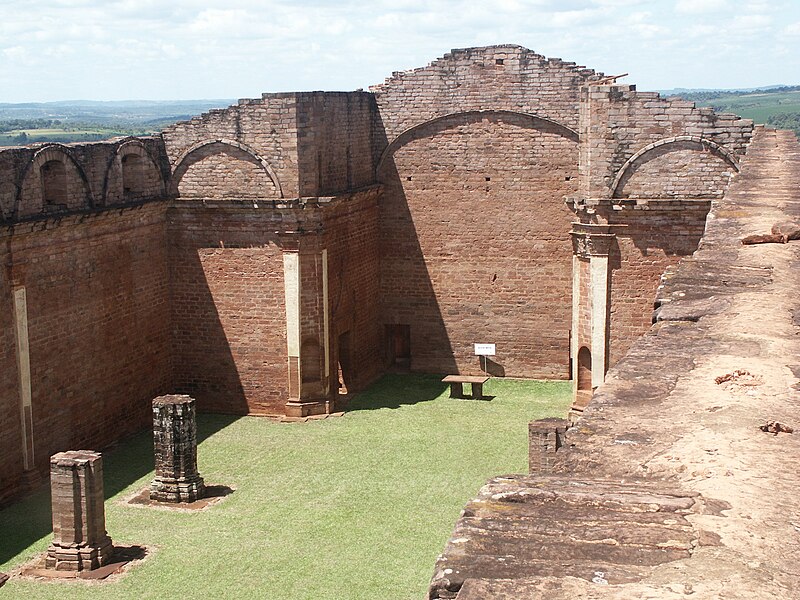
Had this monumental cathedral been completed according to its original architectural vision, it would have stood as one of the largest and most breathtaking religious structures in the entire South American continent. Please lift your eyes upward and gaze upon the soaring red sandstone walls that stand fully open to the vivid blue sky above. …
04 The Center of Life for Thousands of Guaraní Residents
The realization that this serene, grass-covered field was once the vibrant heart of an advanced planned city where thousands of indigenous Guarani residents lived self-sufficiently is truly astonishing. Please look down at the expansive grassy plaza stretching beneath your feet and observe the long rows of stone column foundations aligned beyond it. …
05 The Sole Surviving Room Where Chants and Learning Resounded
At a time when the vast majority of common people in Europe had no access to formal education, free universal schooling in literacy, music, and sculpture was provided to native Guarani children deep within this jungle, representing a luminous milestone in human history. Please look to your right and observe the sturdy stone structure standing solitary amidst the grass. …
06 Coty Guazú: The Great House for Widows and Orphans
Standing as a luminous symbol of South American social welfare in the seventeenth century, the establishment of Coty Guazu, a dedicated communal haven for widows and orphans, fills visitors with profound admiration. Please direct your gaze toward the stone foundations of Coty Guazu, which translates from the Guarani language as the Great House, and the tranquil priests' orchard sprawling quietly behind it. …
07 Closing
As we stand at this peaceful outer viewpoint overlooking the Ruins of Jesus de Tavarangue, take a quiet moment to absorb the panoramic majesty of this sacred landscape. Before you spreads the wide expanse of rich red earth, punctuated by the striking sandstone walls that rise in solemn silence against the tropical sky. The roofless cathedral, forever open to the heavens, possesses an emotional power and haunting resonance that no fully completed monument could ever replicate. …