Contents
History & cultureBY TELLBY8 sections · numbered as on the map01 Orientation
Welcome to Gobustan National Historical-Artistic Preserve, an extraordinary open-air museum located on the western shore of the Caspian Sea in eastern Azerbaijan. The remarkable rock art landscape surrounding you represents one of the most prominent densities of ancient petroglyphs in the entire world. Designated as a UNESCO World Heritage site in two thousand seven under the title Gobustan Rock Art Cultural Landscape, this reserve encompasses more than six thousand individual rock engravings, ancient cave shelters, residential sites, burial mounds, and sacred ritual grounds. These precious petroglyphs span a breathtaking chronicle of human existence, stretching continuously from the Upper Paleolithic era through the Mesolithic, Neolithic, Bronze Age, and Iron Age, all the way into the Middle Ages. Over thousands of years, successive generations of early humans lived, hunted, created art, and practiced sacred ceremonies among these very stones, leaving behind an uninterrupted record of human culture and environmental adaptation.
As you stand here at the reserve entrance, take a moment to gaze across the surrounding landscape. Notice the striking visual contrast between the vast blue waters of the Caspian Sea on the horizon and the dry desert-like terrain dominated by massive limestone boulders and elevated rocky highlands. Millions of years of geological evolution, Quaternary sea level fluctuations, and natural erosion sculpted these limestone hills into steep cliff terraces, rock falls, and deeply shaded cave shelters. During prehistoric epochs, sea levels were significantly higher, washing directly against the upper margins of these rocky terraces. This rich coastal environment offered abundant freshwater, marine life, and game animals, making Gobustan an ideal sanctuary for early hunter-gatherer communities seeking safety and sustenance. Though the landscape today appears arid and sparsely vegetated, the flat vertical surfaces of these exposed limestone rocks provided durable natural canvases for ancient artists.
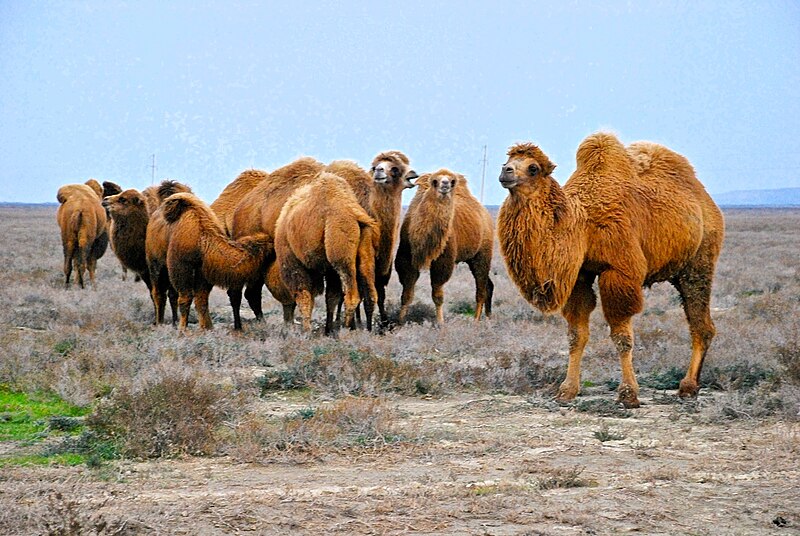
Our walking tour today will guide you along a carefully structured route traversing the upper and lower terraces of Beyukdash Mountain and Kichikdash Mountain. On the elevated upper terraces, you will discover the oldest rock carvings dating back to the end of the Upper Paleolithic period, where early humans carved mysterious female silhouettes and massive wild beasts. As you descend toward the lower terraces and the base of the mountains, you will travel forward through chronological time, encountering Mesolithic archery hunters, Bronze Age ritual dances, Roman imperial inscriptions, and medieval camel caravans. Please follow the stone path as we begin our journey into the distant past. Walk at a comfortable pace, stay on the marked paths, and allow the quiet ambiance of these ancient stones to transport you back thousands of years. Our first stop is the famous Ana-zaga cave shelter, located on the upper terrace of Beyukdash Mountain.
02 Ana-zaga Cave Shelter
Welcome to Ana-zaga cave shelter, located on the prominent upper terrace of Beyukdash Mountain. The name Ana-zaga translates in the local language to Mother Cave, reflecting its profound ancestral significance. Deep inside the shadowed recesses of this natural rock shelter, over ten thousand years ago during the Upper Paleolithic era, ancient prehistoric artists carved extraordinary stylized human and animal figures directly onto the bare, unvarnished limestone walls. …
03 Okuzler and Kaniza Sites
As you walk further along the elevated stone path of Beyukdash Mountain's upper terrace, leaving Ana-zaga cave behind, you will arrive at the interconnected archaeological sites of Okuzler and Kaniza. The name Okuzler translates locally to The Bulls, hinting at the primary thematic focus of the rock art preserved here. …
04 Gaya-arasi Cave and Stone 5
Descending from the heights of Beyukdash Mountain and crossing over to Kichikdash Mountain brings you to the dramatic, rock-strewn site of Gaya-arasi cave. Here, amid a dry and sun-scorched desert landscape where green vegetation is almost entirely absent, lies one of the most astonishing archaeological revelations in all of Gobustan. …
05 Firuz-2 Shelter
Leaving Gaya-arasi cave behind and following the shadowed path along the base of Kichikdash Mountain brings you to the renowned Firuz-Two shelter. The rock art preserved on the limestone walls of this shelter holds a truly legendary place in modern archaeological history. Engraved upon these stones are mysterious sickle-shaped reed boat petroglyphs that deeply captured the imagination of the famous Norwegian explorer Thor Heyerdahl. …
06 Roman Inscription Stone
Arriving at the eastern base of Beyukdash Mountain after descending from Kichikdash Mountain brings you to a flat stone slab that contains one of the most remarkable historical surprises in Central Eurasia. Inscribed directly into the surface of this rock is an authentic Roman Latin inscription, carved by imperial legionnaires who marched thousands of miles from Rome to the western shores of the Caspian Sea. …
07 Yazyly Hill Ritual Grounds
Moving from the Roman inscription stone along the gentle slopes at the foot of Jingirdag Mountain brings you to the open ceremonial grounds of Yazyly Hill. Here, during the Bronze and Iron Ages, ancient communities gathered across generations to perform sacred ritual dances, offer animal sacrifices, and execute complex communal deer drives. …
08 Closing
As our journey through Gobustan National Reserve comes to a close, take a final look across this extraordinary landscape where thousands of years of human history remain etched into the bedrock. From the Upper Paleolithic cave shelters of Ana-zaga to the Mesolithic reed boats of Firuz-Two, the classical Roman inscriptions at the mountain base, and the ceremonial deer-driving grounds of Yazyly Hill, Gobustan stands as an incomparable open-air chronicle of human existence. …