Contents
History & cultureBY TELLBY7 sections · numbered as on the map01 Orientation
Welcome to Tadrart Acacus, a monumental open air gallery of prehistoric rock art situated in the Fezzan region of southwestern Libya, within the eastern Ghat District. Stretching approximately one hundred kilometers north from the border with Algeria, this sandstone massif preserves a priceless chronicle of human history. In 1985, UNESCO designated the Rock Art Sites of Tadrart Acacus as a World Heritage site. This international recognition honors thousands of cave paintings and engravings that vividly record twelve thousand years of dramatic climate shifts and human cultural adaptation across the Sahara.
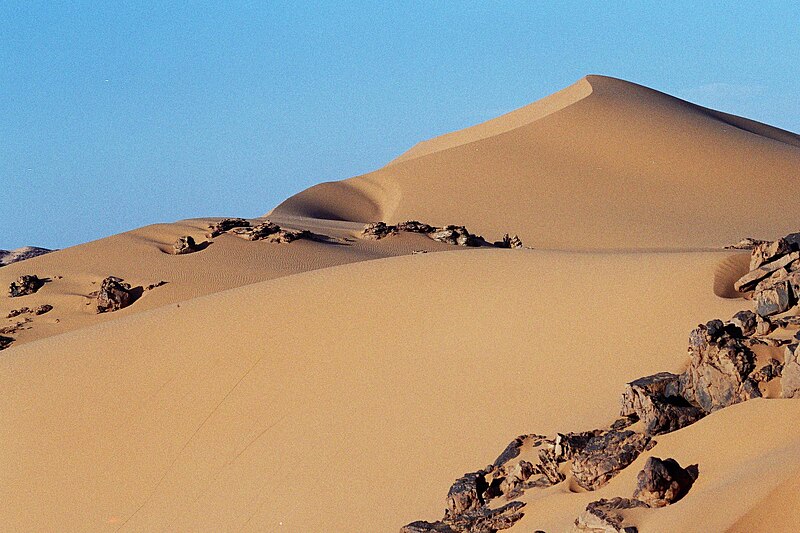
Although today's traveler encounters a hyper arid desert landscape defined by towering rock arches, deep wadis, and sweeping sand dunes, this realm was vastly different during the Early Holocene. During the African Humid Period, the Sahara flourished as a green landscape abundant with freshwater lakes, flowing rivers, and lush savanna vegetation. Early hunter gatherers inhabited these fertile valleys, living alongside magnificent wild animals such as giraffes, elephants, ostriches, and rhinoceroses. These prehistoric populations expressed their world by carving and painting striking images directly onto sandstone cliffs.
As environmental conditions shifted over millennia, the inhabitants continuously adapted their ways of life. Archaeological research reveals three primary occupation phases across the massif: the Early Acacus, Late Acacus, and Pastoral Neolithic. During humid phases, mobile foragers roamed lowland lake margins. When dry conditions set in, populations gathered in protected rock shelters, intensifying wild grain processing with grinding stones and pottery. With animal domestication around seven thousand years ago, herding cattle became the primary survival strategy, celebrated in rich pastoral wall art.
Beyond its archaeological wealth, the Acacus massif displays awe inspiring geological beauty, framing stone arches alongside desert flora like the medicinal plant Calotropis procera near hidden desert wells. From nineteenth century explorations by Heinrich Barth and Henri Duveyrier to mid twentieth century excavations by Fabrizio Mori, researchers uncovered these ancient mysteries. Today, as you walk along these canyon corridors, you are invited to experience the enduring legacy of the Green Sahara. Please proceed toward our first stop to examine the wild animal rock art.
02 Awiss Area: Wild Animals and Round Head Art
You are standing before the dramatic rock cliffs of the Awiss area, located in the northeastern sector of the Tadrart Acacus range. As you gaze across the surrounding landscape, your eyes meet a sun baked expanse of barren sands and weathered sandstone bluffs. However, twelve thousand years ago, this canyon was a vibrant savanna teeming with life. …
03 Uan Muhuggiag Cave and the Black Mummy
You are standing at the entrance of Uan Muhuggiag Cave, one of the most remarkable archaeological treasure troves in the Tadrart Acacus mountains. The most surprising revelation uncovered inside this shadowy shelter is the discovery of the earliest known evidence of dairy milk lipid processing on ceramic fragments, radiocarbon dated to seven thousand five hundred years ago. …
04 Wadi Teshuinat: Scenes of Pastoral Life
We have arrived in the expansive corridor of the Wadi Teshuinat valley, situated in the central heartland of the Tadrart Acacus range. Stepping into this sun scorched ravine, the most striking revelation is that prehistoric paintings along these sandstone walls depict a joyful community herding cattle, playing music, and dancing in celebration. Today, this landscape appears completely arid and devoid of vegetation. …
05 Afzejare Rock Arch and Tefinagh Inscriptions
We are standing before the monumental geological masterpiece known as the Afzejare Rock Arch. As the climate of the Sahara transitioned into hyper aridity and the green savannas disappeared, tropical wildlife and cattle herds retreated from the landscape. Yet, even facing severe aridification, human populations adapted rather than vanished. …
06 Wadi Senddar: Heritage Conservation and Preservation
We are standing at the Wadi Senddar Protection Zone overlook, situated in the southeastern sector of the Tadrart Acacus range. Surrounding us is a breathtaking landscape, yet the most alarming fact that must be confronted here is that in 2005, underground oil exploration using heavy seismic hammers began sending powerful shockwaves through these mountains, severely threatening irreplaceable rock art. …
07 Closing
Standing atop the high overlook of the Tadrart Acacus mountains, we gaze across the sand swept horizon framing this ancient landscape. Today, we have journeyed together through twelve thousand years of Saharan history, tracing a dramatic evolution from the lush green savannas of the Early Holocene to the hyper arid desert of the present day. …