Contents
History & cultureBY TELLBY7 sections · numbered as on the map01 Orientation
Welcome to the breathtaking highlands of Ethiopia, situated two thousand meters above sea level in the upper Awash Valley. Here at Melka Kunture and Balchit, you are standing at one of the most extraordinary UNESCO World Heritage properties on Earth, preserving an uninterrupted chronicle of hominin presence and high-altitude ecosystem adaptation spanning two million years. Rather than presenting a dry list of archaeological classifications or official designation criteria, this guide invites you to immerse yourself in a human story of endurance, intelligence, and survival amidst the challenging mountain environments of East Africa. Located south of Addis Ababa across the Awash River from the village of Melka Awash, this area sits within a vast basin bounded by Pliocene volcanoes such as Wachacha and Furi in the north, and Boti and Agoiabi in the south, with the East African Rift marking its eastern boundary. Downstream from the bridge that provides access toward the southern highlands, three magnificent waterfalls cascade along the river course. Over millions of years, frequent volcanic eruptions overlaid the landscape with ash and tuffs while the Awash River repeatedly reestablished its channels, creating a cumulative stratigraphic sequence of exceptional thickness. These volcanic and alluvial deposits acted like a natural vault, capping and preserving fragile paleo-landscapes, animal fossils, hominin footprints, and stone tools in pristine condition. Through four consecutive techno-complexes—the Oldowan, the Acheulean, the Middle Stone Age, and the Late Stone Age—successive hominin groups including Homo erectus, Homo heidelbergensis, and archaic Homo sapiens continuously occupied this high-elevation sanctuary. Today, our journey through this open-air museum complex will lead you along a carefully structured path. We begin at the orientation center and museum exhibits dedicated to prehistoric Africa, volcanology, paleoanthropology, and local prehistory. From there, we will walk directly to the sheltered open-air excavation sites where ancient occupation surfaces remain exposed exactly as archaeologists found them. We will then examine the shimmering glass fields of the Balchit obsidian quarry, and conclude along the panoramic banks of the Awash River where exposed cliff sections visually display millions of years of layered earth history. Please take a moment to absorb the cool mountain breeze and prepare to step back into two million years of human evolution.
02 Garba IV Site and Developed Oldowan Layer
Approximately one point five million years ago, a young Homo erectus child between three and five years of age lived along the banks of the Awash River, and remarkably, a right hemimandible from this young hominin was preserved intact within Level E, leaving one of the most poignant fossil human discoveries in East Africa. Please take a moment to look down at the dark brownish soil layers and the exposed vertical section of the earth right beneath your feet. …
03 Gombore II Site and Acheulean Handaxes
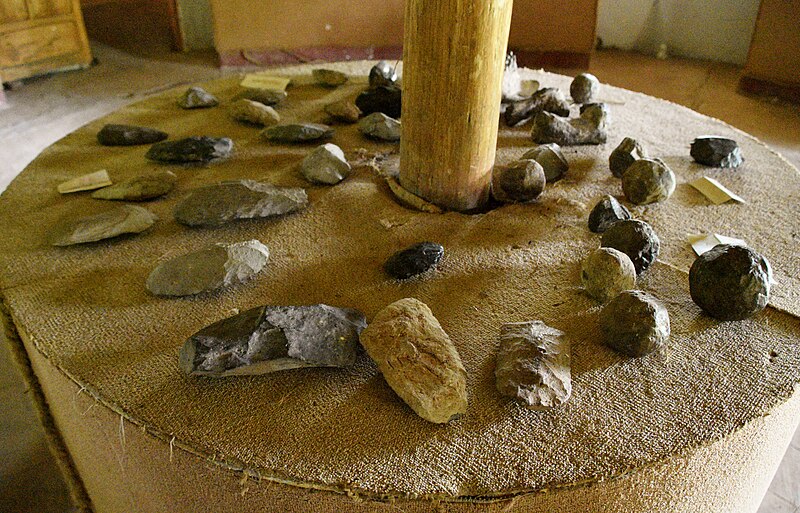
Eight hundred thousand years ago, ancient hominins carefully fashioned dozens of standardized basalt handaxes to process large animal carcasses, creating a dense concentration of Acheulean butchery tools buried together in a single preserved horizon. Please look down through the protective glass barrier at the large, beautifully shaped basalt handaxes and heavy stone blocks laid out on the ancient surface before you. …
04 Garba III Site and Archaic Homo sapiens
Approximately two hundred thousand years ago, archaic Homo sapiens possessing significantly expanded cranial capacities ushered in a revolutionary technological shift toward the Middle Stone Age right at this site. Please raise your eyes and observe the thin, hardened soil layers situated directly behind the museum information board on your left. …
05 Balchit Obsidian Quarry Exposure
This site represents the oldest known natural glass quarry on Earth, where human ancestors continuously extracted obsidian and manufactured stone tools across an extraordinary span of two million years. Please look down at the ground beneath your feet and locate the striking fragments of jet-black volcanic glass glittering under the bright African sunlight. …
06 Awash Riverbank Sedimentary Viewpoint
Whenever violent volcanic eruptions rained ash across the region, the resilient Awash River repeatedly reestablished its course, covering deposits up to one hundred meters thick like a deep-freeze vault that perfectly preserved prehistoric occupation surfaces for millions of years. Please raise your eyes and gaze across the river at the magnificent cliff face displaying horizontal sedimentary layers stacked neatly like pages in a giant geological book. …
07 Closing
As our tour comes to a gentle close, the extraordinary landscape of Melka Kunture and Balchit stands revealed not merely as a collection of prehistoric excavation trenches, but as a monument to human resilience and adaptation across two million years. Situated high on the Ethiopian Highlands two thousand meters above sea level, this exceptional UNESCO World Heritage property holds an unprecedented continuous chronicle comprising four consecutive technological phases: the Oldowan, the Acheulean,…