 Photo Wikimedia Commons
Contents
History & cultureBY TELLBY8 sections · numbered as on the map01 Orientation
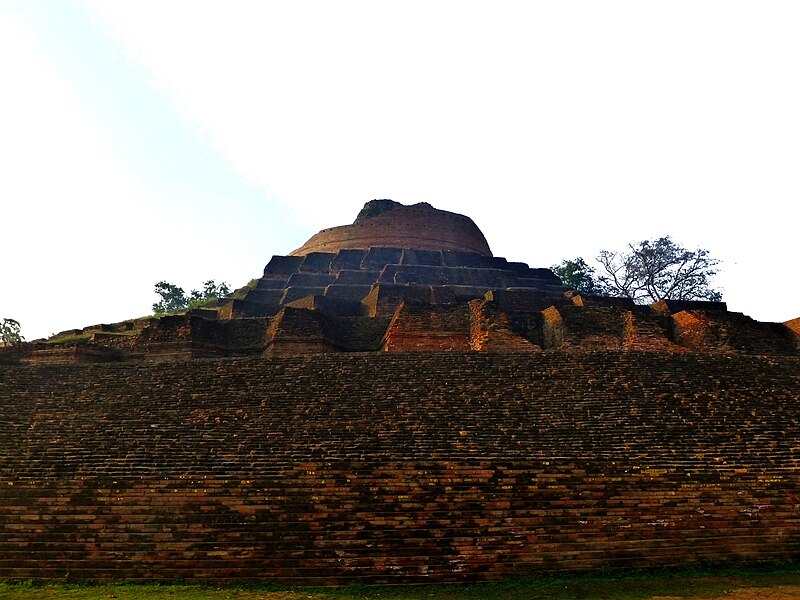
Welcome to the grand historical site of Kesaria Stupa located in the East Champaran district of Bihar state in India. It is our immense privilege to guide you through one of the most monumentally significant and reverent treasures of world Buddhist heritage. Today our audio guide tour is thoughtfully designed to lead you across eight distinct exploration zones. You will begin your walking journey at the main entrance board, proceed through the eastern approach road, inspect the lower basement base, climb toward the middle terraces, observe the upper stupa dome, explore the central axis and historical landscape, admire the conservation viewpoint, and finally conclude at the tour closing area. As you walk between these sections, we will share in depth historical contexts, archaeological revelations, and fascinating facts surrounding this ancient monument.
Geographically, Kesaria Stupa is situated in the Purba Champaran district of Bihar on the border region between India and Nepal. This historic location is situated approximately 120 kilometers away from Patna, the state capital of Bihar, and about 30 miles from the ancient city of Vaishali. Following extensive archaeological excavations, officials from the Archaeological Survey of India officially declared that the state of Bihar holds the proud privilege of housing the largest and tallest ever excavated Buddhist stupa in the whole world.
The East Champaran district covers a total geographical area of 3968.00 square kilometers, comprising 3844.25 square kilometers of rural territory and 123.75 square kilometers of urban territory. According to the official 2011 Census of India, the district recorded a total population of 5099371 inhabitants, including 2681209 males and 2418162 females, ranking second in population size and third in total land area among all districts in Bihar state. The administrative structure of the district encompasses six sub divisions, 27 Community Development blocks, 1293 total villages, and 10 statutory towns, with the district headquarters at Motihari located 150 kilometers from the state capital Patna. Among the 1293 villages, 1252 are inhabited while 41 are uninhabited villages.
Furthermore, East Champaran exhibits a high population density of 1285 persons per square kilometer compared to the Bihar state average of 1106, while recording a sex ratio of 902 and a child sex ratio of 933 for the age group zero to six years. The district contains 981516 total households, including 909672 rural households and 71844 urban households. The local Kesaria statutory town holds an urban population of 18984 residents. Buried under mounds of earth for centuries, Kesaria Stupa was brought back to light through modern archaeological dedication. Please follow the pathway to our next stop at the eastern approach road and excavation site.
02 Eastern Approach Road and 1998 Archaeological Excavation Site
You are currently standing at the eastern approach road and pedestrian walkway of Kesaria Stupa. This very spot marks the historical ground where a dedicated team of officials from the Archaeological Survey of India carried out a monumental excavation in the year 1998. Through their meticulous scientific work, the buried reality of this massive Buddhist stupa was brought to light for the first time in modern human history. …
03 Stupa Lower Basement Base and Global Buddhist Monuments Height Comparison
You are now positioned at the south eastern corner of the lower basement base of Kesaria Stupa. This specific location offers visitors an ideal viewpoint to fully grasp the colossal scale and precise statistical dimensions of this ancient structure. According to the detailed survey reports of the Archaeological Survey of India, the current height of Kesaria Stupa stands at 104 feet, having been reduced from its original height over centuries of natural weathering and seismic events. …
04 Middle Terraces and 1934 Earthquake Historical Record
You are currently walking along the middle terrace pathway of Kesaria Stupa. As you ascend these historic terraces, you can directly sense the dramatic historical transformations and environmental challenges this magnificent structure has endured across millennia. According to official historical documentation provided by the Archaeological Survey of India, Kesaria Stupa maintained a significantly greater elevation until the early twentieth century. …
05 Upper Stupa Dome View and Ancient Videha and Lichchavi Kingdoms
You have now arrived at the upper stupa dome viewing area of Kesaria Stupa. Gazing out over the panoramic landscape from this elevated vantage point, visitors can readily appreciate how the East Champaran region served as a dynamic crossroads of power, governance, and philosophical thought from prehistoric times through classical antiquity. Tracing the ancient history of Purba Champaran reveals deep civilizational roots. …
06 Central Axis and Historical Origin of Champaran
You are now standing at the central axis plaza of Kesaria Stupa. This location provides a magnificent vantage point to admire the architectural symmetry of the stupa while reflecting upon the ancient etymological origins of the name Champaran and the turbulent medieval dynastic history of this region. The district original name Champaran owes its historical origin to the ancient term Champa or Champak-Aranya, which signifies a forest of magnolia trees. …
07 Conservation Viewpoint and Value of Modern Heritage
You are standing at the conservation viewpoint overlooking the outer panoramic view of Kesaria Stupa. This location offers an unparalleled setting to admire the complete architectural form of the monument and appreciate the success of archaeological conservation while contemplating the immense historical significance of Purba Champaran in modern Indian history. …
08 Closing
Dear visitors, thank you very much for joining our audio guide tour of Kesaria Stupa, the tallest excavated Buddhist stupa in the world. As you walk toward the exit area, please take a moment to reflect upon the profound historical and spiritual significance of the monumental treasure you have experienced today. …