 Photo Wikimedia Commons
Contents
History & cultureBY TELLBY8 sections · numbered as on the map01 Orientation
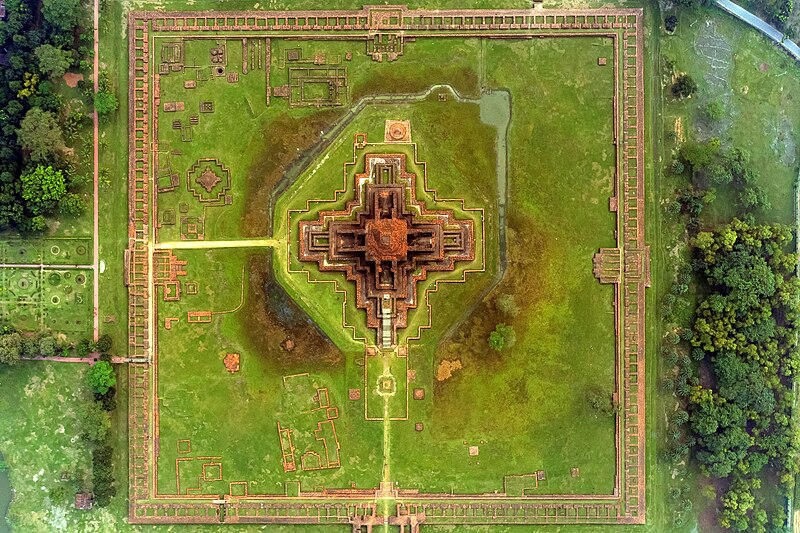
Welcome to the Ruins of the Buddhist Vihara at Paharpur, historically recognized as Somapura Mahavihara, one of the most magnificent monuments of ancient Buddhist civilization in Bengal. As you stand before this breathtaking expanse of red brick architecture, you are looking at the largest single monastic complex discovered south of the Himalayas. The reason this sacred ground was inscribed as a UNESCO World Heritage Site in 1985 lies in its unparalleled historical, spiritual, and architectural significance. Constructed during the flourishing golden age of the Pala Dynasty around the 8th century, this immense monastery served as far more than a secluded retreat for local monks. It functioned as a premier international university and spiritual sanctuary where revered scholars from across Asia gathered to master complex Mahayana philosophy and esoteric Vajrayana doctrines. Furthermore, the visionary architectural layout created here, featuring a stepped cruciform plan rising like a tiered pyramid, became a defining model for sacred monuments across the continent. This groundbreaking design directly inspired famous religious complexes in Myanmar, Java, and Cambodia, making Paharpur the true intellectual and architectural cradle of medieval Asian temple design. During its era of peak prosperity, hundreds of venerable scholars and visiting monks resided within these quadrangular walls, translating sacred Sanskrit scriptures, engaging in rigorous debate, and preserving vital spiritual knowledge for future generations. Although time and environmental exposure have dissolved its soaring upper roofs, every weathered brick and foundational stone still radiates the extraordinary intellectual passion and religious devotion of those ancient masters. Our walking tour today will take you on a carefully curated physical and narrative journey through this monumental sanctuary. We begin at the majestic Northern Gateway, move along the grand perimeter of residential monastic cells, examine the astonishing array of terracotta relief panels and basalt stone sculptures surrounding the central shrine, explore the theoretical mysteries of the upper superstructure, and conclude at the Paharpur Museum where authentic excavated treasures are preserved. As you step forward onto these grounds, allow yourself to travel back over a millennium in time, feeling the profound stillness and enduring spirit of Bengal golden age of enlightenment. Let us now embark together on this memorable journey through history.
02 Northern Gateway and Outer Perimeter
Did you know that each side of this massive quadrangular complex spans an incredible 330 meters, making it the largest single monastic enclosure anywhere south of the Himalayas? Please take a moment to look closely at the towering red brick pillars of the northern entrance and the long perimeter walls stretching out before you right now. …
03 Monastic Cells and Drainage System
Is it not extraordinary that 177 individual residential cells are arranged in a perfect square along the inner walls, with the capacity to accommodate up to one thousand practicing monks simultaneously within a single complex? Please look down at your feet and toward the corners of the cell walls right now, where you can see small brick drainage channels running from inside each cell directly toward the central courtyard. …
04 Central Temple Plinth and Terracotta Plaques
Did you know that over 2000 sculpted terracotta plaques surrounding this temple plinth depict not only sacred stories of the Buddha past lives but also vibrant folk tales, indigenous animals, and humorous scenes of daily human life? Please examine the glowing red clay relief plaques embedded along the middle terrace wall right in front of you now. …
05 Stone Sculptures at Central Shrine Plinth
Is it not fascinating that over 60 Hindu stone sculptures are embedded around the lowest base plinth of the supreme Mahayana Buddhist shrine of Paharpur? Please look down at the delicate outlines of the black basalt statues set into the lowest tier of the plinth right now. Unlike the terracotta plaques made of baked clay on the upper terraces, these dark basalt sculptures carved from hard stone line the very bottom foundation of the central shrine. …
06 Central Upper Shrine Structure
Did you know that the terraced cruciform pyramidal design pioneered right here at Paharpur served as the original prototype for iconic Asian monuments including the Ananda Temple in Pagan, Myanmar, as well as Chandi Sewu and Prambanan in Central Java? Please tilt your head upward to gaze at the soaring 21-meter high red brick structure that diminishes in steps toward the sky right now. …
07 Paharpur Museum
Did you know that while many terracotta panels on the outdoor temple walls are protective replicas, over 800 authentic original terracotta masterpieces and rare metallic treasures are preserved right inside this museum display hall? Please look at the 5th-century Gupta period copperplate inscription and clay monastic seals inside the central glass display case right now. …
08 Closing
As we stand on this elevated viewpoint looking out across the vast quadrangle of Paharpur, our audio tour comes to a thoughtful conclusion. The glorious journey of Somapura Mahavihara, which began in the 8th century under the ambitious patronage of the Pala Dynasty, gradually entered a period of quiet decline during the 12th century with the rise of the Sena Dynasty and shifting regional trade routes. …