 Photo Wikimedia Commons
Contents
History & cultureBY TELLBY8 sections · numbered as on the map01 Orientation
Standing before the vast expanse of the Arabian Sea, your journey to the unconquered maritime stronghold begins at the coastal village of Rajapuri. Visitors board traditional wooden sailboats at the Rajapuri jetty, embarking on a sea voyage that precisely mirrors the historical path traversed by ancient traders, noble navies, and formidable warriors over the centuries. As the boat glides across the rolling coastal waves, a massive fortress emerges in the middle of the sea, rising dramatically from an oval-shaped rock off the coast near Murud in the Raigad district of Maharashtra state. Located approximately 165 kilometers south of Mumbai, this geographical point served as a vital linchpin along India's western coastline, commanding absolute military oversight over critical maritime trade routes that connected major historical trading ports such as Broach, Daman, Diu, and Mangalore. The compound name Murud Janjira carries a fascinating linguistic history rooted in the regional convergence of cultures. The word Janjira is a local corruption of the Arabic word jazira, which literally translates to island. In historical Marathi, the region of Murud was originally referred to as Habsan, meaning the land of the Habshi or Abyssinian people. Furthermore, the name Murud itself derives from the word morod, a term peculiar to the Konkani language that is entirely absent in Marathi. Thus, the name Murud Janjira represents a unique geographical concatenation of Konkani and Marathi terms. Looking outward from the sea, the most striking feature is the sheer 40 foot high fortification wall, built directly upon natural rock foundations to create an imposing granite boundary rising straight from the oceanic waters. The origin of this maritime defensive bastion dates back to the 15th century, when local Rajapuri fishermen under the leadership of Koli chief Itbarrao Koli constructed a small wooden garrison on this massive rock in order to safeguard their families and livelihoods from constant pirate raids. Recognizing the immense strategic advantage of this solitary marine rock formation, the Nizam Shahi Sultan of the Ahmadnagar Sultanate dispatched his general Piram Khan to capture the wooden fort. Subsequently in 1567, Malik Ambar, an Abyssinian regent of Siddi origin serving the Ahmadnagar Sultanate, replaced the primitive timber structure with a permanent, massive stone fortification. Originally designated as Jazeera Mahroob Jazeera, the fortress was meticulously engineered to withstand both heavy naval artillery bombardment and violent ocean storms. Today, as you approach across the water towards those massive 40 foot granite walls, you are directly witnessing one of the most formidable engineering marvels in world naval history, a fortress that maintained complete operational independence through centuries of regional warfare.
02 The Concealed Main Gate and Darya Darwaza
As your sailboat arrives directly at the base of the massive granitic perimeter wall, you will encounter one of the most brilliant tactical secrets of medieval military architecture. The main entry gate of Murud Janjira Fort, positioned directly facing the coastal village of Rajapuri on the mainland, is completely invisible from a distance across the open sea. …
03 The Tiger and Elephants Sculpture at the Gateway
Positioned prominently on the outer masonry wall directly flanking the main entry gateway, visitors will observe an extraordinary high-relief stone sculpture that encapsulates the raw power and political symbolism of the Siddi rulers. The intricate relief carving depicts a fierce tiger-like beast holding multiple massive elephants tightly in its razor-sharp claws. …
04 The 26 Bastions and Granitic Wall Perimeter
Walking along the elevated outer ramparts of Murud Janjira, one is enveloped by a continuous ring of heavy stone defenses engineered with absolute medieval military precision. The fort perimeter is reinforced by 26 massive circular artillery towers, or bastions, which remain fully intact to this day, protruding outward from the main wall to provide overlapping fields of defensive fire. …
05 The Three Great Cannons: Kalaal Baangadi
Positioned atop the strategic bastions of Murud Janjira are the famous heavy artillery pieces that defined the fort's long-range striking power, most notably the legendary triad of massive cannons known as Kalaal Baangadi, Chavri, and Landa Kasam. Among the hundreds of native and European artillery pieces remaining on the ramparts, Kalaal Baangadi holds historic distinction as the third largest cannon in all of India. …
06 The Inner Court, Mosque Ruins, and Palace Complex
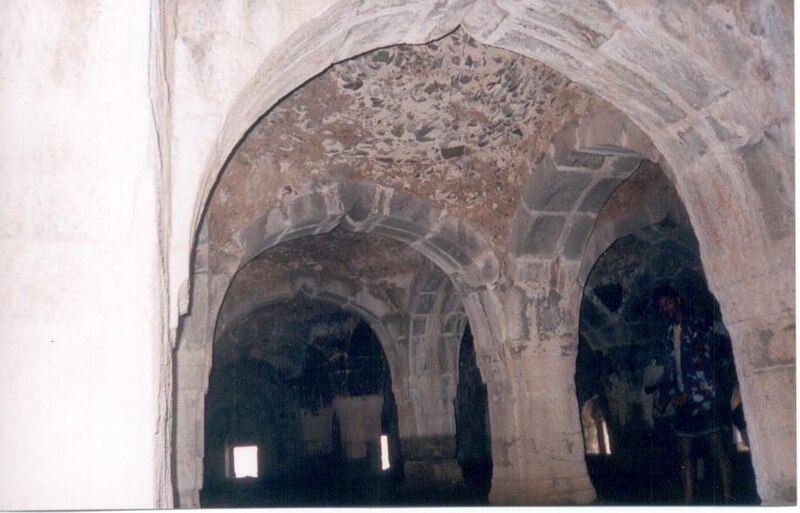
Stepping inside the core interior of Murud Janjira, visitors transition from a strictly military bastion into what was once a thriving, self-contained medieval island city. In its operational heyday, the interior complex was densely populated, featuring multi-story residential quarters for officers, military barracks, administrative courts, an elegant mosque, stone bathhouses equipped with engineered water channels, and the majestic multi-story Palace of the Nawab. …
07 The Miraculous Freshwater Ponds inside the Sea Fort
Near the central complex of Murud Janjira Fort, visitors will encounter perhaps the most extraordinary natural marvel of this maritime stronghold: two large freshwater ponds and a remarkably deep well situated right in the middle of the salty Arabian Sea. Reaching depths of approximately 60 feet, or 18 meters, these functional freshwater reservoirs continuously yield pure, sweet drinking water despite being completely surrounded on all sides by millions of gallons of saline ocean water. …
08 Closing
As our audio guide tour reaches its conclusion, visitors are invited to stand near the elevated ramparts adjacent to the Palace of the Nawab, offering a breathtaking panoramic vista across the glittering Arabian Sea. From this commanding vantage point on the outer wall, looking northwest across the ocean waters, one can clearly observe Padmadurg Fort, also known locally as Kasa Fort. …