 Photo Wikimedia Commons
Contents
History & cultureBY TELLBY7 sections · numbered as on the map01 Orientation
Welcome to the Fray Bentos Industrial Landscape, an extraordinarily preserved historical site situated along the scenic and tranquil banks of the Uruguay River. This monumental complex stands proudly as a United Nations Educational, Scientific and Cultural Organization World Heritage site because it preserves an remarkably complete physical and social record of global food production, industrial technology, and working-class community life spanning the nineteenth and twentieth centuries. Universally recognized for decades as the world's big kitchen, this single industrial facility transformed the vast livestock resources of the South American pampas into preserved food products that nourished millions of people across five continents. During major international conflicts, the preserved meat produced right here played a vital role in sustaining frontline populations and soldiers in distant lands. As you gaze across this sweeping riverside landscape, you can observe how natural river channels, towering brick chimneys, monumental cold storage vaults, processing workshops, and planned residential neighborhoods harmoniously interlock to form an unprecedented global production ecosystem.
Today's walking journey will guide you through the historic core of this enterprise and its adjacent company town, offering an evocative window into the daily operations that fundamentally reshaped global food supply chains. We will begin our tour at the high-ceilinged slaughtering yard, where raw livestock entered the continuous processing line. From there, we will proceed to the monumental cold storage chambers and machine room, followed by the mechanical canning division where the iconic metal containers were manufactured. Afterward, our route leads to the riverfront pier and its historic steam cranes, where ocean-going ships anchored to receive cargo bound for world markets. Finally, we will wander into the residential sector, examining the striking contrast between the grand manager's villa and the orderly streets of the workers' neighborhood. As you walk between these historic brick structures, take time to appreciate how every building, rail line, and specialized machine contributed to a seamlessly integrated international enterprise. Let us now begin our journey by stepping toward the slaughtering yard.
02 Slaughtering Yard
The slaughtering yard standing before you represents one of the most astonishing achievements of nineteenth and twentieth-century industrial engineering, operating a continuous processing line capable of handling up to 2,000 cattle per day in a relentless 45-minute sequence with virtually zero material waste. Every single animal that entered this facility was processed with absolute mechanical precision, ensuring that no usable part was discarded or lost. …
03 Cold Storage Chambers & Machine Room
The extraordinary facility standing before you housed the largest industrial refrigeration installation in South America during its era and marks the historic site where Uruguay's very first electric lightbulb was switched on in 1883. The activation of electrical power at this remote riverfront complex represented a monumental technological breakthrough for the entire nation, illuminating the vast working spaces and enabling continuous night operations for the first time in South American…
04 Mechanical Canning Division
The mechanical canning workshop before you is the historic birthplace of the world-famous Fray Bentos corned beef tins and concentrated meat extracts that sustained millions of Allied soldiers during both the First and Second World Wars. Inside the muddy, rain-soaked trenches of Europe, these distinctive square metal tins were far more than mere combat rations; they represented an indispensable lifeline and a vital source of protein for troops fighting under brutal conditions. …
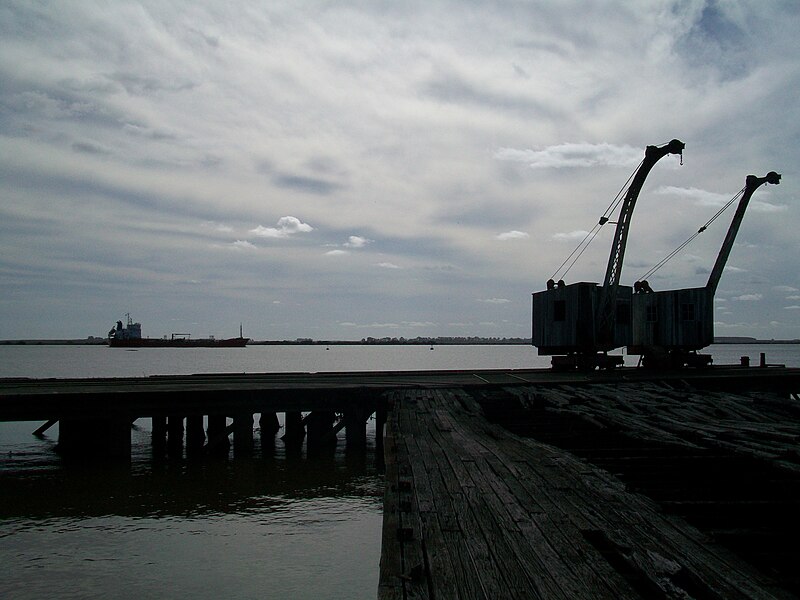
05 Anglo Port Pier & Cranes
The Anglo Port Pier before you was once a roaring epicenter of international maritime commerce, where in 1898 alone, more than 450 transatlantic steamships docked alongside these wooden wharves to connect rural Uruguay directly to five continents. During its operational peak, the vessel traffic at this remote river port equaled or exceeded that of several major European harbors. …
06 Executive Villa & Workers' Town
The residential settlement before you formed a remarkably complete company town that housed a bustling cosmopolitan community of 4,000 factory workers who immigrated here from more than 55 different nations. To accommodate this diverse international labor force in a previously unpopulated frontier region, the enterprise established a fully self-contained urban environment featuring schools, social clubs, sports facilities, and healthcare amenities. …
07 Closing
Today, we have traveled together through the monumental spaces of the Fray Bentos Industrial Landscape, a site that stood for over a century as a revolutionary hub connecting the grasslands of South America directly to dinner tables across five continents. After decades of continuous operation, during which it earned worldwide fame as the world's big kitchen and sustained millions through times of war and peace, the factory finally closed its doors in 1979 due to shifting global markets and…