Contents
History & cultureBY TELLBY8 sections · numbered as on the map01 Orientation
Welcome to Orang National Park, a breathtaking natural sanctuary situated gracefully on the northern bank of the mighty Brahmaputra River in the vibrant state of Assam, India. Spanning across both the Darrang and Sonitpur districts, this magnificent protected reserve covers a total geographic expanse ranging from 78.81 square kilometers to 79.28 square kilometers. Positioned as an integral part of the globally renowned Indo-Burma biodiversity hotspot, the park features a landscape sculpted by alluvial soil, sprawling marshlands, and dense alluvial floodplains. Because its unique terrain, riverine wetlands, and rich wildlife habitats mirror those of the famous Kaziranga National Park, Orang has affectionately earned the widely recognized title of Mini Kaziranga. During its historical timeline, the reserve was briefly renamed the Rajiv Gandhi Wildlife Sanctuary, though public resonance ultimately restored its cherished local name of Orang.
The human and ecological history of this territory is both fascinating and layered. Prior to the year 1900, the land was inhabited by indigenous local tribes who maintained settlements throughout the area. However, following a devastating epidemic disease, the tribal population was forced to abandon their ancestral dwellings, leaving the region uninhabited. Recognizing its ecological potential, British colonial authorities issued notification number 2276 R on May 31, 1915, and officially declared the territory as the Orang Game Reserve in 1919. Decades later, control was transitioned to the wildlife wing of the State Forest Department to align with the strategic conservation goals of Project Tiger. To formalize its protection, the site was officially established as a wildlife sanctuary on September 20, 1985, under notification number FRS 133 85 5, before receiving its ultimate upgrade to full National Park status on April 13, 1999, via notification number FRW 28 90 154.
Geographically and climatically, Orang experiences a distinct subtropical monsoon climate characterized by an impressive average annual rainfall of approximately 3000 millimeters. The annual weather pattern unfolds across three primary seasons: summer, monsoon, and winter. Summer spans from April through June, bringing warm temperatures ranging from 12 to 28 degrees Celsius in the mornings and rising to 25 to 32 degrees Celsius in the afternoons, accompanied by high relative humidity levels between 66 percent and 95 percent. The monsoon season lasts from July to October, delivering intense rainfall that causes river channels to spill over and form vast seasonal floodplains. The optimal period for visiting occurs during the dry winter months from November to March, when morning temperatures cool to between 5 and 15 degrees Celsius and pleasant afternoon temperatures hover between 20 and 25 degrees Celsius, creating ideal conditions for wilderness exploration.
02 Pasnoi Riverbank and the Historic Elephant Camp
You are now standing along the picturesque bank of the Pasnoi River, a serene waterway that flows gently through the heart of Orang National Park. Located directly adjacent to these calm riverbank waters is the historic Elephant Camp, meticulously maintained and operated by the Wildlife Wing of the Forest Department of Assam. …
03 Central Alluvial Grasslands: Realm of the Indian Rhino
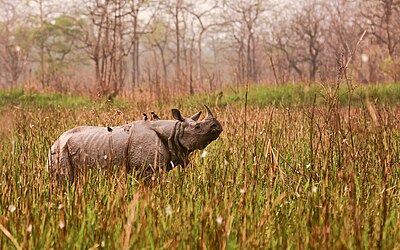
Welcome to the central observation vantage point overlooking the vast alluvial grasslands of Orang National Park. Spread out before you is an expansive terrain dominated by towering vegetation, where giant Elephant Grass thrives alongside dense stands of Phragmites karka and Imperata cylindrica. This dramatic grassland ecosystem has been carved and enriched over thousands of years by the alluvial silt deposits carried by the Brahmaputra River during its annual flooding cycles. …
04 Wetland Complex and Tribal Water Heritage
You are now observing the intricate Wetland Complex of Orang National Park, a vital aquatic network that plays a fundamental role in sustaining the park's vibrant biodiversity. The hydrological structure of Orang consists of a unique combination of 12 natural wetlands alongside 26 historic artificial water bodies. …
05 Avian Sanctuary: Home of the Critically Endangered Bengal Florican
Welcome to the Avian Sanctuary zone of Orang National Park, an extraordinary paradise for bird enthusiasts and ecological researchers alike. Recognized globally for its exceptional ornithological richness, Orang has been designated as an Important Bird and Biodiversity Area by BirdLife International. Environmental authorities regard this park as the single most critical wet-grassland bird habitat on the entire Indo-Gangetic Plain, as well as one of the three most outstanding Important Bird…
06 Northern Moist Forest: The Royal Bengal Tiger Sanctuary
You have now transitioned into the Northern Moist Forest zone, situated on the higher northern terrace of Orang National Park. Moving away from the open riverine floodplains, this elevated terrain is dominated by dense Eastern Himalayan moist deciduous forest, characterized by a complex forest structure and an expansive tree canopy. Prominent tree species establishing this dense woodland include Bombax ceiba, Dalbergia sissoo, Sterculia villosa, Trewia nudiflora, and Litsea monopetala. …
07 Brahmaputra Riverfront and Waterway Safari
You are now standing at the southern boundary of Orang National Park, where the magnificent Brahmaputra River flows in all its majestic grandeur. The southern and eastern borders of the reserve are defined by this monumental river system, featuring sprawling sandy islands known locally as char areas, along with a complex network of spill channels and interconnected tributaries. …
08 Closing
As you complete your memorable tour and return to the exit gate of Orang National Park, we extend our heartfelt gratitude for your visit. Known fondly as Mini Kaziranga, this extraordinary natural sanctuary showcases both the incredible biological richness of Assam and the complex challenges that modern wildlife conservation faces today. Because Orang is entirely encircled by inhabited human villages, the park experiences constant anthropogenic pressures along its boundaries. …