 Photo Wikimedia Commons
Contents
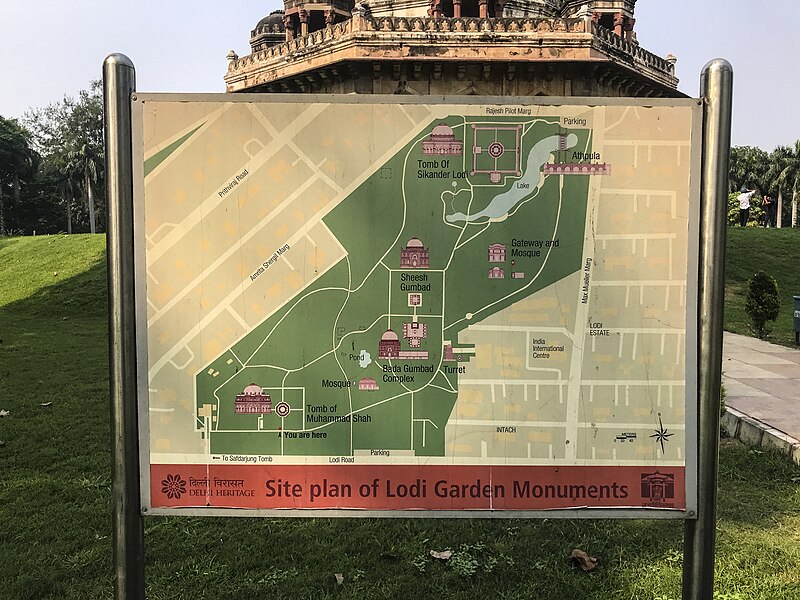
History & cultureBY TELLBY8 sections · numbered as on the map01 Orientation
Welcome to Lodi Gardens, a breathtaking ninety acre urban sanctuary and historical heritage park located along Lodi Road between Khan Market and Safdarjung Tomb in the heart of New Delhi. As you begin your walk today, please take a moment to adjust your pace and enjoy the serene, refreshing atmosphere of these ancient grounds. This lush park is not only one of the most cherished public green spaces in Delhi, but also an extraordinary open air architectural museum containing magnificent tombs, mosques, and ornamental bridges erected over five hundred years ago.
To truly appreciate Lodi Gardens, we must first examine its fascinating spatial and social history. Long before it became a public park, this territory was occupied by a rural settlement known as Khairpur Village, situated near the historic banks of the Yamuna River. In nineteen thirty six, during the era of British colonial rule, the residents of Khairpur were relocated under a major urban redesign project supervised by Lady Willingdon, wife of the British Viceroy, Freeman Freeman Thomas, Marquess of Willingdon. The region was transformed into a beautifully landscaped public park filled with native and exotic trees, winding footpaths, and expansive lawns, initially opening under the name Lady Willingdon Park. Following Indian Independence in nineteen forty seven, the complex was officially renamed Lodi Gardens to honor the fifteenth century dynasty whose grand monuments dominate the landscape.
The park underwent a comprehensive modernization and relandscaping in nineteen sixty eight under the direction of the distinguished American modernist architect Joseph Allen Stein and landscape architect Garrett Eckbo. Stein redesigned the grounds into the harmonious environment we experience today, introducing the central artificial lake with its sweeping fountain, as well as the specialized glasshouse dedicated to rare botanical preservation. More recently, in twenty ten, the Indian National Trust for Art and Cultural Heritage, widely known as INTACH, conducted an extensive restoration project across all the monuments, consolidating their masonry and safeguarding them for future generations.
The site originally served as a royal necropolis for the rulers and court nobility of the Sayyid and Lodi dynasties during the late Delhi Sultanate period. Historians note that three distinct ruling families chose this location for their monumental mausoleums due to its close spiritual proximity to the Nizamuddin Dargah, the sacred shrine of the venerated thirteenth century Sufi saint Khwaja Nizamuddin Auliya. Burial near a holy saint was believed to bestow divine blessings and eternal grace upon deceased monarchs. As you stroll along these paved pathways today, you are walking through multi layered strata of Delhi history, moving from medieval Sultanate politics through colonial urban transformations and into the modern green lung of India capital city. Please enjoy the tranquil surroundings as we make our way toward our first historic highlight, the magnificent Tomb of Muhammad Shah Sayyid.
02 Tomb of Muhammad Shah Sayyid
We now stand before our first major architectural monument, situated in the southern quadrant of Lodi Gardens, the magnificent Tomb of Muhammad Shah Sayyid. This extraordinary mausoleum was commissioned around fourteen forty five by Alauddin Alam Shah to honor his deceased father, Muhammad Shah Sayyid, who ruled as the third monarch of the Sayyid dynasty from fourteen thirty four to fourteen forty five. …
03 Bara Gumbad and Turret
We have now arrived at the central western sector of Lodi Gardens, standing directly before the monumental stone edifice known as Bara Gumbad and its enigmatic neighboring eastern turret. The name Bara Gumbad translates literally to Big Dome in Hindi and Urdu, perfectly describing the massive hemispherical stone dome that dominates the skyline of the central garden complex. …
04 Bara Gumbad Masjid and Mehman Khana
Stepping into the serene stone courtyard attached to Bara Gumbad, we face the exquisite Bara Gumbad Masjid on our west and its mirrored companion building, the Mehman Khana, on our east. The Bara Gumbad Masjid was completed in fourteen ninety four, an exact historical date confirmed by an authentic Arabic inscription carved directly onto its central mihrab niche. …
05 Shish Gumbad
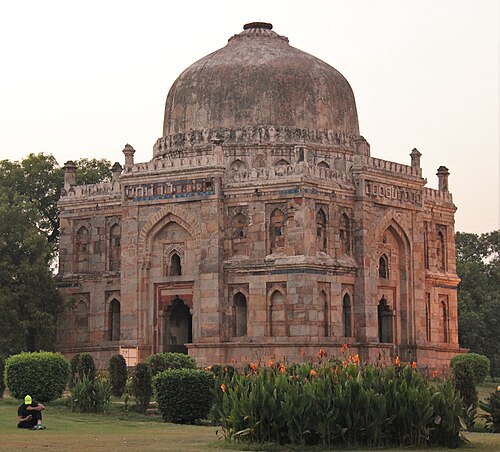
Located directly north of the Bara Gumbad complex, across a short open lawn, stands the striking square mausoleum known as Shish Gumbad. The name Shish Gumbad translates literally to Glazed Dome or Glass Dome, earned because of the vibrant turquoise and cobalt blue glazed ceramic tiles that decorate the upper facade of its primary entrance. …
06 Tomb of Sikandar Lodi
We now reach the northern section of Lodi Gardens to explore the fortified Tomb of Sikandar Lodi. This grand mausoleum was commissioned around fifteen seventeen by Ibrahim Lodi, the last ruler of the Lodi dynasty, to honor his deceased father, Sultan Sikandar Lodi, who ruled from fourteen eighty nine to fifteen seventeen. …
07 Athpula Bridge and Mughal Monuments
We now arrive at the northeastern sector of the gardens, standing near the tranquil water channel before the picturesque Athpula Bridge and its surrounding Mughal period monuments. The name Athpula translates directly to Eight Piered Bridge in Hindi, named after the eight sturdy stone piers that support the structure across the water. …
08 Closing
Welcome to the final stop of our Lodi Gardens audio tour, located near the vibrant Rose Garden and the National Bonsai Park by Gate Number 1. What began in the fifteenth century as a quiet royal necropolis for the Sayyid and Lodi dynasties has evolved over centuries into New Delhi most beloved public heritage park and a vital ecological sanctuary. …