 Photo Wikimedia Commons
Contents
History & cultureBY TELLBY7 sections · numbered as on the map01 Orientation
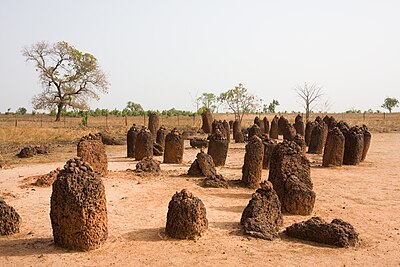
Welcome to the sacred Wassu Megalithic Site located within the lush natural landscape of the Niani district in Gambia north of Janjanbureh Here stands one of the most extraordinary ceremonial sanctuaries in West Africa preserved across vast river valleys and carrying the profound spiritual memories of past generations This remarkable cultural landscape represents a sacred ceremonial ground constructed over a period of more than fifteen hundred years from the third century before the common era through the sixteenth century of the common era as a enduring tribute to ancestors and a realm for complex mortuary practices Recognized internationally for its outstanding universal value and historical importance this unique landscape has been officially inscribed as a UNESCO World Heritage Site reflecting its profound significance to human civilizational history Across the broader Senegambia region over one thousand stone circles and burial mounds spread across thirty thousand square kilometers along major river systems between the Gambia River and the Saloum River This vast archaeological zone spans three hundred fifty kilometers in length and one hundred kilometers in width constituting the largest density of megalithic stone circles documented anywhere in the world Containing thousands of individual stone monuments that defined ancient territorial boundaries and preserved ancestral lineage connections across centuries As you stand at the main entrance looking across the open sanctuary ground you can see the eleven primary stone circles of Wassu arranged in striking geometric patterns These dark reddish brown laterite pillars stand silently above the earth as a living testament to the master stonemasons and highly organized communities of ancient times Each column reflects careful quarry extraction from local iron rich laterite deposits and precise placement around central burial shafts Designed to connect the living with the departed through elaborate spiritual rituals and community gatherings Exploring this ancient landscape allows you to witness how prehistoric societies transformed natural rock into enduring symbols of community memory faith and social harmony The builders of these circles created a complex sacred landscape that endured across centuries showcasing remarkable cultural continuity in West African mortuary traditions Take a moment to observe the spatial arrangement of the eleven stone rings glowing under the bright sunlight as we begin our guided audio narrative journey through this ancient West African sanctuary where silent stones continue to share timeless stories of lineage devotion and human achievement across generations
02 Spot 1: The Giant Monolith Standing 2.59 Meters High
The astonishing reality that the tallest standing stone column in the entire Senegambian region rising to an impressive height of two point five nine meters is located right here at Wassu offers a breathtaking introduction to this ancient heritage site Across the vast geographical expanse containing thousands of monoliths this particular stone stands supreme as the absolute apex of ancient West African megalithic architecture Look at the column on your left to observe the smooth cylindrical…
03 Spot 2: Evans and Ozanne Excavations and Radiocarbon Dating
The surprising fact that under these quiet stone circles lie multi layered ancient burials constructed between the tenth and fourteenth centuries dating specifically from nine hundred twenty seven to thirteen hundred five offers a profound look into the deep mortuary heritage of West Africa Beneath the serene surface of this grassy field lies a complex subterranean necropolis that preserves the sacred burial practices of ancient Senegambian societies across several centuries Look at the dirt…
04 Spot 3: Eastern Frontal Stones and Harvest Solstice Alignment
The remarkable discovery that almost all isolated frontal stones stand specifically on the eastern side of the stone circles aligned precisely with the rising sun during the winter harvest season reveals the incredible astronomical knowledge of ancient West African societies Turn your head and look to the east to observe the solitary stone pillar standing outside the perimeter of the primary ring This isolated column situated apart from the main circle of monoliths represents a classic frontal…
05 Spot 4: Laterite Extraction and Ancient Masonry Guilds
The astonishing reality that ancient artisans extracted massive laterite blocks weighing up to seven tons using simple iron chisels without causing a single structural fracture continues to amaze modern engineers and visiting archaeologists Look closely at the texture on the stone surface to observe the weather worn tool marks left on the dark reddish brown laterite rock These subtle hand carved grooves preserved on the hard stone face provide undeniable physical evidence of the meticulous…
06 Spot 5: The Fifty Dalasi Banknote and Grave Goods
The remarkable fact that the Wassu stone circles are featured prominently on the national currency of Gambia the fifty dalasi banknote as an ultimate emblem of national pride highlights the immense cultural value of this heritage site Look at the information panel along with the panorama of the circles to observe how the artwork depicted on the Gambian currency perfectly corresponds to the actual arrangement of monoliths before you By depicting these prehistoric stone rings on their national…
07 Closing
Our historical and spiritual journey through the sacred Wassu Stone Circles in the Niani district of Gambia now comes to a peaceful conclusion Today we have walked among giant laterite monoliths that have stood silently above this soil for over fifteen hundred years bearing witness to the remarkable faith and architectural skill of ancient West African societies These dark reddish brown pillars bridge the vast gap of time conveying how ancient communities honored their ancestors and preserved…