 Photo Wikimedia Commons
Contents
History & cultureBY TELLBY7 sections · numbered as on the map01 Orientation
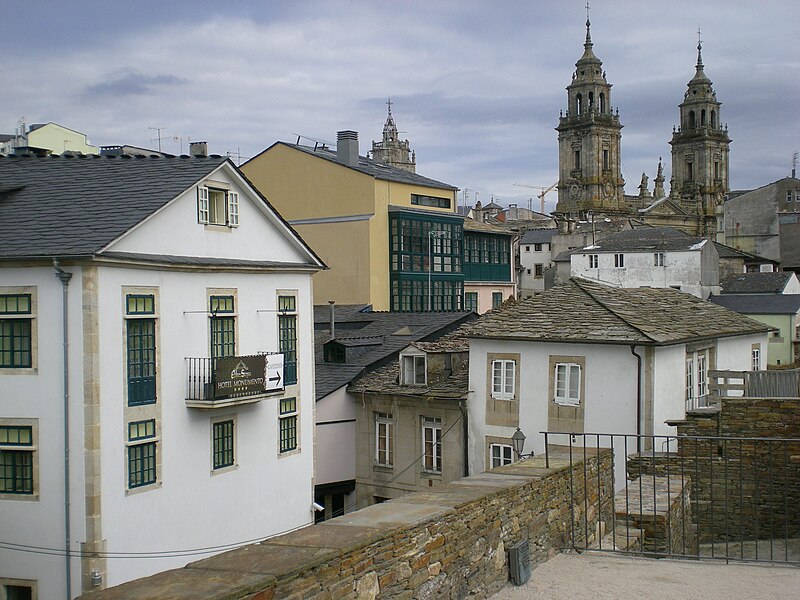
Welcome to Lugo Cathedral, a sacred sanctuary where centuries of historical memory and spiritual devotion resonate through ancient granite walls. Located in the historic city of Lugo within the Galicia region of northwestern Spain, this magnificent cathedral stands as an essential highlight along the northern and primitive routes of the legendary Santiago de Compostela pilgrimage. Recognized as a UNESCO World Heritage Site for its outstanding universal value within the Caminos de Santiago network, the cathedral represents an extraordinary architectural treasure where deep faith and artistic expression have continuously evolved over nearly two millennia.
The sacred history of this ground reaches back to the very origins of Christianity in the region during the first century, when the initial Christian chapel was founded here. In the middle of the eighth century, around the year 755, Bishop Odoario undertook a sweeping restoration of the pre-existing sanctuary. Historical records commemorate that King Alfonso II, known as the Chaste, was so profoundly impressed by the beauty and structural harmony of Bishop Odoario's temple that he adopted it as the direct architectural blueprint for constructing the famous Cathedral of Oviedo. By the early twelfth century, the aging structure required a complete rebuilding. In the year 1129, Bishop Pedro III and the cathedral chapter engaged the master builder Raimundo de Monforte to construct a grand Romanesque cathedral. Master Raimundo designed a formidable granite edifice featuring a Latin cross plan with three naves, a prominent transept, and a semicircular ambulatory with five radiating chapels, a monumental project that reached its final completion in 1273.
Beyond its magnificent architectural synthesis, Lugo Cathedral holds a singular spiritual distinction within the Catholic world. By virtue of a sacred papal privilege granted in the seventeenth century and reaffirmed by official papal bulls, the cathedral maintains the unbroken, continuous exposition of the Blessed Sacrament. This perpetual adoration of the Eucharist earned Lugo the revered title of the City of the Sacrament. The sacred emblem depicting the chalice and the radiant host was incorporated directly into the official heraldic coat of arms of both the city of Lugo and the surrounding Autonomous Community of Galicia, flanked by the Latin inscription proclaiming steadfast allegiance to the mystery of faith.
As you step through this holy monument, prepare to embark on a captivating narrative journey through Romanesque, Gothic, Renaissance, Baroque, and Neoclassical masterworks. Please follow the spatial cues in this guide as we begin our exploration at the cathedral's celebrated northern entrance.
02 North Door & Narthex
Suspended beneath a magnificent starry vault carved in the medieval era, an extraordinary marble capital depicting the Last Supper hangs down like an inverted stone peak frozen in midair. This singular architectural creation, floating between earth and heaven at the northern entrance, stands as one of the most celebrated and original masterpieces of Romanesque sculptural art in all of northern Spain. …
03 High Altar Fragments & Transept
Once dominating the high altar with breathtaking Renaissance splendor, a monumental carved retablo was fractured into pieces by a catastrophic eighteenth-century earthquake and now stands divided across opposite walls of the transept. This dramatic division illustrates both the immense destructive force of natural disasters and the extraordinary devotion of those who painstakingly saved the masterwork from total destruction. …
04 Choir Stalls in Main Nave
Standing proudly in the center of the main nave, this magnificent seventeenth-century choir enclosure is the only medieval and early modern cathedral choir in all of Galicia to remain completely intact in its original central location. While almost every other cathedral in the region removed or relocated their central choir structures during later centuries to clear the nave, Lugo preserved this extraordinary wooden monument exactly where it was constructed. …
05 Chapel of the Virgin of the Big Eyes
Gazing down upon generations of faithful pilgrims with remarkably large, compassionate eyes, the medieval polychrome stone statue of the Virgin of the Big Eyes has served as the beloved patroness and spiritual protector of Lugo for over eight centuries. Her striking, serene expression gives both this famous chapel and the entire cathedral its primary historical dedication.
Please step into the luminous chapel located at the central eastern apse directly behind the high altar. …
06 Chapel of San Froilán & Old Tower
To test whether his true divine calling was to live as a solitary hermit or as a public preacher, a devout ninth-century saint placed red-hot burning coals directly into his mouth without suffering any harm. This legendary ordeal marks the saintly life of San Froilán, the beloved co-patron saint of Lugo whose revered shrine rests inside this chapel.
Position yourself in front of the Renaissance Chapel of San Froilán, constructed during the seventeenth century. …
07 Closing
As you stand outside in the Plaza de Santa María facing the main western entrance, look up at the soaring Neoclassical facade designed by the naval engineer Julián Sánchez Bort in 1769. Completed over the course of the eighteenth and nineteenth centuries through the dedicated contributions of Lucas Ferro Caaveiro, Miguel Ferro Caaveiro, and Nemesio Cobreros, this grand front seamlessly unites the interior architectural journey you have just taken. …