 Photo Wikimedia Commons
Contents
History & cultureBY TELLBY7 sections · numbered as on the map01 Orientation
Welcome to the sacred valley of Musawwarat es-Sufra, a breathtaking sanctuary where the spirit of the ancient Kingdom of Kush remains deeply embedded in the semi-desert landscape. Nestled in a large natural basin surrounded by low, reddish-brown sandstone hills in the western Butana region, this remarkable site forms an integral component of the Archaeological Sites of the Island of Meroe, which was inscribed as a UNESCO World Heritage property in two thousand eleven. Situated approximately twenty-five kilometers southeast of the Nile River and twenty kilometers north of Naqa, Musawwarat stood as a monumental testament to the political power, immense wealth, and spiritual sophistication of the Kushite state, which flourished as a dominant regional empire from the eighth century BCE to the fourth century CE. Beyond the immediate fertile riverine zones, this semi-arid hinterland sanctuary provided a vital geographical bridge for high-level cultural, artistic, architectural, and linguistic exchanges connecting Sub-Saharan Africa with the Mediterranean and Middle Eastern worlds along major ancient trade corridors over a millennium. The property encompasses an extraordinary array of preserved architectural masterpieces, including the sweeping Great Enclosure with its labyrinthine courtyards and elevated terraces, the exquisitely decorated standalone Lion Temple of Apedemak, and monumental water management installations designed to capture and store seasonal rainfall in a land devoid of permanent human settlement. Historical awareness of Musawwarat in modern times began with early nineteenth-century European travelers such as Linant de Bellefonds in eighteen twenty-two and Frédéric Cailliaud, followed by the first detailed scientific descriptions produced by Carl Richard Lepsius. Decades later, major systematic archaeological fieldwork was undertaken from nineteen sixty to nineteen seventy by the Butana Expedition of Humboldt University of Berlin under the visionary leadership of Professor Fritz Hintze, whose team famously re-erected the collapsed Lion Temple and constructed its protective roof. Today, site protection is overseen by the National Corporation for Antiquities and Museums, ensuring that ongoing research and conservation continue to unlock its secrets. As you gaze across this dramatic landscape where reddish sandstone topography contrasts beautifully with scattered green bushes, reflect upon the brilliant engineering and profound religious devotion that enabled the Kushites to transform an arid wilderness into a majestic ceremonial heartland. Throughout this comprehensive audio tour, we will explore the physical vestiges, excavation breakthroughs, and architectural mysteries that define this unique desert sanctuary.
02 The Great Hafir: Water System in the Desert
An extraordinary engineering revelation at Musawwarat es-Sufra is that long before any of the grand stone temples or sweeping enclosures were erected, a colossal artificial lake measuring two hundred and fifty meters in diameter and excavated more than six meters into the earth was constructed to harvest the scarce desert rainfall. Direct your eyes toward the sweeping floor beneath the massive earthen embankments. …
03 Complex I D: The Unfinished Royal Sanctuary
Remarkably, Complex I D represents a frozen moment in ancient Kushite history where monumental construction was abruptly halted in antiquity, leaving behind unfinished wall foundations that suddenly terminate without even foundation trenches continuing their intended lines. Direct your visual attention to the carved stone bases arranged on the ground, which once supported four interior columns. …
04 Great Enclosure: Central Terrace and Royal Cartouches
The Great Enclosure stands as an architectural wonder without parallel in the entire Nile Valley, sprawling across an astonishing forty-five thousand square meters with a labyrinth of courtyards, raised terraces, ramps, corridors, and pillared chapels. Look closely at the round cross-sections of the sandstone columns standing in Room five hundred and sixteen, situated within the Western Chapel. …
05 Courtyard Garden and Elephant Sculptures
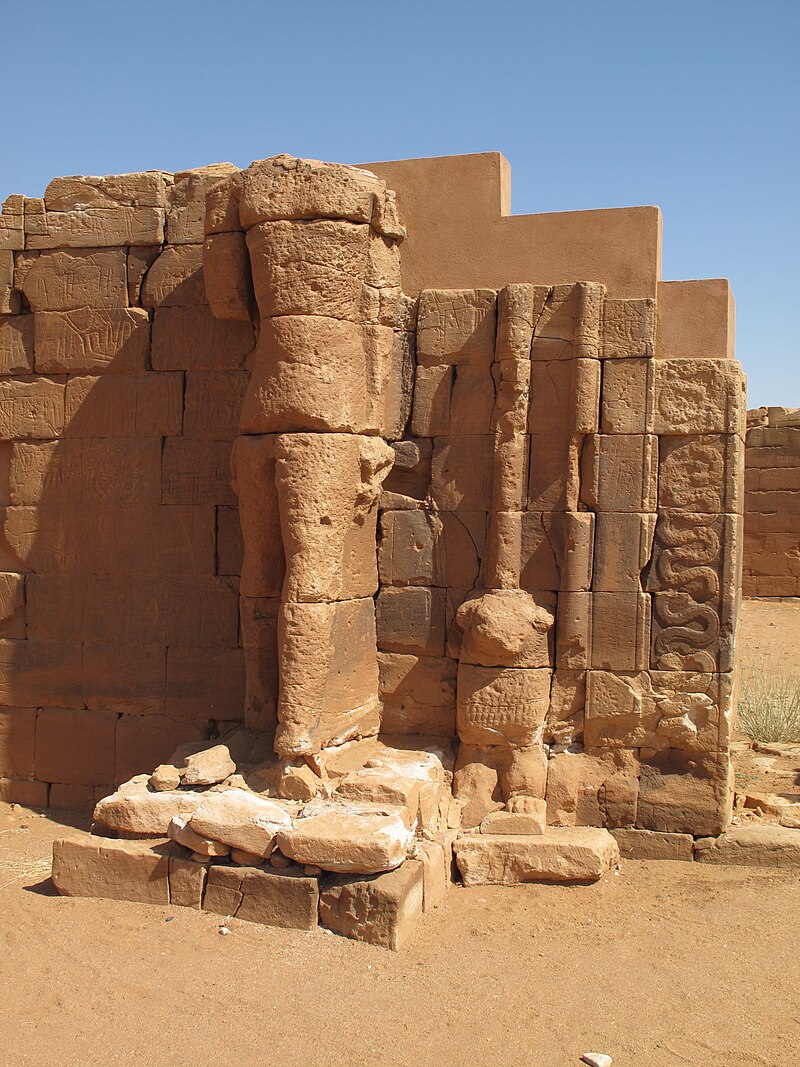
Astonishingly, deep within the arid, stone-bound courts of the Great Enclosure, archaeologists uncovered unmistakable physical evidence of a lush ancient royal garden that was artificially irrigated using complex water channels and basins. Elevate your line of sight toward the outer sandstone wall surfaces to admire the majestic relief carvings and statues depicting elephants, animals that held immense symbolic, military, and ceremonial importance at Musawwarat es-Sufra. …
06 The Lion Temple of Apedemak
The outer walls of the Lion Temple feature a breathtaking, uniquely Kushite iconographic wonder: a depiction of the warrior god Apedemak rendered as a majestic three-headed, four-armed lion deity. Direct your attention to the impressive entrance pylon and the interior of this single-chambered rectangular sanctuary, which measures fourteen point two one meters in length, nine point one three meters in width, and four point seven meters in height, featuring six drum-formed columns that once…
07 Closing
As our comprehensive audio journey through the sacred valley of Musawwarat es-Sufra comes to a close, take a final moment to gaze across this extraordinary semi-desert landscape where reddish-brown sandstone hills frame the silent ruins of an ancient empire. From the hydrological brilliance of the Great Hafir that harvested life-giving rainwater from seasonal storms, to the frozen history of the unfinished Complex I D, the lush irrigated courtyards of the Great Enclosure, and the majestic lion…