 Photo Wikimedia Commons
Contents
History & cultureBY TELLBY7 sections · numbered as on the map01 Orientation
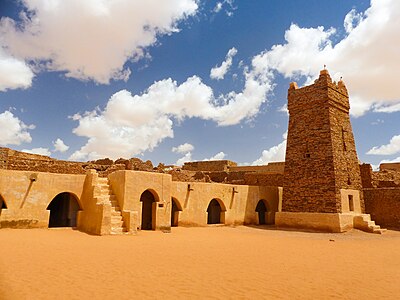
Welcome to the entrance of the ancient ksar of Chinguetti, a historic desert town located in the heart of the vast Western Sahara. Chinguetti, along with Ouadane, Tichitt, and Oualata, was inscribed as a UNESCO World Heritage Site in nineteen ninety-six. For centuries, it has been recognized as a central hub of nomadic culture and medieval Islamic scholarship. These ancient ksour served as vital stopping points along trans-Saharan trade routes. They demonstrated remarkable human adaptation to the harsh desert environment over many generations. According to oral traditions, early settlements in this region were established in antiquity. The town later flourished into a prosperous trading center under the Almoravid Empire. Historical records described Chinguetti as one of the most prominent settlements in Mauritania. In fact, it gave its name to the entire nation, which was known for centuries as the land of Chinguetti.
Chinguetti earned a luminous reputation as the Sorbonne of the desert due to its rich intellectual heritage and scholarly community. Positioned at a crucial junction on the Trig allamtuni caravan route linking the Maghreb to the Western Sudan region, the town welcomed countless camel trains. Merchants utilized salt extracted from the Idjil salt mines as a primary currency. They traded salt for gold, ivory, spices, ostrich feathers, sugar, and grains. This vast commercial prosperity attracted scholars, pilgrims, and teachers from across the Islamic world. Handwritten manuscripts covering Quranic studies, medicine, astronomy, botany, and mathematics were continuously transcribed, purchased, and preserved here. Desert schools known as mahadir were established throughout the ksar, serving as essential centers for spiritual learning.
You are now about to step into the winding dry-stone alleys of the old ksar. These narrow pathways were specially engineered to withstand heavy Saharan winds. In an environment defined by scorching summer heat over fifty degrees and freezing winter nights, local inhabitants utilized surrounding natural materials to build a resilient sanctuary. Although changing trade routes and the declining water table of the Batha river led to population decline, the historic ksar center remains remarkably intact. Ancient stone homes are arranged concentrically around the central mosque, reflecting the deep cultural influence of nomadic haima tent traditions. As you absorb the quiet atmosphere of these historic stone passageways, please walk forward toward our first stop, the square minaret tower of the Old Mosque.
02 Old Mosque Square Minaret
Look up at the impressive square minaret rising over ten meters high above the low dry-stone walls of Chinguetti. You are gazing upon a masterpiece of ancient Saharan architecture. Native master builders constructed this tower completely without cement, mortar, or synthetic bonding materials. Instead, they meticulously interlocked hand-cut blocks of local dry stone, known as legré. …
03 Legré Stone Alleyway and Entrance
Take note of the extraordinary thickness of the dry-stone walls enclosing this narrow alleyway. These massive barriers measure approximately fifty centimeters thick. They are constructed using a double-faced masonry technique with two parallel layers of local legré stone. Between these stone faces, builders packed an insulating core of mud mortar. This wall design provides exceptional thermal inertia. …
04 Tgoidira Courtyard and Geometric Niches
Standing in the quiet courtyard of the Hamoni Library, consider a remarkable historic paradox. Around the year two thousand, municipal and international institutions constructed a modern museum building in Chinguetti. It was designed to centralize and preserve all of the town's ancient manuscripts. However, that ambitious project failed to secure a single manuscript because local manuscript-owning families were excluded from the planning. …
05 Palm Wood Roof and Elevated Floor Heating System
Welcome inside the interior manuscript chamber of the Ahel Loudaa Library. As you stand in this quiet room, discover an ingenious engineering solution created by ancient Saharan scholars. While summer temperatures in Chinguetti routinely exceed fifty degrees Celsius, winter nights bring biting frosts dropping close to zero degrees. To safeguard fragile parchment and paper manuscripts from destructive freezing and moisture, this library utilized a specialized underfloor heating system. …
06 Terrachidia Mud Render and Traditional Restoration Area
Gaze upon this restored exterior wall and discover a dramatic story of traditional wisdom and architectural renewal. Decades ago, well-intentioned workers applied modern cement renders containing up to thirty percent cement over the ancient stone walls. However, the dense cement trapped moisture deep inside the stone masonry. This trapped water gradually washed away the ancient mud binder, causing severe cracks and wall collapse. …
07 Closing
Standing here on the high viewpoint overlooking the dry Batha riverbed, take in the breathtaking panoramic view of Chinguetti set against the undulating golden dunes of the Sahara Desert. Over centuries, this historic ksar has faced fragile survival against severe environmental and socio-economic challenges, including encroaching sand dunes, the declining water table, insect infestation by wood-destroying termites, and population migration to distant urban centers. …