 Photo Wikimedia Commons
Contents
History & cultureBY TELLBY8 sections · numbered as on the map01 Orientation
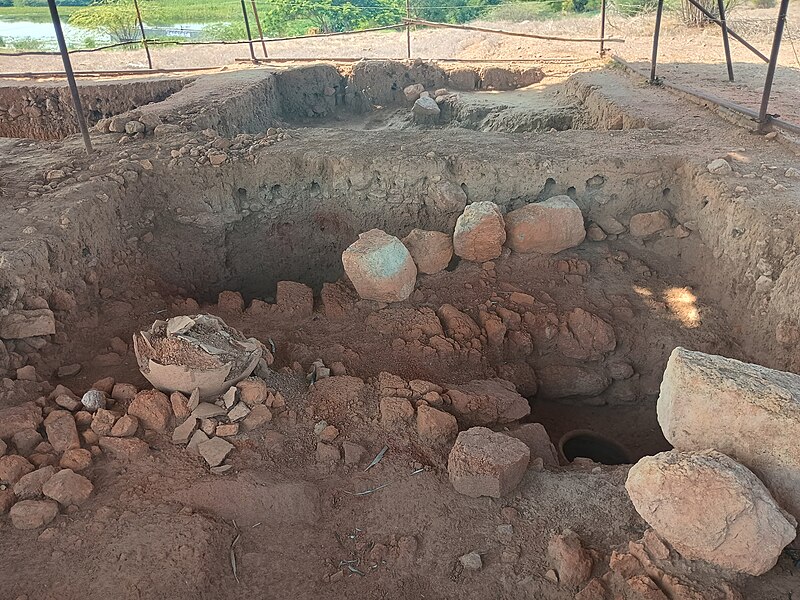
Welcome to the Adichanallur Archaeological Site, one of the most vital bioarchaeological landscapes and prehistoric treasures in South Asia. I am your senior curator and audio guide architect, and it is my immense privilege to accompany you on this comprehensive journey into the South Indian Iron Age. Located in the Thoothukudi district of Tamil Nadu, approximately 680 kilometers south of Chennai and just 4 kilometers west of Srivaikuntam town, this monumental archaeological complex spans 114 acres, equivalent to 50.6 hectares, along the right bank of the sacred Thamirabarani River. Locally known as parambu, a traditional Tamil term designating dry ground, a high ridge, or an elevated gravelly mound, this rolling landscape protected the material remains and biological traces of an extraordinary ancient civilization for thousands of years. Adichanallur represents a vast Iron Age burial network traditionally dated between 1000 BC and 600 BC. organic samples recovered during the 2004 to 2006 excavation seasons were submitted to the Beta Analytic Testing Laboratory in the United States, and the formal radiocarbon results delivered to the Madurai Bench of the Madras High Court in 2019 confirmed dates ranging precisely from 905 BC to 696 BC. This scientific confirmation officially established Adichanallur as one of the oldest dated Iron Age sites in Tamil Nadu. Moreover, systematic field investigations in 2005 uncovered approximately 169 terracotta burial urns housing human skeletons that date back at least 3,800 years. These monumental earthenware vessels, known in Tamil as thazhi, illustrate the grand urn burial tradition of the early Tamils, shedding profound light on their complex mortuary practices, spiritual beliefs, and veneration of ancestor spirits. Geographically, Adichanallur sits merely 15 kilometers west of Korkai, the ancient capital and legendary pearl fishery port of the Early Pandyan Kingdom mentioned in classical Sangam literature and ancient Greco Roman texts. Far from being an isolated mortuary zone, Adichanallur served as an indispensable inland engine of agricultural wealth, animal husbandry, and advanced pyrotechnology. Raw metals, agricultural yields, and crafted objects produced here were transported down the Thamirabarani River corridor to coastal trade hubs, connecting inland Tamil communities directly with ancient Indian Ocean commerce. As you walk along our interpretive path today, you will encounter the silent yet expressive testimonies of ancient metalworkers, wet rice farmers, and community leaders. Please follow the marked walkway as we proceed to our first detailed stop at Locality C.
02 Locality C Trenches and the Urn Burial Tradition
You are currently standing at Locality C, one of the most scientifically revealing and densely populated mortuary sectors within the Adichanallur archaeological complex. During the systematic field excavations conducted between 2021 and 2023 by the Trichy Circle of the Archaeological Survey of India, detailed scientific inquiry focused specifically on Trenches ZM46 and ZN46 within Locality C. …
03 Bioarchaeology: Ancient Health, Stress, and Daily Life
Welcome to the Bioarchaeology and Paleopathology Section, where ancient human skeletal remains offer an unvarnished chronicle of physical labor, nutritional stress, and disease in Iron Age South India. Anthropological research conducted by Gopika T.G. and her research colleagues at the Deccan College Anthropological Laboratory in Pune examined skeletal remains recovered from twelve urn burials and one pit burial in Trenches ZM46 and ZN46 of Locality C, excavated by the Archaeological Survey of…
04 Mastery of Metals: High-Tin Bronze, Gold Diadems, and Iron Weapons
Welcome to the Metallurgy and Metal Crafts Section, where the extraordinary pyrotechnological expertise of Iron Age Adichanallur is displayed. From the early surface recoveries of Doctor Fridolin Jagor in 1876 to the comprehensive systematic excavations conducted by Alexander Rea between 1899 and 1905, Adichanallur has yielded thousands of spectacular metal artifacts forged from high tin bronze, iron, and solid gold. …
05 The In-Situ Open Museum: Preserving Heritage Where It Began
Welcome to the In Situ Open Museum Section of Adichanallur, a groundbreaking milestone in South Asian heritage conservation. On August 5 2023, Union Minister for Finance Nirmala Sitharaman officially laid the foundation stone for this landmark facility, initiating India premier iconic on site museum project. …
06 Chronicles of Excavation: From 1876 to High Court Carbon Dating
Welcome to the Excavation History Pavilion, which chronicles nearly one hundred and fifty years of archaeological discovery, academic debate, and judicial milestones at Adichanallur. The site first attained international scientific prominence in 1876, when German ethnologist Doctor Fridolin Jagor visited the gravel mounds alongside Mr Stuart, the acting Collector of Tirunelveli, and the district engineer. …
07 The Thamirabarani Heritage Corridor: Connecting Ocean and Inland Trade
Welcome to the Thamirabarani River Overlook, where you can view the sweeping contours of the 35 kilometer Thamirabarani Heritage Corridor connecting inland production centers to the coastal trade networks of the Indian Ocean. Originating in the high Agasthyamalai peaks of the Western Ghats, the Thamirabarani River flows eastward into the Gulf of Mannar. …
08 Closing
We have reached the conclusion of our audio tour through the Adichanallur Archaeological Site, a monumental landscape where the dawn of the South Indian Iron Age comes alive. Together, we have traveled across three thousand years of human history, exploring the silent yet profound testimonies left behind by the ancient Tamils. …