 Photo Wikimedia Commons
Contents
History & cultureBY TELLBY7 sections · numbered as on the map01 Orientation
Welcome to San Javier, officially designated as San Francisco Xavier de los Piñocas, the founding and historically significant Jesuit mission complex nestled within the dry seasonal forests and expansive savannas of eastern Bolivia. As you stand near the main entrance plaza, you are stepping into a profound historical realm where two vastly different worlds met, interacted, and harmoniously blended. San Javier was established as the primary founding center of the celebrated Jesuit missions of Chiquitanía. It represents a truly remarkable social, spiritual, and architectural experiment that successfully united indigenous communities with European intellectual and artistic traditions, earning its place as an invaluable UNESCO World Heritage site.
Unlike many other historical mission settlements across South America that were built along navigable river networks, San Javier and the surrounding Chiquitos missions were constructed in complete isolation from major waterways. Lacking navigable rivers, the community had to rely entirely on overland transportation routes using horses and oxen to traverse the vast seasonal forests and dry savannas. Surrounding woodland and tropical grasslands formed a formidable natural barrier, yet the Jesuit fathers and native Chiquitano peoples built a thriving self-sufficient communal society. Native tribes who once lived scattered across the tropical wilderness came together here, sharing daily responsibilities in agriculture, livestock management, and specialized artisanal workshops. The challenging tropical landscape required unique architectural adaptations, leading to exceptionally wide overhanging timber roofs and open covered corridors designed to shelter the community from torrential equatorial rains and intense heat.
As you gaze across the open central plaza toward the striking timber church, observe how the entire spatial layout reflects a thoughtful balance between communal utility and spiritual devotion. The missionaries brought sophisticated building knowledge from Central Europe, while local indigenous artisans provided indispensable understanding of regional hardwoods, natural earth pigments, and weather-resistant techniques. Together, they constructed magnificent timber structures without relying on heavy stone foundations or imported iron fasteners. The intricate woodwork, delicate painted murals, and rich musical heritage created within these sacred walls preserved a vibrant cultural identity that outlasted imperial dynasties, frontier boundary conflicts, and shifting political borders.
During our audio walking tour, we will explore the expansive main plaza, examine the freestanding wooden bell tower that once echoed across the savanna, admire the massive Solomonic twisted columns supporting the outer porch, marvel at the painted plaster facade adorned with tropical plant motifs, and finally enter the awe-inspiring timber nave to behold the magnificent carved retable. Take a moment to enjoy the tranquil atmosphere, absorb the warm breeze carrying the scent of surrounding tropical woods, and prepare to embark on a journey through one of the most inspiring cultural landscapes in the Americas.
02 The Central Plaza: A Hub of Communal Life
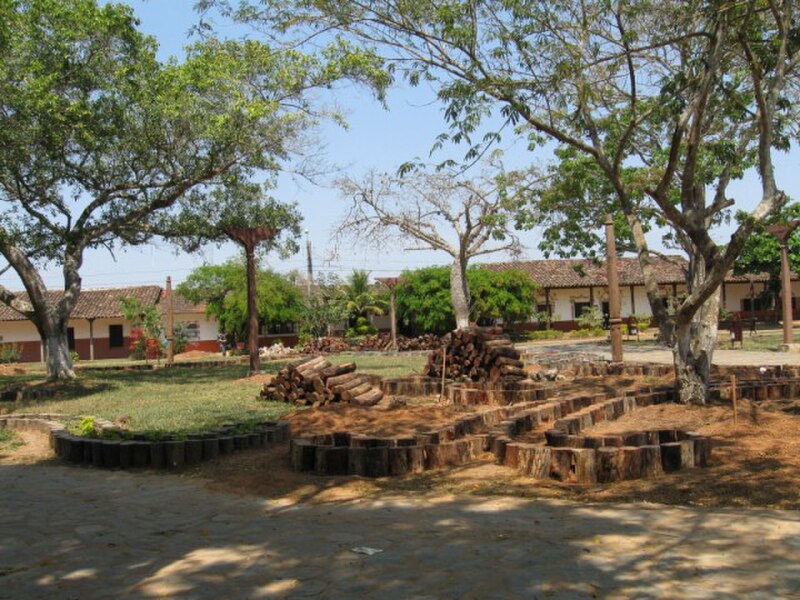
Please stand in the middle of the spacious green square and gaze directly toward the main church facade. This quiet and open central plaza was once the vibrant heart of a revolutionary communal experiment carved out of the remote Amazonian savanna. What startles many modern visitors is the revelation that this distant settlement, constructed in sixteen ninety-one amidst thick seasonal dry forests, successfully established a completely self-sufficient communal society that functioned in total…
03 The Wooden Bell Tower: Resonance Across the Savanna
Please tilt your head upward and look directly at the high wooden roof of the bell tower standing independently next to the main church. This soaring timber bell tower holds an astounding historical secret that continues to amaze structural engineers and historians. The heavy bronze bells hanging inside its upper chamber were not imported from European foundries or distant colonial capitals. …
04 The Covered Porch: Solomonic Wooden Columns
Please step directly in front of the covered entrance corridor and gaze up at the spiraling wooden column on the left supporting the wide roof. As you stand before these extraordinary Solomonic columns, you are looking at one of the finest woodworking achievements in the entire South American continent. What catches most visitors by absolute surprise is the revelation that these massive, complexly twisted columns were not assembled from multiple carved pieces glued or joined together. …
05 The Decorated Facade: Floral Motifs and Sunbursts
Please raise your eyes and observe the vivid yellow floral patterns and glowing sunburst motifs painted directly above the central portal and across the front facade. The brilliantly painted plaster wall facing you is a magnificent visual spectacle that catches the bright tropical sunlight. What astonishes art historians and conservation experts is that all the vibrant pigments used here, including the luminous whites, deep ochres, and radiant yellows, were derived entirely from natural mineral…
06 The Sacred Interior: Carved Wooden Retable and Nave
Please walk slowly along the central aisle and focus your attention on the golden carved wooden altar at the front of the nave. As you step into the cool interior, you are embraced by an extraordinary sense of sacred stillness and structural grandeur. What strikes visitors with immense surprise is that this entire interior, including the towering roof supports, wall panels, and intricate retable, was constructed entirely without stone, making it one of the largest all-timber sacred structures…
07 Closing
As we step back out into the bright sunlight of the main plaza, take a final look across the peaceful landscape of San Javier. What makes this extraordinary UNESCO World Heritage site so deeply moving is the realization that it is not a frozen relic of a bygone era or a silent museum piece. San Javier is a living cultural heritage site where the unique synthesis of European Baroque art and Amazonian indigenous wisdom continues to thrive within the daily rhythm of the community. …