 Photo Wikimedia Commons
Contents
History & cultureBY TELLBY8 sections · numbered as on the map01 Orientation
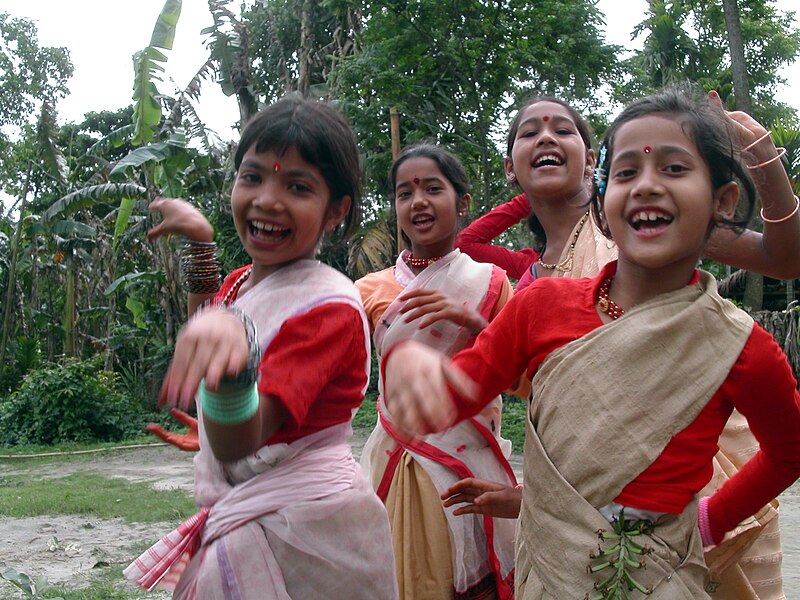
Welcome travelers to Majuli, an extraordinary river island resting quietly in the middle of the mighty Brahmaputra River in Northeast India. Your journey to this enchanted place begins at Nimati Ghat near Jorhat, where you board a wooden ferry and set sail across wide brown waters. As the boat engine rumbles softly and the cool river breeze sweeps past, watching the distant northern shore gradually emerge through the morning mist is an unforgettable arrival experience in itself. The moment you step off the ferry onto the sandy banks of Kamalabari Ghat, Majuli announces its presence not through monumental brick architecture, but through an aura of profound peace, continuity, and unbroken human resilience. Recognized by Guinness World Records as the world's largest inland river island, Majuli is bounded by the main channel of the Brahmaputra River to its south and east, the Subansiri River to its west, and anabranch channels like the Kherkatia Suti and Luit Suti to its north. According to geomorphological studies, the island was forged through a series of severe earthquakes between 1661 and 1696, followed by a cataclysmic flood in 1750 that diverted the Brahmaputra into the Burhi Dihing channel. Historically incorporated into the Ahom kingdom under King Suhungmung in 1525 as the Dihing province, Majuli became a sacred sanctuary when the legendary 15th-century saint and social reformer Srimanta Sankardev met his foremost disciple Madhavdev at Belguri in an event cherished as Manikanchan Sanjog. For over five hundred years, Majuli has served as the pulsing heart of Assamese Neo-Vaishnavite culture, propagating a spiritual philosophy that integrated religion with classical music, dance, theater, and communal brotherhood. Yet, Majuli is also a fragile landscape defined by impermanence. The restless Brahmaputra River continuously reshapes the land through severe seasonal flooding and bank erosion, causing significant landmass to wash away over the decades. Despite these environmental disruptions, the indigenous Mising, Deori, and Sonowal Kachari communities have refused to abandon their ancestral home. Instead, they adapted their architecture by building stilted bamboo houses, aligned their agriculture with seasonal floods to cultivate unique rice varieties like Komal Saul and Bao Dhan, and preserved vibrant traditions such as the Ali Ai Ligang festival, where villagers perform the energetic Gumrag Soman dance and share traditional delicacies like Purang Apin rice and Apong rice beer. As you stand here at Kamalabari Ghat, prepare yourself for a deeply authentic travel experience. Let us now walk gently into the living story of Majuli.
02 Relics and Arts of Auniati Satra
Our exploration of Majuli's cultural treasure trove begins at Auniati Satra, one of the most prominent and historically significant Neo-Vaishnavite monasteries on the island. Established in the sixteenth century by the revered saint Niranjan Pathakdeva, Auniati Satra stands as a towering pillar of spiritual devotion and cultural preservation. …
03 Center of Arts and Classical Learning
Welcome to Kamalabari Satra, celebrated for centuries as the intellectual, artistic, and literary heart of Majuli Island. Founded by the revered spiritual master Badala Padma Ata, this monastery played a pivotal role in refining Assamese classical arts and spreading them across the Indian subcontinent. At the core of Kamalabari's legacy is Sattriya culture, an elevated classical art form that encompasses sacred instrumental music, expressive dance, and devotional theatrical drama. …
04 Historical Cannons and Legacy of Garamur
Our journey across Majuli now brings us to Garamur Satra, a destination that offers a fascinating blend of spiritual sanctity, historical defense, and vibrant festive tradition. Established by the revered leader Lakshmikantadeva, Garamur Satra is divided into two main administrative and spiritual sections: Garamur Bor Satra and Garamur Saru Satra. Together, these twin institutions have played a vital role in sustaining the religious, social, and cultural fabric of the island for generations. …
05 Raas Mahotsav Festival and Royal Faith
We arrive now at Dakhinpat Satra, renowned throughout Assam for its profound sanctity, elegant architecture, and deep historical ties to the royal house of the historic Ahom kingdom. Founded by the legendary spiritual master Banamalidev, Dakhinpat Satra is widely regarded as one of the most reverent and spiritually charged sanctuaries on Majuli Island. From the moment you step into its manicured precincts, a feeling of deep serenity and sacred quietude washes over you. …
06 Mask Making and Touch of Traditional Pottery
Our fifth stop highlights the extraordinary artistic hands of Majuli, featuring two unique artisanal traditions that have gained international acclaim: the mask makers of Shamaguri Satra and the potters of Salmora village. We begin our visit at Shamaguri Satra, world famous for its ancient craft of traditional mask making. …
07 Molai Forest and Wetland Ecosystem
Step into the ecological wonders of Majuli as we visit Molai Forest and the surrounding wetland viewpoints. Molai Forest is the living testament to one man's unbelievable dedication to nature conservation. Decades ago, Jadav Payeng, locally known as the Forest Man of India, began planting saplings on a barren, severely eroded sandbar along the Brahmaputra River. …
08 Closing
As our journey across Majuli Island comes to an end, we stand together on the western viewpoint hill watching the golden sunset paint the vast Brahmaputra River in shades of crimson and orange. Watching the sun dip gently below the horizon is a deeply moving experience that captures the true essence of this enchanted place, where water, faith, and human endurance merge into one continuous story. …