Contents
History & cultureBY TELLBY7 sections · numbered as on the map01 Orientation
Welcome to the breathtaking Citadel of Salah Ed-Din, an architectural masterpiece perched dramatically atop a high rocky ridge surrounded by deep ravines and lush forests, located thirty kilometers east of Latakia near the town of al-Haffah. Rather than relying on mere conventional titles, this site stands as an outstanding testament to the grand interaction of military architecture, seamlessly layering features from its Byzantine origins in the tenth century, Frankish transformations under the Crusaders in the twelfth century, and subsequent additions by the Ayyubid and Mamluk dynasties. It represents the ultimate evolution of fortified architecture in the Near East, where diverse civilizations continuously adapted and improved upon existing stone defenses. Occupied since at least the mid-tenth century under a dependent of the Hamdanid emir Sayf al-Dawla, the site was captured in nine hundred seventy-five by Byzantine Emperor John I Tzimiskes. By the early twelfth century, the Franks incorporated it into the Principality of Antioch, where Crusader Lord Robert the Leper and his successors undertook an extensive building program. In July eleven eighty-eight, the legendary Ayyubid Sultan Saladin conquered this formidable fortress after a swift three-day siege, granting it as a property donation to Prince Nasir al-Din Mengüverish, who transformed it into a refined palatial residence. Later in the late thirteenth century, Mamluk Sultan Qalawun recovered the castle from the rebel emir Sunqur al-Ashqar, converting it into a thriving provincial administrative center. Our walking route today guides you through these centuries of stratified history. We begin at the magnificent eastern ditch, where medieval engineers carved a gargantuan channel straight into the living rock, leaving a solitary rock needle that once supported a wooden drawbridge. From there, we move to the south bastion to inspect the massive Crusader keep and the Ashar tower with its impenetrable stone walls. Next, we step into the high courtyard to explore the Ayyubid palace complex, complete with elegant reception halls and traditional hammams modeled after the Aleppo Citadel. Continuing onward, we visit the Mamluk mosque with its historical inscriptions and the impressive reception tower. We then descend into the spacious lower enclosure to examine the surrounding walls and the north-west section where Saladin forces achieved their decisive breakthrough. Finally, we conclude our tour at an elevated lookout point overlooking the majestic green valleys and surrounding mountains. As you navigate along this seven-hundred-meter-long triangular rocky spur, prepare to immerse yourself in a timeless journey through medieval engineering, siege warfare, and cultural synthesis.
02 The Great Eastern Ditch and Rock Needle
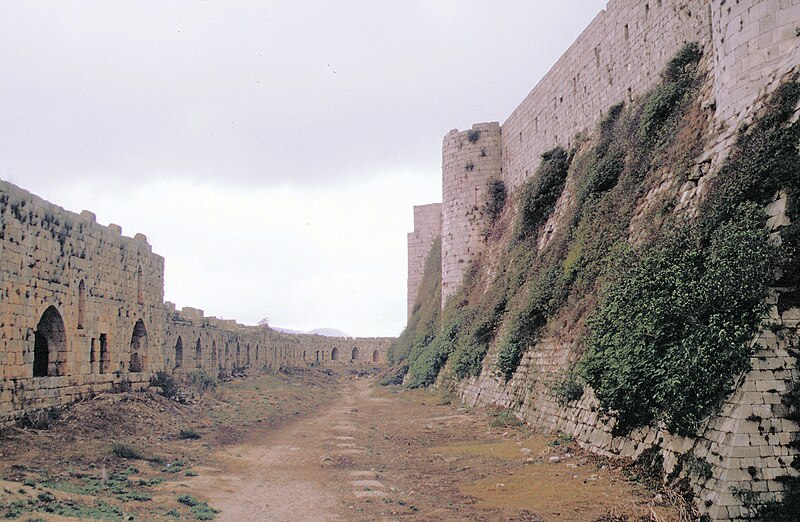
Prepare to stand in awe before one of the most astonishing military engineering feats of the medieval world. The breathtaking eastern ditch before you is not a natural ravine carved by rivers, but a colossal artificial channel hand-cut directly into the solid limestone bedrock using heavy steel chisels and iron hammers. To construct this monumental defensive barrier, medieval stonemasons excavated an extraordinary total of one hundred seventy thousand tons of living rock. …
03 The Crusader Donjon and Keep
As you step past the threshold of the eastern defenses, you are immediately confronted by an intimidating masterpiece of medieval military architecture. Dominating the entire southern bastion and directly overlooking the deep rock-cut ditch is the colossal Crusader donjon, or keep. The sheer physical presence of this monumental square tower is staggering, featuring solid stone walls that measure an extraordinary five meters in thickness. …
04 High Courtyard and Ayyubid Palace Complex
As you step into the refined precincts of the high courtyard, the atmosphere shifts dramatically from stark military defensive architecture to the delicate sophistication of Islamic palatial art. This very courtyard was the stage for one of the most remarkable military triumphs of the Middle Ages. In the summer of eleven eighty-eight, following his decisive victory at the Battle of Hattin and the recapture of Jerusalem, Sultan Saladin launched a rapid and brilliantly executed military campaign…
05 The Mamluk Mosque and Reception Tower
Standing right in the center of the high courtyard, you encounter a quiet yet historically profound structure: the Mamluk mosque. The presence of an active Islamic house of worship built directly inside a former Crusader stronghold serves as clear physical proof that this castle evolved into a major provincial administrative center under the Mamluk Sultanate. …
06 Lower Enclosure and North-West Wall
Descending from the elevated eastern citadel into the expansive western sector brings you to the lower enclosure and the north-western outer wall. This spacious lower area is the exact location where a dramatic tactical twist decided the outcome of the legendary siege of eleven eighty-eight. While the Frankish Crusaders had poured immense labor into excavating the monumental thirty-meter-deep eastern ditch, they had left the quarrying of the northern ditch incomplete due to time and labor…
07 Closing
As our journey comes to an end, please step up to this elevated lookout point and take a moment to gaze across the majestic landscape. Perched dramatically on a rocky spur seven hundred meters long, surrounded by the deep ravines and lush forests of the Jabal Ansariyya mountain range, the Citadel of Salah Ed-Din stands as a breathtaking monument to human determination and architectural ingenuity. The path we have walked today is far more than a collection of picturesque stone ruins. …