Contents
History & cultureBY TELLBY7 sections · numbered as on the map01 Orientation
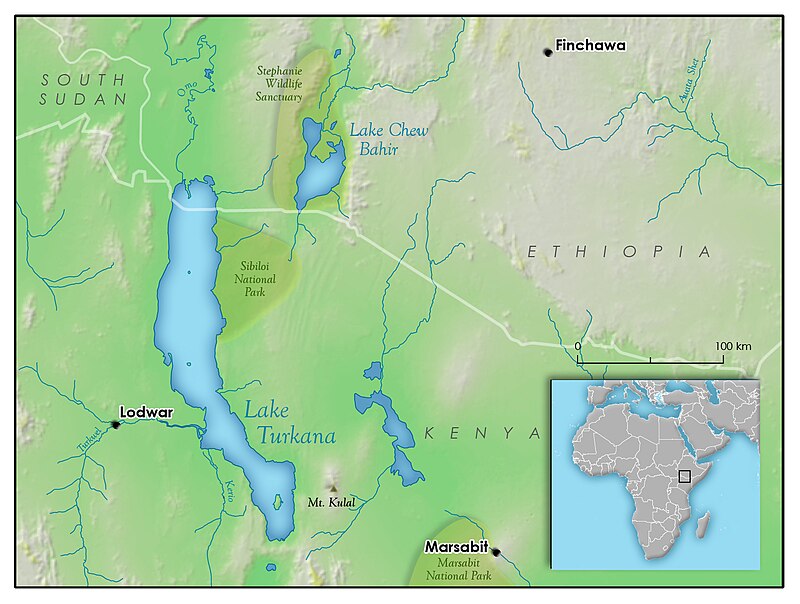
Welcome to the Lower Valley of the Omo, a majestic and historic landscape nestled in southwestern Ethiopia where the ancient story of humanity comes alive. Standing here at this breathtaking viewpoint, you are not merely looking at a scenic riverbank, but at one of the most paramount prehistoric sanctuaries on the entire planet. Spanning an expansive area of one hundred and sixty-five square kilometers near Lake Turkana, these age-old sedimentary deposits hold the priceless record of our earliest ancestors. Because of its fundamental importance to the global study of human evolution, paleo-environmental transformations, and prehistoric culture, UNESCO officially designated the Lower Valley of the Omo as a World Heritage site in 1980.
As you look out across the steep terraces and red-hued strata framing the water, reflect on the incredible scientific discoveries made right within this soil. More than fifty thousand animal and hominid fossils have been excavated from these sedimentary beds, including over two hundred and thirty crucial hominid specimens belonging to Australopithecus and Homo gracilis. Furthermore, archaeological investigations have unearthed ancient quartzite tools and the remains of prehistoric encampments representing the oldest known technical activities of human beings dating back two point four million years. This vast natural library, anchored by bio-stratigraphical, radiometric, and magneto-stratigraphical scales spanning between one and three point five million years, offers an extraordinary window into how early hominids adapted, fashioned implements, and gradually evolved into modern Homo sapiens over millions of years.
Listen closely to the deep and steady sound of the river flowing through the valley floor. Rising high in the Ethiopian Highlands and carving its way south toward Lake Turkana, this vast stream provided life-sustaining water to prehistoric beings in a challenging environment. Though millions of years have passed, the valley retains its primal splendor and undeniable scientific resonance, serving as the ultimate universal yardstick against which all ancient deposits in East Africa are measured.
Today, our audio guide will lead you along the banks of the Omo River to explore its remarkable geological formations, early technological breakthroughs, historical exploration expeditions, and the rich traditions of the indigenous tribes who still inhabit these fertile floodplains. Step forward with us now as we embark on an unforgettable journey into the very cradle of human existence.
02 The Confluence Lookout of Gibe and Gojeb Rivers
The hydrological position of the Omo River within Ethiopia's vast territory is truly extraordinary and unmatched. This river represents the largest Ethiopian river system outside the Nile Basin, possessing a vast independent hydrographic network contained entirely within the nation's international boundaries. …
03 Fossil Excavation Terrace of Early Hominids
The paleontological significance of the Lower Valley of the Omo is nothing short of extraordinary on a global scale. From this single valley system, scientific researchers have excavated and identified over fifty thousand animal and hominid fossils, including more than two hundred and thirty invaluable hominid fossil specimens dating across the Pliocene and Pleistocene epochs. …
04 Ancient Stone Tool Encampment Site
The very ground beneath your feet marks the historic spot where prehistoric beings transitioned from merely adapting to nature to actively transforming raw materials through human intellect. The Lower Valley of the Omo holds the distinguished scientific record of yielding the oldest known technical activities of prehistoric beings on Earth. …
05 Flood Retreat Cultivation Fields along the Riverbank
The annual seasonal flooding of the Omo River is a powerful natural phenomenon that has nourished countless indigenous cultures for thousands of years. As heavy seasonal rains sweep down from the Ethiopian Highlands, the river overflows its banks, depositing vast layers of nutrient-rich, fertile silt along its lower valley. …
06 Bottego Expedition Crossing Point
During an era when the ultimate destination of the Omo River remained a complete mystery to the Western world, courageous explorers risked their lives to track and map its treacherous meanders. Tucked away in the remote interior of the African continent, the course of the Omo was shrouded in geographical uncertainty for centuries. The arduous cartographic expeditions undertaken to chart this powerful stream transformed geographic knowledge and permanently etched the river onto world maps. …
07 Closing
As we bring our audio guide tour to a close, take a moment to gaze across the sweeping valley where the Omo River completes its grand journey, flowing gracefully south into Lake Turkana. Providing over ninety percent of the total water inflow that sustains this massive endorheic lake in the Gregory Rift, the Omo River has served as an indispensable lifeline for nature and humanity across millions of years. …