 Photo Wikimedia Commons
Contents
History & cultureBY TELLBY7 sections · numbered as on the map01 Orientation
Welcome to the Roman Walls of Lugo, the most complete and extraordinary military architectural heritage surviving from the ancient Roman world. Standing right here today, you are gazing upon the only Roman fortification on Earth whose entire two-kilometer perimeter remains completely intact and unbroken across all three continents once ruled by Rome. Recognizing this unmatched historic significance, UNESCO inscribed these magnificent walls as a World Heritage site on November thirtieth in the year two thousand.
The origin of this historic settlement dates back to around thirteen BC when Paulo Fabio Maximo founded Lucus Augusti under the authority of Emperor Augustus. Established to annex the northwestern Iberian Peninsula into the Roman Empire and control the rich local gold mines, the town initially developed as civilian settlements, known as canabae, outside the legionary garrison where merchants, craftsmen, and soldiers' families lived. However, during the second half of the third century AD, as threats from barbarian incursions grew across the empire, Roman military engineers constructed this massive stone fortification around the entire urban area.
Built in accordance with the architectural principles of Vitruvius, the defensive circuit stretches over two thousand two hundred and twenty-six meters in perimeter and reaches heights up to twelve meters. The defense was enhanced by a massive outer ditch, or foso, measuring twenty meters wide and four meters deep located five meters in front of the towers, while inside the walls ran the intervallum, a dedicated military roadway facilitating the rapid deployment of troops and supplies. Furthermore, double imperial stairways were hidden inside the tower walls, accessible only by movable wooden ladders that could be raised in times of danger to isolate the upper walkway.
The outer structure was assembled using locally quarried granite and slate stones, while the interior core was packed with a dense mortar composed of earth, stones, and river pebbles. Today, the wall no longer divides the city, but serves as a living monument that connects ancient history with modern life. The wide elevated walkway along the top of the ramparts, known as the adarve, offers visitors a unique opportunity to walk the exact path trodden by ancient Roman guards. As you begin your audio tour, you will explore five key spots along the circuit, starting with the original ancient gateway of Porta Mina, moving to the sacred entrance of Puerta de San Pedro, continuing to the iconic two-story window tower of A Mosqueira, passing the artillery bulwark of Reducto de Maria Cristina, and discovering the secret military postern of Puerta Falsa. Prepare to step back in time as you walk upon one of the greatest engineering marvels of antiquity.
02 Porta Miñá: The Intact Gateway of Ancient Travellers
Porta Mina, standing majestically before you, is the oldest and most remarkably intact original Roman gateway in the entire Iberian Peninsula, having maintained its authentic structural integrity without collapsing or undergoing major structural rebuilding for over seventeen hundred years since Roman stonemasons first laid its foundation blocks in the third century.
Take a moment to look closely at the magnificent visual elements directly in front of you. …
03 Puerta de San Pedro: Entrance of the Sacred Way
Astonishingly, it was at this exact stone threshold that two of the most critical arterial highways of the entire Roman Empire, the nineteenth and twentieth causeways, intersected to form the strategic grand entrance into the heart of ancient Lucus Augusti.
Look up directly at the grand exterior facade standing right before your eyes. …
04 A Mosqueira: The Last Standing Upper Window Tower
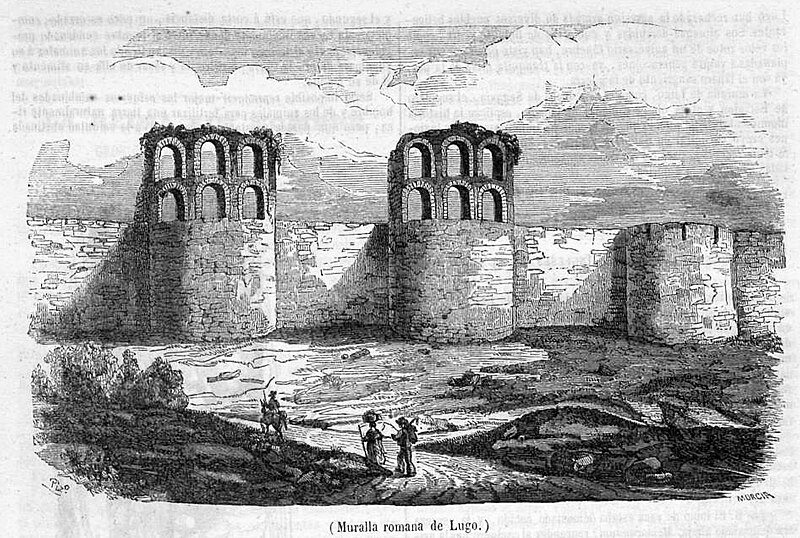
A Mosqueira is the single most iconic tower along the entire fortification, standing as the sole miracle among the original eighty-five towers that still preserves its vaulted upper second-story windows in their original Roman form.
Direct your gaze upward toward the top of the rampart to admire the two magnificent arch-shaped windows towering gracefully above the main wall. …
05 Reducto de María Cristina: The Layered Bulwark of History
The Reducto de Maria Cristina represents a fascinating historical layering where a nineteenth-century triangular artillery bastion was built directly on top of the ancient third-century Roman wall foundations, combining two totally different military eras into a single structural monument.
Take a look around the immediate area near your feet and along the outer parapet wall. …
06 Puerta Falsa: The Secret Postern of Military Strategy
Puerta Falsa, standing before you today, is a classical Roman posterula, a concealed military postern gate intentionally designed with narrow dimensions and low height to remain hidden from enemy sight and facilitate secret sorties during times of siege.
Observe the physical structure of this modest gateway and its surrounding walls. …
07 Closing
Thank you very much for joining us on this audio guide tour of the Roman Walls of Lugo. Today, you have journeyed across seventeen centuries of unbroken history, experiencing one of the most remarkable military architectural achievements of the ancient Roman Empire.
From the extraordinarily preserved ancient entrance of Porta Mina to the sacred entrance of Puerta de San Pedro along the Primitive Pilgrim Way, the magnificent two-story window tower of A Mosqueira, the multi-layered fortification…