 Photo Wikimedia Commons
Contents
History & cultureBY TELLBY8 sections · numbered as on the map01 Orientation
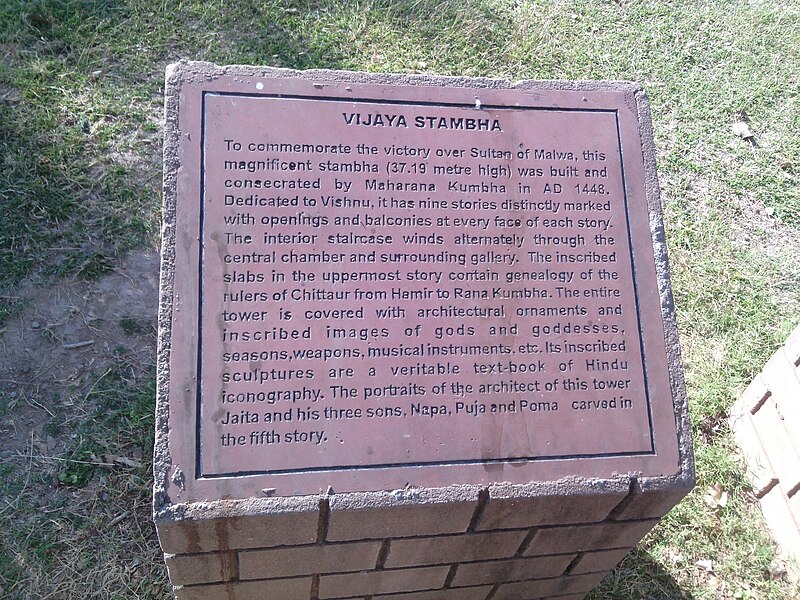
Welcome to Chittorgarh Fort, the grandest and most expansive fortress in all of India. As you enter this immense citadel, which spans approximately seven hundred acres across a sweeping high plateau, you immediately realize that this is not a site designed to be traversed entirely on foot. Visitors drive through its broad expanses, passing through imposing stone gates and historic winding pathways. Designated as a UNESCO World Heritage site in two thousand thirteen, Chittorgarh served as the historic capital of the Mewar kingdom until fifteen sixty eight. Unlike other famous fortresses of Rajasthan, such as Amber Fort in Jaipur or Mehrangarh Fort in Jodhpur, which stand as enduring displays of political power that successfully sustained itself over centuries, Chittorgarh represents a dramatic display of power that faced profound, recurring tragedy. The fort was besieged and taken three separate times in its harrowing history, first in thirteen hundred and three, second in fifteen thirty five, and finally in fifteen sixty eight. On each of these three catastrophic occasions, the prolonged siege ended in the terrible Rajput custom known as jauhar, a tradition of mass immolation where royal women and defenders chose death in flames over surrender to invading forces. After its final fall in fifteen sixty eight, the fort was permanently abandoned rather than rebuilt, leaving its vast grounds as a silent memorial to tragic sacrifice and heroic defiance. Yet, amidst these sprawling, weathered ruins that mostly commemorate historic defeats, there stands a breathtaking monument of unyielding triumph. Before you rises the magnificent Vijaya Stambha, or the Tower of Victory. Constructed in fourteen forty eight by Maharana Kumbha of Mewar, this nine storey red sandstone tower was raised to mark a glorious military victory over the combined forces of Malwa. As the soft, warm light of late afternoon illuminates the plateau, casting golden hues across the red sandstone and white marble, the tower offers an extraordinary visual contrast against the ancient ruins surrounding it. My name is Fenrir, senior heritage scholar and scriptwriter for UNESCO World Heritage audio guides. Through this audio journey, I will guide you step by step around this iconic monument, exploring its deep historical context, its structural brilliance, and its extraordinary legacy of religious pluralism. As you step out of your vehicle and walk toward the entrance plaza before the tower, allow yourself to take in the serene atmosphere, the distant ring of temple bells, and the breeze sweeping across the ancient plateau. Together, we will uncover how Maharana Kumbha transformed a victory column into a immortal masterpiece of stone carving, architectural syncretism, and spiritual resilience. Please prepare your mind for a profound reflection on history, culture, and high architecture as we begin our guided walk.
02 Starting Point: Rana Kumbha Palace Yard and the Beginning of the Route
We begin our guided tour at the historical courtyard of Rana Kumbha Palace, which serves as the traditional starting point for royal pilgrimages and guided explorations inside Chittorgarh Fort. Standing in this historic open yard, you can gaze outward across the open terrain toward the soaring silhouette of Vijaya Stambha rising dramatically against the clear Rajasthan sky. …
03 Second Point: Gaumukh Kund and the Sacred Water Garden
As we step away from the palace courtyard and approach the base of the tower, we reach its north eastern perimeter, where you will find the celebrated Gaumukh Reservoir, also known as Gaumukh Kund, situated within the sacred pilgrimage zone called Gaumukh Tirthshala. Chittorgarh Fort encloses numerous ancient temples and sacred pilgrimage shrines across its vast plateau, but Gaumukh Kund is universally recognized as the single most sanctified spot within the entire fort complex. …
04 Third Point: Base and Lower Storeys (1st to 3rd) - Damru Shape and Arabic Inscriptions
Now, stand directly before the massive base terrace of Vijaya Stambha and tilt your head upward to study its foundational architecture. The entire monument is built upon an ample square stone terrace measuring forty-two feet on each side. The broad base of the tower column itself measures thirty-five feet in width on each face. As your eyes trace the upward line of its nine storeys, you will notice a fascinating geometric contour in its overall architectural silhouette. …
05 Fourth Point: Middle Storeys (4th to 6th) - Chief Architect Sutradhar Jaita and Open-Air Sculpture Gallery
As we examine the middle section of the tower, spanning the fourth, fifth, and sixth storeys, observe the remarkable architectural logic of its structural design. Visitors frequently compare Vijaya Stambha to Delhi Qutub Minar, yet their architectural forms represent completely different traditions. While the Qutub Minar is designed as a smooth, tapering cylindrical shaft featuring circular and angular flanges, Vijaya Stambha is constructed as a extraordinary series of vertically stacked,…
06 Fifth Point: Upper Storeys (7th to 9th) - Kirti Stambha Prashasti and Goddess Padmavati
Looking up toward the seventh, eighth, and ninth storeys, imagine the extraordinary interior journey leading to the summit of the tower. Built inside the central core of Vijaya Stambha is a narrow, spiraling stone staircase consisting of exactly one hundred and fifty-seven steps that wind upward to the top floor. …
07 Sixth Point: Surrounding Sacred Temples and Modern Cultural Emblem
Standing in the open central plaza near Vijaya Stambha, take in the surrounding sacred landscape. The victory tower does not stand in architectural isolation; it forms a breathtaking ensemble with adjacent sacred monuments inside the fort, including the famous Meera Temple, dedicated to the legendary mystic poetess Meera Bai, and the ancient Kalika Mata Temple. …
08 Closing
We have reached the conclusion of our guided walking tour of Vijaya Stambha. Stand here at the panoramic viewing site as the late afternoon sun casts a warm golden glow across the red sandstone and white marble surfaces of the victory tower. Before you lies a sweeping landscape where history speaks through every weathered stone and sculpted panel. …