 Photo Wikimedia Commons
Contents
History & cultureBY TELLBY8 sections · numbered as on the map01 Orientation
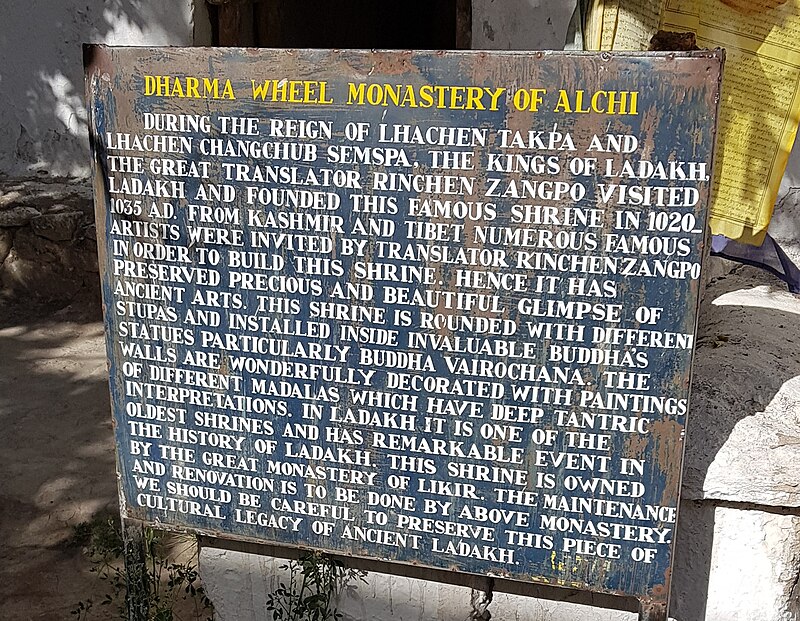
Welcome to Alchi Monastery, a revered sanctuary where the sacred spirit of the Himalayas and a thousand years of cultural heritage endure in quiet majesty. I am your audio guide, a cultural heritage specialist honored to lead you through the mysterious world of Indo-Tibetan Buddhist art preserved in this high mountain realm of India. We are currently situated at the Alchi monastic complex, located in lower Ladakh on the southern bank of the Indus River, approximately sixty kilometers west of the regional capital of Leh. Resting at an altitude of three thousand one hundred meters in a high-altitude desert rain-shadow zone, this sacred complex presents a striking silhouette of humble whitewashed mud-brick structures and elegant domed stupas. While the surrounding terrain consists of rugged rocks, arid sands, and soaring mountain peaks, the immediate vicinity of the sanctuary flourishes like a tranquil oasis filled with green barley fields and apricot groves. Alchi village itself comprises four distinct hamlets, with the monastic complex occupying an independent enclave on a rocky plateau overlooking the river. According to local tradition, this monastic complex was established between the tenth and eleventh centuries by the celebrated translator Rinchen Zangpo under the patronage of King Yeshe-Ö of the Guge Kingdom. Tradition recounts that the king dispatched twenty-one young scholars to Kashmir to study Buddhist philosophy, and Rinchen Zangpo was one of only two who survived the formidable topography and harsh climate to return and erect one hundred and eight monasteries across the Trans-Himalayas. However, rigorous art-historical analysis and recent translations of key inscriptions, including the Garland of Butter Lamps, reveal a more nuanced history. The monastery was actually founded through successive stages during the twelfth century under the patronage of the noble 'Bro clan, who ruled lower Ladakh independently from the Purang-Guge Kingdom of upper Ladakh. The oldest hall, the Dukhang, was founded around 1140 CE by an unnamed patrilineal uncle of the patron Tsültrim Ö and completed by the monk Kaldan-sherab. Subsequently, the monumental three-storeyed temple known as the Sumtseg and the Great Chörten were established between 1200 and 1220 CE by Tsültrim Ö himself. Positioned in a secluded bend across the Indus River away from major military routes, Alchi escaped the destruction that befell other Himalayan monuments. The dry high-altitude climate served as a natural preserver for these unbaked clay walls and delicate mineral pigments. Together with nearby Mangyu and Sumda Chun, Alchi forms the lower Ladakh group of monuments, representing an unparalleled synthesis of Tibetan mud-brick architecture, Kashmiri carving, and Persian courtly motifs. Today, the complex remains an active holy shrine under the religious authority of Likir Monastery while being preserved in partnership with the Archaeological Survey of India. Let us now walk slowly toward the first sacred gateway of this timeless sanctuary.
02 Gateway Stupa - Ceiling Paintings and Four Teachers of Kakani Chörten
We are now standing before the pass-through gateway stupas at the main entrance of the Alchi monastic complex. Known locally as Kakani Chörten, these extraordinary structures represent an architectural and artistic form unique to Alchi. Unlike conventional Himalayan stupas, which are designed solely to be circumambulated and viewed from the exterior, these gateway chörtens serve as sacred portals through which pilgrims walk, looking upward at the breathtaking ceiling murals and wall paintings…
03 Dukhang - The Assembly Hall and the Royal Banquet
Passing through the gateway stupa into the central courtyard, we arrive before the Dukhang, or Assembly Hall, the oldest temple within the Alchi monastic complex. Established around 1140 CE by an unnamed patrilineal uncle of the patron Tsültrim Ö and completed by the monk Kaldan-sherab, the Dukhang has served for nearly nine centuries as the spiritual heart of the monastery where monks gather to perform sacred chants, rituals, and tantric meditations. …
04 Sumtseg Ground Level - Monumental Bodhisattvas and Sacred Dhoti Murals
We have now entered the ground level of the Sumtseg, the world-renowned three-storeyed temple that represents the absolute artistic apex of the Alchi complex. Built between 1200 and 1220 CE by the monk Tsültrim Ö, the exterior of the Sumtseg appears remarkably modest, constructed with unbaked mud bricks, natural stone, and simple whitewashed plaster in strict accordance with Tibetan architectural traditions. …
05 Sumtseg Upper Levels - Drigungpa Lineage and 48-Panel Textile Ceiling
Lifting our gaze beyond the ground floor niches of the Sumtseg, we observe the elegant structure of the second-floor balcony and the lantern roof above. Historically, novice monks who mastered foundational Buddhist doctrines before the colossal Bodhisattvas on the ground level would advance to this upper story to engage in deeper tantric visualization and meditation. …
06 Manjushri Temple - Four-Sided Manjushri and Doctrine of Wisdom
After exploring the Sumtseg, moving a short distance brings us to the Manjushri Temple, locally known as Jampe Lhakhang. Comparative iconographic studies with the Sumtseg and Sumda Assembly Hall suggest that this shrine was constructed around 1225 CE. Although modest in its exterior dimensions, stepping inside reveals an extraordinary central sanctuary dominated by a unique four-sided sculptural monument dedicated to Manjushri, the Bodhisattva of Transcendent Wisdom. …
07 Indus River Outlook - Natural Setting and Preservation Challenges
Having completed our tour of the temple interiors, we step out to the rear of the Alchi complex and gather upon an elevated outlook overlooking the Indus River. Below the cliff, the cold, jade-green waters of the Indus flow powerfully through the gorge, framed by the majestic snow-capped peaks of the Ladakh and Zanskar mountain ranges. …
08 Closing
Dear pilgrims and honored visitors, our journey through the Alchi monastic complex now comes to its peaceful conclusion. Standing in the quiet courtyard of this ancient sanctuary, where the artistic traditions of Kashmir, Tibet, India, and Persia harmoniously converged, we look back upon the unpretentious mud-brick structures that hold one of the greatest artistic miracles of the Himalayan world. …