 Photo Wikimedia Commons
Contents
History & cultureBY TELLBY7 sections · numbered as on the map01 Orientation
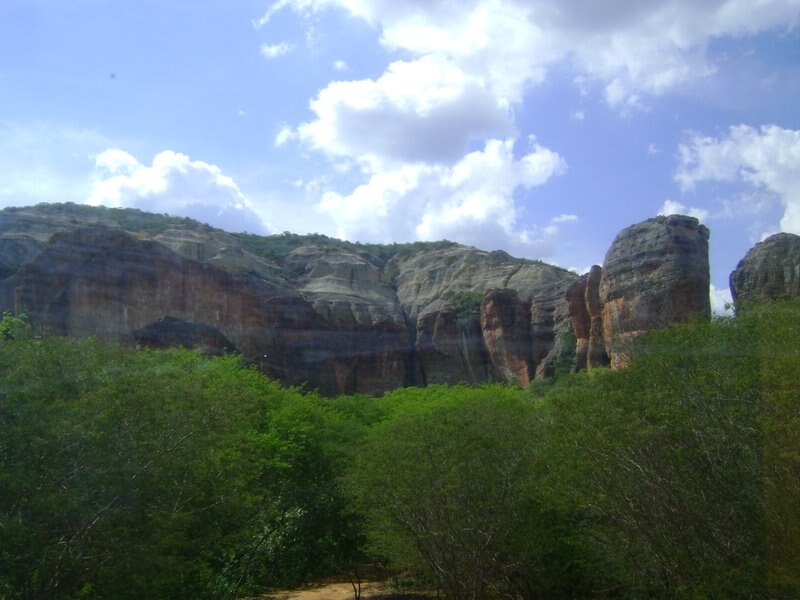
Welcome to Serra da Capivara National Park, a land of profound antiquity located in the state of Piauí in northeastern Brazil. This extraordinary landscape holds one of the world's largest and most significant concentrations of prehistoric cave paintings and human settlement evidence, earning its designation as a cherished UNESCO World Heritage site. As you stand near the main entrance pathways, you are surrounded by dramatic Silurian sandstone massifs that rise majestically above the semi-arid caatinga scrubland. Geologically, these towering cliffs began their formation over four hundred thirty million years ago when this entire region lay submerged beneath a warm tropical sea. Over incomprehensible spans of time, water, wind, and rain carved through the compressed sediment layers, creating deep canyons, overhanging rockshelters, and complex cavern networks. Geomorphologically, the park sits along a dramatic Cuesta escarpment featuring a steep drop of two hundred to two hundred fifty meters that separates the high chapada plateau from the lower Precambrian pediment plain known locally as the Sertão. This varied landscape supports both deciduous shrub vegetation and dense semi-deciduous tree-caatinga in the shaded canyons where moisture persists throughout the year. Today, the national park encompasses more than thirteen hundred registered archaeological sites, including over six hundred individual rock art shelters that safeguard tens of thousands of painted figures. The systematic exploration of this wilderness began in the nineteen seventies under the pioneering leadership of archaeologist Niède Guidon and the Foundation for the Museum of the American Man. Her excavations brought to light evidence of ancient human presence that challenged long-established scientific paradigms regarding the timeline and routes of human settlement across the South American continent. The journey you are about to undertake will guide you along elevated wooden walkways nestled directly against the bases of these towering red sandstone cliffs. As you walk through this shaded corridor where green foliage contrasts with weathered rock walls, you will encounter ancient panels filled with red ochre figures, abstract geometric signs, and dynamic scenes of human life created by early artists. These ancestral creators ground local iron ore minerals, mixed them with binders, and used fine brushes made of animal hair or plant fibers to leave an enduring record of their symbolic universe. Take a moment to adjust your pace, breathe in the dry air of the caatinga forest, and prepare to immerse yourself in a story that spans tens of thousands of years. From this orientation area, our pathway leads directly toward the awe-inspiring cliff base of Boqueirão da Pedra Furada, where our exploration of South America's deepest human history truly begins.
02 The Majestic Red Sandstone Cliff
As you step onto the approach path leading toward the immense cliff overhang of Boqueirão da Pedra Furada, you are confronted by an astounding geological story and an iconic chapter in world archaeology. These colossal red sandstone cliffs were formed more than four hundred thirty million years ago during the Silurian period, when this entire region lay deep beneath a warm tropical sea. …
03 The Mystery of the White Circle
Standing directly in front of the main rock art panel of Boqueirão da Pedra Furada, you are observing a masterpiece where ancient artistic expression intersects with cutting-edge analytical science. A remarkable scientific revelation unfolded here when researchers applied advanced uranium-series disequilibrium dating to micro-carbonate crusts, proving that specific white abstract motifs on this wall were created over ten thousand years ago during the early Holocene epoch. …
04 Abstract Geometrics and Red Ochre Strokes
Arriving at the upper sector of Toca do Paraguaio, situated within a narrow and secluded valley on the Bom Jesus do Gurguéia plateau, you enter a sanctuary of prehistoric art. Amazingly, researchers have documented over nine hundred individual abstract figures, geometric patterns, and anthropomorphic motifs painted across this shelter using delicate brushes crafted from animal hair or plant fibers. …
05 Traces of Early Human Burial
Stepping into the lower sector burial site of Toca do Paraguaio, you are standing above a sacred space where the life and death of South America's earliest inhabitants were marked with profound reverence. Remarkably, buried beneath this exact sandstone floor lay the near-complete skeleton of an ancient woman who was laid to rest over ten thousand years ago, accompanied by intentional mortuary offerings of raw red and orange hematite iron ore. …
06 The Ancient Quartz Tool Workshop
Arriving at our final site stop, the grand rockshelter workshop of Sítio do Meio, you are entering an ancient manufacturing center that showcases the remarkable technical skill of prehistoric stone tool artisans. Remarkably, over twenty thousand years ago, during the depths of the Last Glacial period, early humans deliberately selected smooth, high-quality quartz cobbles weathered from Silurian marine conglomerates atop the Cuesta escarpment and transported them from local drainage channels to…
07 Closing
Our walking journey through the ancient landscapes of Serra da Capivara National Park now comes to a close. Standing beneath these colossal red sandstone cliffs, surrounded by tens of thousands of years of human artistic and cultural evolution, offers a humbling perspective on our shared human story. From the four-hundred-thirty-million-year-old Silurian ocean sediments that formed these majestic amphitheaters along the Cuesta escarpment to the delicate hematite strokes painted during the…