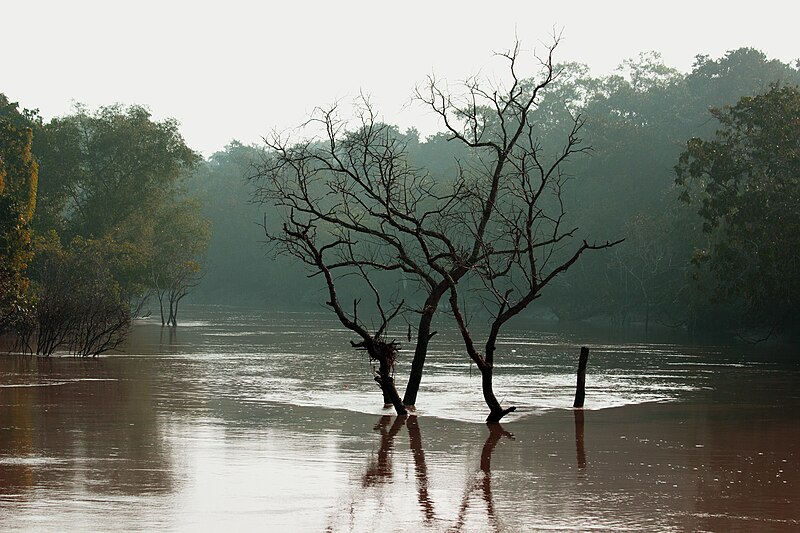
 Photo Wikimedia Commons
Contents
History & cultureBY TELLBY8 sections · numbered as on the map01 Orientation
Welcome to Bhitarkanika National Park, a magnificent mangrove paradise nestled in the Kendrapara district of Odisha in eastern India. This incredible sanctuary lies within a vast deltaic system created by the convergence of the Brahmani, Baitarani, Dhamra, and Pathsala rivers before they empty into the Bay of Bengal. Together, these waterways nourish the second largest mangrove ecosystem in India, creating an intricate labyrinth of tidal creeks and lush forest channels that have earned this region the proud nickname of Indias mini Amazon. The history of this natural sanctuary is defined by decades of dedicated conservation. On April 22, 1975, an expansive region covering 672 square kilometers was officially declared the Bhitarkanika Wildlife Sanctuary to protect its vulnerable saltwater crocodile population and fragile estuarine habitats. Recognizing its extraordinary biological diversity and ecological significance, the government elevated 145 square kilometers of the core area to Bhitarkanika National Park on September 16, 1998. Further reinforcing its global importance, the wetland was designated as a Ramsar Site on August 19, 2002, becoming the second Ramsar site in the state of Odisha following Chilika Lake. Bhitarkanika serves as a vital refuge for an impressive array of wildlife species. Official biological censuses record exactly 1,671 saltwater crocodiles inhabiting the winding waterways, making it home to the largest population of these estuarine reptiles in the nation. Uniquely, around 10 percent of the adult crocodiles here exceed 6 meters in length, representing some of the largest recorded living specimens on the planet. The park is also a premier sanctuary for avifauna, hosting over 80,000 resident birds during the monsoon nesting season and welcoming more than 120,000 migratory waterfowl from distant northern lands such as Siberia and Central Asia during the winter months. The rich mangrove soil retains exceptional amounts of nitrogen, phosphorus, and potassium, fueling high biological productivity and acting as a natural buffer that protects more than 300 surrounding villages from severe coastal storms. The ideal time to explore this sanctuary is between October and March, when the weather is gentle and wildlife viewing is at its absolute peak. Visitors should note that the park is completely closed every year from May 1 to July 31 to protect the saltwater crocodiles during their critical breeding and nesting season. As you embark on this boat safari through the tranquil waters, prepare to encounter a thriving wilderness shaped by tides and time.
02 Khola Entry Jetty
Welcome to the Khola Entry Jetty, the official gateway and starting point for your journey into the heart of Bhitarkanika National Park. As you step onto the wooden embarkation platform, the rhythmic sound of gently lapping water and the distant echoes of forest wildlife create an unmistakable atmosphere of natural adventure. Khola Jetty serves as the primary access point to the intricate network of tidal waterways that define this internationally recognized Ramsar wetland. …
03 Mangrove Waterways and Creek Safari
As our boat navigates deeper through the winding creeks, we are surrounded by one of the most dynamic plant communities on Earth. The mangrove forests of Bhitarkanika represent a triumph of evolutionary adaptation, flourishing in an intertidal environment defined by daily fluctuations of saltwater and mud. Looking closely at the forest edges, you will notice the remarkable stilt root systems of the trees. …
04 Dangamal Crocodile Breeding Centre and Museum
Stepping ashore at Dangamal, we arrive at the administrative heart and chief research hub of the park, the Dangamal Crocodile Breeding Centre and Museum. Established as a sanctuary for the endangered saltwater crocodile, known scientifically as Crocodylus porosus, this facility has played a monumental role in saving the species from local extinction. …
05 Ancient King's Hunting Tower and Nature Trail
Leaving the waterways behind, our excursion transitions to the forest interior along a tranquil terrestrial walking route known as the Nature Trail. Deep within the shady canopy stands a fascinating historical landmark, the ancient King Hunting Tower. Built generations ago by local royalty who once ruled these estuarine lands, the stone tower was used as a strategic lookout for game hunting in the wilderness. …
06 Bagagahana Heronry and Bird Sanctuary
We now arrive at Bagagahana, one of the most magnificent heronries and bird sanctuaries along the entire eastern coast of India. Situated within the heart of the mangrove forest, Bagagahana is an extraordinary avian haven where thousands of birds gather annually to nest, feed, and raise their young. Bhitarkanika as a whole supports an astonishing array of over 320 bird species, and Bagagahana stands out as the primary epicenter for seasonal breeding and migratory staging, offering an…
07 Ekakula Beach and Gahirmatha Marine Sanctuary
Reaching the outer perimeter of our journey, we arrive at Ekakula Beach, where the tranquil mangrove channels open up to meet the vast horizon of the Bay of Bengal. Leaving the enclosed forest corridors, visitors are greeted by refreshing sea breezes, pristine sandy shores, and the rhythmic sound of crashing ocean waves. …
08 Closing
This brings us to the conclusion of our audio guide journey through the remarkable natural wonders of Bhitarkanika National Park. Today, we have traversed the intricate waterways of Indias mini Amazon, encountering majestic saltwater crocodiles, vibrant bird colonies, and ancient forest trails that showcase the extraordinary biological wealth of this protected delta. …