 Photo Wikimedia Commons
Contents
History & cultureBY TELLBY8 sections · numbered as on the map01 Orientation
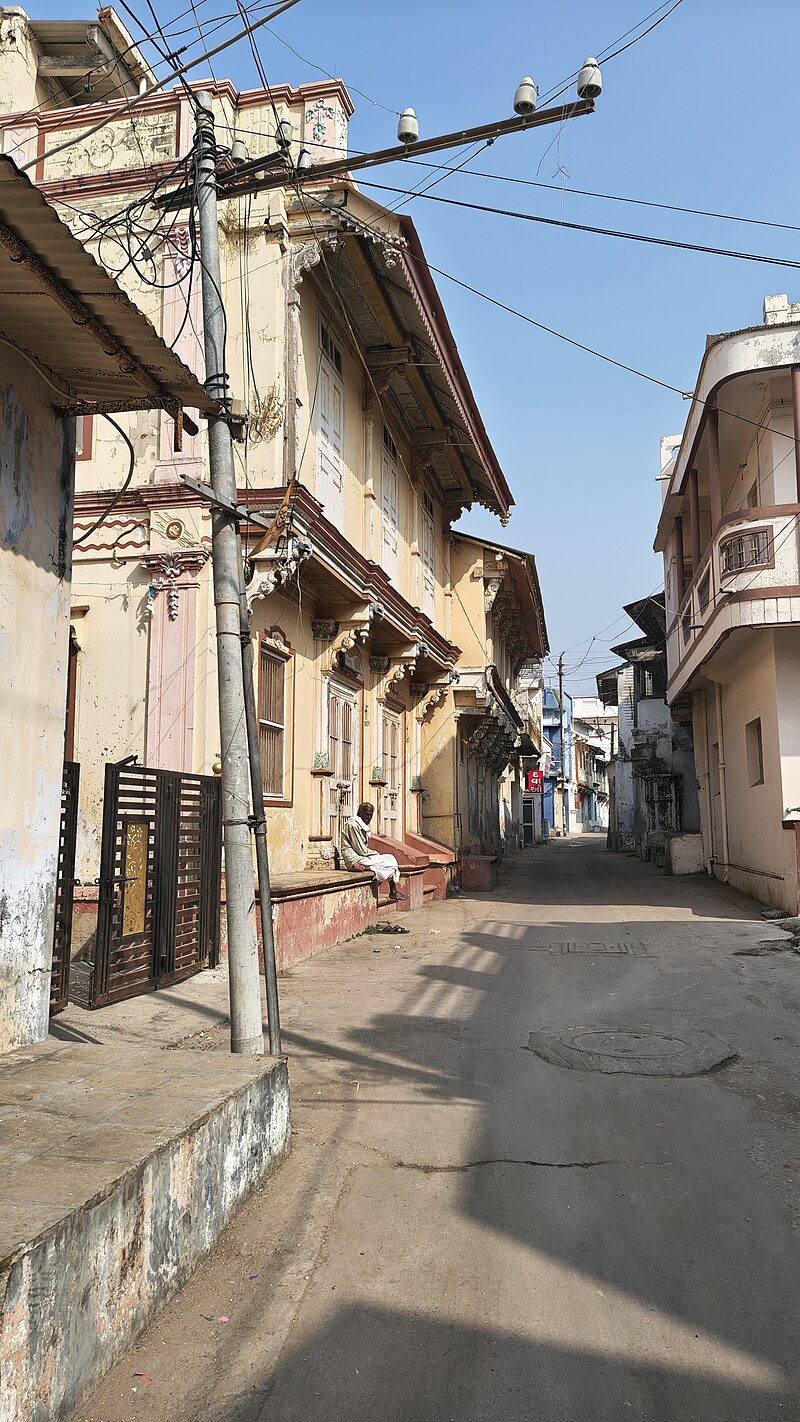
Welcome to Vadnagar, an extraordinary ancient town located in the Mehsana district of Gujarat, where thousands of years of human civilization continue to thrive without interruption. Situated roughly 35 kilometers from Mehsana city and about 90 kilometers northeast of the bustling metropolis of Ahmedabad, Vadnagar stands as one of the oldest continuously inhabited settlements in the entire Indian subcontinent. Recent archaeological excavations carried out across six deep trenches reveal that human occupation on this fertile ground began around 800 BCE, nearly 2,754 years before the present day. Remarkably, while countless ancient cities across the globe rose, crumbled, and were abandoned to time, life in Vadnagar has persisted seamlessly through the centuries right into our modern era.
Throughout its multi-millennial journey, Vadnagar was celebrated under various historic names recorded in epic literature and sacred chronicles. In the great Indian epic Mahabharata, it was designated as Anartapura, the prominent capital of the ancient Anarta Kingdom. Within the sacred pages of the Skanda Purana, specifically in the Tirtha Mahatmya section of the Nagara Khanda, the town was reverently called Chamatkarapura, which translates to the City of Miracles. According to local lore, an afflicted king was miraculously cured of his severe ailments upon stepping into this holy domain. Later, in the year 640 CE, the famous Chinese Buddhist monk and traveler Xuanzang visited this bustling urban center, documenting it in his travelogues as Anandapura, a prosperous city filled with learning and spiritual sanctuaries. In the 19th century, Sir Alexander Cunningham, the illustrious founder and first Director General of the Archaeological Survey of India, systematically identified Xuanzang's Anandapura as the modern town of Vadnagar.
Archaeologists have systematically uncovered seven distinct cultural periods stacked layer upon layer beneath Vadnagar. These chapters encompass the Pre-Mauryan era from 800 to 320 BCE, followed by the Mauryan Empire, the Indo-Greek period, the Indo-Scythian or Shaka-Kshatrapas period, the golden age of the Hindu Solanki dynasty, the Islamic Sultanate and Mughal periods alongside the Gaekwad and British colonial rule, culminating in the vibrant recent period. Each historic stratum yields incredible physical proof of long-distance trade, architectural innovation, and spiritual coexistence. Owing to its outstanding universal value and cultural richness, Vadnagar was officially added to the UNESCO World Heritage tentative list in December 2022.
In modern national history, Vadnagar holds special prominence as the birthplace and childhood home of Narendra Modi, the 14th Prime Minister of India. It is a place where humble origins intersect with deep spiritual, artistic, and commercial traditions. Here, Hindu, Buddhist, and Jain heritage thrived harmoniously for over two millennia. As you begin walking through its ancient streets today, prepare to step directly into a living museum of South Asian civilization. Let us now move toward our first official stop on this historic tour.
02 Spot 1: Vadnagar Archaeological Experiential Museum - Panorama of 2500 Years
As you step through the main entrance of the Vadnagar Archaeological Experiential Museum, you are walking into a landmark facility that redefines historical preservation in India. Constructed at an estimated cost of 298 crore rupees, equivalent to approximately 31 million US dollars, this state-of-the-art institution represents a monumental commitment to protecting South Asian heritage. …
03 Spot 2: Ancient Buddhist Monastery Ruins - Swastika Layout and 2nd Century Relics
Leaving the museum and walking into the fortified historic core of Vadnagar, please make your way toward the outer viewing perimeter of the Ancient Buddhist Monastery Ruins. As you stand along the elevated walkway looking down into the excavated site, you can clearly trace the stone foundations, central courtyard, and surrounding monastic rooms. …
04 Spot 3: Hatkeshwar Mahadev Temple - Patron Deity of Nagar Brahmins and Intricate Carvings
As you arrive at the main eastern entrance of the Hatkeshwar Mahadev Temple, pause to take in the impressive silhouette of its soaring spire and surrounding perimeter wall. Facing eastward, this revered 17th-century sanctuary serves as the principal seat of Lord Shiva in his form as Hatkeshwar, the cherished patron family deity of the native Nagar Brahmin community. …
05 Spot 4: Kirti Toran - 12th Century Solanki Victory Arches in Red Sandstone
Leaving the Hatkeshwar Temple and walking toward the northern edge of the historic walled town near Sharmistha Lake, you arrive at the iconic Kirti Torans, the most celebrated visual symbol of Vadnagar. As you stand directly beneath these two giant sandstone monuments and look up, you are met with two soaring victory arches reaching nearly 40 feet, or 12 meters, in height. …
06 Spot 5: Sharmistha Lake - Ancient Reservoir and Water Park
After examining the Kirti Torans, step onto the tranquil lakeside promenade of Sharmistha Lake. As you walk along the water's edge, look across the gentle waves toward the small central island, which has been converted into an urban park featuring an open-air theatre and shaded walking paths. Sharmistha Lake is an ancient reservoir created during the Solanki period that stands as a brilliant showcase of medieval hydraulic engineering. …
07 Spot 6: Tana-Riri Garden and Railway Station - Musical Legend and Modern Heritage
Walking south from Sharmistha Lake, step into the peaceful, tree-shaded grounds of Tana-Riri Garden before continuing toward the nearby Vadnagar Railway Station. As you enter the memorial garden pathways, you are introduced to a poignant 16th-century musical legend set during the reign of Mughal Emperor Akbar. The twin sisters, Tana and Riri, were Nagar Brahmin women and granddaughters of the revered Gujarati poet-saint Narsinh Mehta. …
08 Closing
This brings us to the conclusion of our audio tour of Vadnagar, an extraordinary town where over twenty-five centuries of continuous living history continue to flourish. The ancient settlement you explored today is far more than a static outdoor collection of historic monuments. It represents one of the rare places on Earth where human life, culture, and urban activity have persisted without interruption from around 800 BCE through seven distinct cultural eras right into our modern era. …