Contents
History & cultureBY TELLBY7 sections · numbered as on the map01 Orientation
Welcome to the extraordinary cliffside vantage point overlooking the Zangmar River reservoir, situated near the village of Barun in Maku County, within the northwestern West Azerbaijan province of Iran. Standing before you on this lofty ridge is the Chapel of Dzordzor, also known as the Chapel of the Holy Mother of God, a sacred masterpiece of medieval Armenian architecture dating back to the fourteenth century. This serene stone sanctuary is inscribed on the UNESCO World Heritage List as part of the Armenian Monastic Ensembles of Iran, sharing this prestigious global recognition with the nearby Saint Thaddeus Monastery and Saint Stepanos Monastery. For hundreds of years, this consecrated building has served as an exceptional testimony to Armenian architectural craftsmanship and decorative art, capturing a dynamic historical crossroad where Armenian Christian culture interacted with surrounding regional powers, including Byzantine, Orthodox, and Persian traditions. Positioned on the southeastern frontier of the historical Armenian cultural domain, this monastery was a vibrant focal point for religious devotion, literary expression, and spiritual exchange across the geographic borderlands. As you embark on this peaceful walking tour, you are stepping into a landscape where human perseverance and dramatic scenery come together in complete harmony. Originally, this entire chapel sat far lower in the gorge, directly beside the bank of the rushing river. When the construction of a major regional dam threatened to submerge the monument beneath a newly formed reservoir in the late twentieth century, an exceptional joint salvage operation was mounted by heritage authorities, engineers, and church leadership. Block by block, the medieval edifice was meticulously taken apart and reassembled on this elevated bedrock outcrop, preserving its historic authenticity for future generations. Set against the sparkling turquoise waters and sweeping mountain canyon, the chapel stands today as a triumphant symbol of heritage preservation. Throughout this guided walk, we will uncover the dramatic story of its rescue, the noble figures who founded its monastic legacy, and the refined geometric details hidden within its stone masonry. Please take a quiet moment to absorb the vast open view and refresh your spirit before we begin our walk toward our first official stop.
02 Spot 1 - The Reservoir Viewpoint and The Relocation Ridge
Did you know that this entire stone chapel was completely dismantled block by block and reassembled on this higher ridge in an astounding timeframe of just twenty five days to rescue it from drowning beneath a newly constructed dam reservoir. That miraculous engineering salvage operation stands as one of the most remarkable triumphs of cultural heritage preservation in modern history. …
03 Spot 2 - The Western Entrance and Metal Door
Would you believe that this solitary, quiet chapel resting on an isolated cliff was once the pulsing heart of a thriving medieval monastic center founded between thirteen fifteen and thirteen forty two. While today only this singular chapel remains standing above the reservoir, in its medieval heyday it was surrounded by extensive monastic quarters, scriptoriums, and study halls where dozens of monks, theologians, and manuscript illuminators resided. …
04 Spot 3 - Exterior Stone Walls and Masonry
It is truly astonishing to observe that the cut stone masonry of this chapel is interlocked with such absolute mathematical precision that virtually no mortar is visible on the outer face of the walls. This incredible seamless execution is a defining characteristic of master medieval Armenian architecture. Please run your eyes horizontally along the clean, straight lines of the ashlar stone blocks that make up the exterior wall facade. …
05 Spot 4 - Lancet Windows and False Columns
Is it not remarkable that despite its extremely unadorned and plain stone wall design, this compact chapel once housed one of the most celebrated medieval academies for literature, religious philosophy, and manuscript reproduction in the Armenian world. While the monastery prioritized modest spiritual focus over ostentatious exterior carvings, it resonated as a powerhouse of medieval intellect. …
06 Spot 5 - The 16-Grooved Dome and Cruciform Architecture
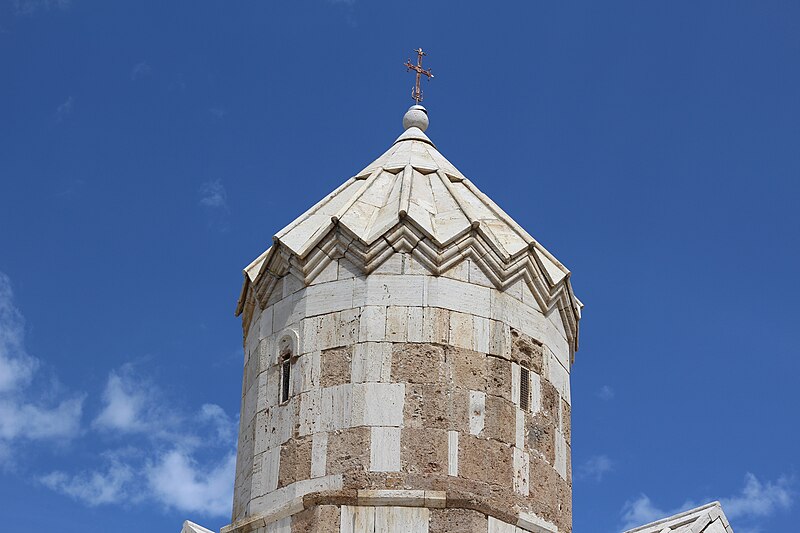
It is truly extraordinary that a chapel with a modest ground footprint measuring only seven point two meters long by five point one meters wide soars upward to a impressive height of twelve point five eight meters beneath its central dome. This dramatic verticality creates a soaring, weightless quality that makes the chapel feel far larger on the inside than its compact external envelope suggests. …
07 Closing
As our walking tour around the Chapel of Dzordzor comes to a close, we hope this audio journey has filled your heart with deep appreciation for the incredible endurance of cultural heritage. The monument standing before you today is far more than a simple medieval sanctuary. It is a living symbol of spiritual strength, artistic brilliance, and human resilience that has successfully transcended centuries of hardship and displacement. …