 Photo Wikimedia Commons
Contents
History & cultureBY TELLBY8 sections · numbered as on the map01 Orientation
Traveling along the major highway that connects Srinagar and Leh, you cross over the high Fotu La pass at an elevation of four thousand one hundred and eight meters. Descending westward from that mountain pass for about fifteen kilometers and turning around a massive rock ridge, a broad verdant valley suddenly opens up before your eyes. This dramatic vantage point is known as the Gonkyi La viewpoint, where travelers receive their first breathtaking sight of the monastic complex. Standing at the Gonkyi La pass, the magnificent panorama of Lamayuru Monastery perched dramatically atop a high rock crag jutting into the valley floor is revealed in all its grandeur. Guiding pilgrims and travelers toward this holy sanctuary is an impressive row of one hundred and eight chortens lined up precisely along the approach path. Looking toward the western end of the valley, you will see a surreal, chalky white terrain known as Markalaga. Markalaga consists of ancient silt deposits left behind when a vast lake that once filled this entire valley dried up over many centuries. Weathered by wind and water into extraordinary pinnacles and undulating folds, this landscape evokes the otherworldly experience of walking on the surface of the moon, leading visitors to call it the Moonland. To the east, the valley narrows into a deep, winding gorge that extends for ten kilometers before joining the Indus River near the town of Khaltsi, located nineteen kilometers northeast. Lamayuru Monastery stands proudly at an elevation of three thousand five hundred and ten meters atop its rugged crag. Its traditional local name, Yougrung Tharpaling, translates as the Monastery of Eternal Liberation. The word Yungdrung represents the swastika, an ancient symbol of eternity and immutability rooted in the indigenous Bon culture that predated Tibetan Buddhism in Ladakh. Originally recognized as a foremost Bon sanctuary, Lamayuru later transitioned through the Kadampa order before becoming a major seat of the Drikung Kagyu school. The striking visual contrast between the stark barren mountain crags, the lush irrigated green fields, and the eerie white lake sediments creates a landscape found nowhere else on earth. Now, let us walk along the path of the one hundred and eight chortens and enter the sacred history of Lamayuru Monastery.
02 Main Spring Chumig & Lotsawa Chortens
As you descend toward the western entrance road of the lower village, you encounter the main natural spring known locally as Chumig, an oasis providing life-giving water to both local villagers and weary pilgrims. Clustered around this vital water source is an extraordinary group of ancient stone structures known as the Lotsawa Chortens. …
03 Senge Lhakhang / Lion Temple
Standing atop a steep rock crag at the southernmost point of the complex is the oldest surviving structure in Lamayuru, known as the Senge Lhakhang or Lion Temple, dating back to the eleventh or twelfth century. This small shrine is an extraordinary architectural treasure that preserves the purest style of early West Himalayan Buddhist art. …
04 Skora & Male/Female Reliquary Dungten
Entering the central circumambulatory corridor known as the Skora, you are confronted by the impressive sight of two colossal reliquary chortens called Dungten. In Ladakhi tradition, a Dungten is a monumental reliquary built to preserve the sacred bodily relics or ringshel of revered figures. According to ancient local lore, these two massive structures serve as the reliquaries for the two legendary lions that appeared when the primordial lake drained away. …
05 Dukhang & Naropa's Meditation Cave
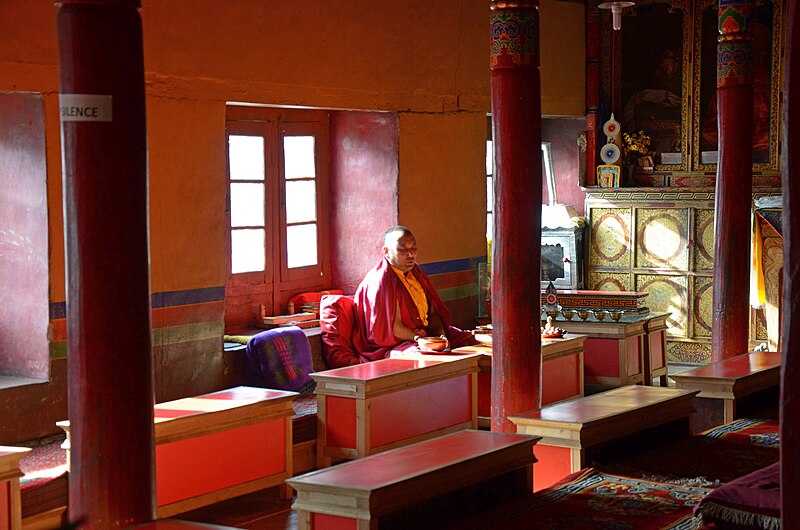
Stepping inside the main assembly hall, known as the Dukhang, you enter the spiritual heart of Lamayuru Monastery, where an atmosphere of profound antiquity and devotion fills the air. The interior walls of the Dukhang are adorned with vibrant murals depicting Buddhist deities, historical lineage masters, and protective guardians, while ornate silk thangka banners hang gracefully from the wooden ceiling beams. …
06 Drashag & Chamsra Dance Floor
Moving toward the northwestern plateau situated just above the main temple complex, you arrive at the monks' residential quarters known as Drashag, alongside the ritual dance floor courtyard called Chamsra. This site functions as the living and educational core of the monastery, where resident monks study Buddhist philosophy, memorize canonical scriptures, and practice intricate ritual chants. …
07 Meditation Centre & Angonsum Lhato
Looking up toward the steep upper slopes above the main monastic complex, you see the modern Meditation Centre overlooking the sanctuary, and at the absolute summit of the highest rock peak, the protective shrine known as Angonsum. The Meditation Centre is a recent addition to the settlement, established in nineteen seventy seven by a revered Tibetan master to provide a secluded refuge where monks can engage in long-term solitary meditation away from worldly distractions. …
08 Closing
It is now time to conclude our walking tour through the sacred precinct of Lamayuru Monastery. We hope that the ancient legends, the profound devotion of master scholars, and the magnificent harmony between solar light and sacred architecture have left a deep and lasting memory in your heart. This valley stands as a holy sanctuary built upon the dried bed of a primordial lake, where ancient Bon traditions, the artistic legacy of Rinchen Zangpo, and the meditation cave of Naropa are layered…