 Photo Wikimedia Commons
Contents
History & cultureBY TELLBY7 sections · numbered as on the map01 Orientation
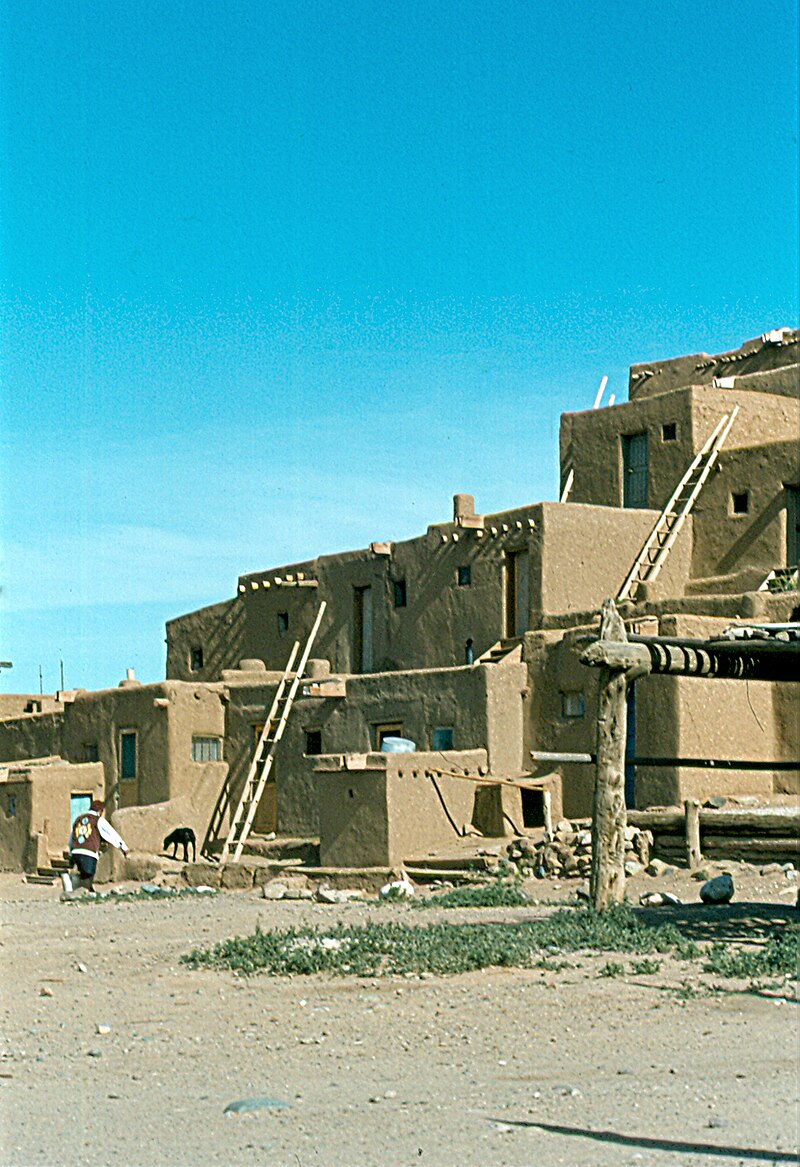
Welcome to Taos Pueblo, a magnificent living community where people have continuously resided for over a thousand years. Located in northern New Mexico at the base of the Sangre de Cristo Mountains in the Taos Valley, this extraordinary settlement represents the enduring culture and living traditions of the Pueblo Indian people. The people of Taos claim an aboriginal presence in this valley since time immemorial, carrying forward an unbroken cultural lineage. Archaeological evidence and oral traditions show that the Taos people first settled in the Taos Valley around nine hundred Common Era, with the earliest surviving structural foundations laid around the year one thousand. The main multi-story pueblo ensemble seen today was formally established in the late thirteenth and early fourteenth centuries along the tributary valleys of the Rio Grande, standing as the largest and most historic of the surviving pueblos in this region. The settlement is uniquely divided into two main multi-story adobe complexes by the clear waters of Red Willow Creek, which flows directly through the heart of the village from its sacred headwaters in Blue Lake deep within the surrounding mountains. Built entirely from adobe bricks composed of earth, water, and straw, these iconic terraced structures demonstrate a remarkable mastery of traditional construction techniques that have harmonized with the harsh southwestern environment for centuries. The historic site covers nineteen point zero one hectares and retains its full integrity without any formal buffer zone. The community maintains strict tribal regulations to safeguard its authentic way of life, including a total prohibition of electrical power lines and indoor piped water supply inside the historic walled precinct. Rather than existing as a static monument to the past, Taos Pueblo is an active self-governing nation operating under its autonomous Tribal Council, Governor, War Chief, and traditional spiritual leaders. The pueblo holds limited sovereign nation status within the United States, with its lands originating from an ancient Spanish Land Grant held in trust by the federal government. The pueblo was designated a National Historic Landmark in nineteen sixty and was subsequently inscribed as a UNESCO World Heritage Site in nineteen ninety-two, recognizing its outstanding universal value as a traditional architectural ensemble from the pre-Hispanic period of the Americas that retains its ancient form through a thriving living culture. As you walk through this ancient village, you will observe the rough-textured adobe walls hand-plastered by tribal members, the wooden ladders stretching toward the sky, and the timeless flow of the river that has sustained agricultural life for generations. Please enjoy this audio guide as we explore the rich history, spiritual resilience, and living heritage of Taos Pueblo.
02 The Multi-Story North House
You are standing before the magnificent North House complex, known locally as Hlauuma. This towering multi-story adobe structure is widely celebrated as one of the most photographed and painted buildings in North America, representing the oldest continuously inhabited multi-story apartment building in the United States while preserving its thousand-year-old architectural form. …
03 Red Willow Creek and Village Life
You have arrived at the peaceful banks of the pristine stream flowing through the heart of the village. This modest waterway is far more than a simple river, it is Red Willow Creek, known locally as Rio Pueblo de Taos, flowing directly from sacred Blue Lake, or Ba Whyea, located high in the surrounding mountains. Look at the clear water flowing at your feet and notice how it naturally divides the settlement into two distinct residential sectors, the North House and the South House. …
04 San Geronimo Church and Historical Struggle
You are standing at the historic church grounds of Taos Pueblo, a place marked by deep spiritual significance and tragic historical conflict. The crumbling adobe ruins of the original mission church represent the site where in eighteen forty-seven, during a single brutal day of military bombardment, over one hundred and fifty Pueblo inhabitants tragically lost their lives while seeking sanctuary. …
05 Sacred Underground Kivas
You are approaching the most sacred spiritual core of Taos Pueblo. Within this ancient village lie seven underground ceremonial chambers known as kivas, which remain completely private and strictly inaccessible to outsiders. Look at the tops of long wooden ladders extending above ground and the circular earthen enclosures that mark these subterranean sanctuaries. Before delving into the tribe's governance, observe how these structures gently rise above the earth as rounded clay mounds. …
06 Traditional Hornos and Mica Pottery
You have entered the lively craft courtyard, a vibrant center of daily life and artistic creation within Taos Pueblo. The traditional pottery produced here is uniquely crafted from micaceous clay rich in natural mica particles, giving the vessels a sparkling orange sheen when fired and enabling them to withstand direct cooking flames. Look at the beehive-shaped round clay ovens, known as hornos, arranged across the courtyard. …
07 Closing
Taos Pueblo stands not as a silent monument to a bygone era, but as a vibrant living sanctuary where ancient heritage and contemporary community life remain seamlessly unified. Among the most transformative chapters in the modern history of the pueblo was the heroic struggle to reclaim its sacred Blue Lake and surrounding mountain lands, which had been expropriated into the Carson National Forest under President Theodore Roosevelt in the early twentieth century. …