 Photo Wikimedia Commons
Contents
History & cultureBY TELLBY6 sections · numbered as on the map01 Orientation
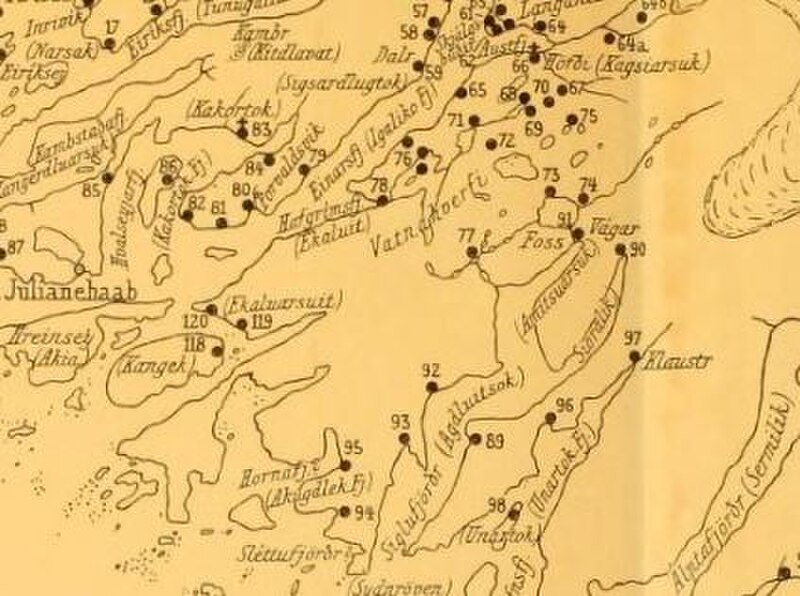
Welcome to the extraordinary Arctic landscape of Vatnahverfi. In two thousand seventeen, this remarkable region was officially designated as a UNESCO World Heritage Site as a central component of Kujataa Greenland. This landscape holds exceptional historical significance because it marks the earliest introduction of European pastoral farming to the Arctic zone, representing a unique cultural encounter and long-term interaction between European Norse settlers and Indigenous Arctic communities. Geographically, Vatnahverfi forms an expansive peninsula spanning over five hundred square kilometers between the fjords of Alluitsup kangerlua and Igalikup kangerlua, extending northeast toward the majestic Jespersens Glacier. The Old Norse name Vatnahverfi translates directly as the Lake District, reflecting the abundant freshwater lakes and streams that defined daily existence in this subarctic sanctuary. Around the year nine hundred eighty five, Scandinavian settlers arrived from Iceland alongside Erik the Red to establish thriving homesteads along these fertile valleys. Archaeological research has identified the structural remains of fifty individual Norse farms in Vatnahverfi alone, which constitutes ten percent of all known farms across the entire Eastern Settlement, known historically as Eystribyggd. During the colony's zenith, the district supported an estimated peak population of approximately five hundred residents, averaging eight to ten individuals per farmstead. For nearly five centuries, this resilient community raised livestock, harvested marine resources, and maintained trade connections with distant European markets before mysteriously vanishing around the mid fifteenth century. Today, modern Greenlandic sheep farmers have revived agricultural traditions on these very same pastures, creating a living bridge between medieval history and present day Arctic life. Our audio guide will accompany you through key archaeological locations across the peninsula. We begin at the coastal fjord entrance at Eqaluit to discover the founding farm of chieftain Hafgrim, proceed to the religious center of Undir Hofdi church, navigate toward a farm deeply buried beneath sand drifts, visit an isolated inland homestead where the final inhabitant spent his last days, and conclude at the royal waterfall estate of Foss and Kongsgarden. As you stand upon this historic soil, listen closely to the gentle mountain breeze and the peaceful water currents. Let us step back in time to explore the enduring spirit of the human communities who shaped this northern land.
02 Hafgrim's Homestead at Eqaluit
Standing at the entrance of the western fjord section, you are present at the exact location where the founding Norse chieftain Hafgrim first claimed land in the late nine hundred eighties. According to medieval Scandinavian saga accounts, including the Landnamabok and the Greenlanders' Saga, Hafgrim was one of the prominent founding leaders who accompanied Erik the Red in the great exodus out of Iceland in nine hundred eighty five to establish the very first permanent Scandinavian colony in…
03 Undir Hofdi Church Ruins
Arriving at the northern branch of the fjord near Sondre Igaliku, you stand before the sacred grounds of Undir Hofdi church. Archaeological excavations at this solemn location produced an astonishing discovery inside the altar area, where researchers uncovered lumps of heat-fused clay and layers of completely melted glass buried within the burnt destruction stratum. …
04 The Sand-Buried Farm Sixty-Four C
As we walk inland away from the coast, we reach the extraordinary farm site known to archaeologists as farm site sixty-four c. The most astonishing fact about this location is that the entire farm structure was found completely buried beneath shifting sand dunes that measured over three meters, or ten feet, thick. …
05 Inland Farm One Hundred Sixty-Seven
We have now arrived at farm site one hundred sixty-seven, located in the secluded interior halfway between Hafgrimsfjord and Austfjord. This remote site is famous for one of the most tragic discoveries in Arctic archaeology, where excavators uncovered the complete skeleton of a solitary Norse Greenlander lying right in the entrance doorway of his house. …
06 Closing
As our audio journey through Vatnahverfi comes to an end, we stand surrounded by a majestic landscape where multi-layered histories peacefully coexist. Nearly five hundred years of Norse agricultural civilization vanished into silence around the mid fifteenth century, yet this land was never truly forgotten. Archaeological research, initiated by Danish scholar C.L. …