 Photo Wikimedia Commons
Contents
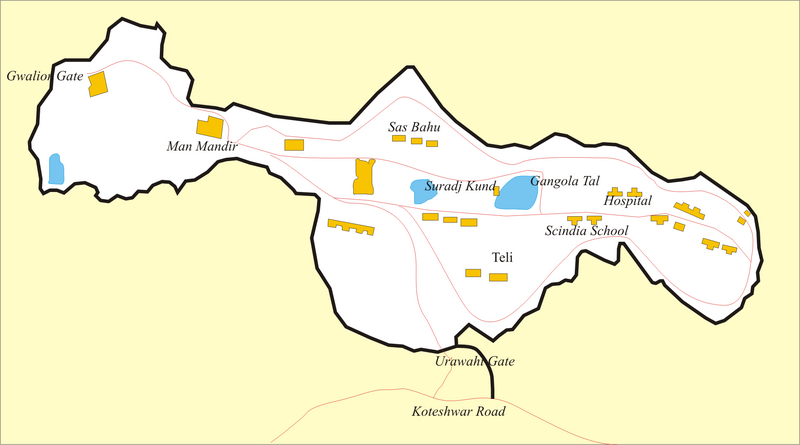
History & cultureBY TELLBY8 sections · numbered as on the map01 Orientation
Welcome, valued visitors, to the magnificent Gwalior Fort, an enduring symbol of India's heroic past and architectural mastery located in northern Madhya Pradesh. Conveniently accessible as a prime destination from Agra, this imposing citadel rises sheer above the city skyline, offering a commanding presence over the surrounding plains. Built atop a long, narrow plateau of ochre-coloured Vindhyan sandstone capped with basalt, known as Gopachal Hill, the fort dominates its environment with breath-taking grandeur. At its highest point, the plateau stands 342 feet above the terrain, stretching roughly 1.5 miles in length with an average width of about 1,000 yards, or 910 meters. The near-perpendicular precipice of the hill offered an extraordinary natural defense, complemented by the gentle flow of the nearby Swarnrekha River.
When Babur, the founder of the Mughal Empire, first gazed upon this incredible stronghold, he was deeply moved by its majesty, immortalizing it in his memoirs as the pearl amongst the fortresses of Hind and remarking that not even the winds could touch its masts. Owing to its imposing sheer cliffs and formidable defensive layout, the stronghold famously earned the title the Gibraltar of India across historical literature.
The origins of this famous fortress are rooted in an ancient local legend dating back to the 3rd century CE. According to tradition, a local monarch named Suraj Sen ruled this region while suffering from leprosy, a disease deemed incurable at the time. While hunting on Gop Mountain, the king encountered a revered hermit named Gwalipa, also known as Galav. Taking pity on the afflicted ruler, Saint Gwalipa directed him to drink water from a sacred spring atop the ridge. Upon drinking the water, King Suraj Sen was miraculously cured. In profound gratitude, the king erected a protective stone wall around the spring, known today as Suraj Kund, and founded a great fort atop the hill, naming it Gwalior, meaning the abode of Saint Gwalipa. Over the centuries, a vibrant city expanded around the base of the mountain.
Beyond myth, ancient Sanskrit inscriptions and Gupta period records designate this landmark as Gop Parvat, Gopachala Durg, Gopgiri, and Gopadiri, all translating to Cowherd's Hill. Archaeological evidence, including a notable 6th-century stone inscription from the reign of the Huna emperor Mihirakula commemorating a sun temple, confirms that this ridge has been fortified for over fifteen centuries. Through the ages, the fort witnessed the changing fortunes of the Kushanas, Nagas, Guptas, Hunas, Pratiharas, Kacchapaghatas, Tomaras, Pathan Sultans, Surs, Mughals, Jats of Gohad, Scindias, and the British. As you begin your exploration today, prepare to immerse yourself in a timeless chronicle of empire, architecture, and enduring spiritual faith.
02 Hathi Pol - The Elephant Gate and Fortifications
As you ascend the stone ramp leading toward the northeastern and southeastern entrances of the fortress, take a moment to observe the dramatic defensive architecture surrounding you. Your path brings you to Hathi Pol, or the Elephant Gate, standing alongside the historic Badalgarh Gate. To neutralize enemy assaults, ancient builders constructed a sequence of seven successive gateways along the access ramp. …
03 Man Mandir Palace - Turquoise Tiles and Royal History
Standing before you is the magnificent Man Mandir Palace, situated at the northeastern corner of the citadel complex. Commissioned in the 15th century by Raja Man Singh Tomar, who ruled between 1486 and 1516, and refurbished in 1648, this palace represents the absolute pinnacle of Tomar dynasty architecture. It is widely known as the Painted Palace due to the extensive ceramic tilework decorating its outer facade. …
04 Chaturbhuj Temple - The Origin of Numeric Zero
As you walk along the stone pathway ascending toward the summit of the fortress, direct your attention to a quiet shrine carved directly into the sandstone cliff side. This is the Chaturbhuj Temple, globally renowned as the Zero Temple. While modest in scale compared to the fortress palaces, this rock-cut sanctuary occupies a place of transcendent importance in the history of global mathematics and human intellectual achievement. …
05 Saas Bahu Temples - Masterpiece of Sandstone Architecture
Welcome to the breathtaking Saas Bahu Temples, a supreme masterpiece of medieval sandstone architecture located within the fort campus. Constructed between 1092 and 1093 CE during the rule of the Kacchapaghata dynasty, these temples represent one of the finest surviving examples of classical North Indian temple design. …
06 Teli ka Mandir - Blending Dravidian and Nagara Styles
Standing proudly before you is Teli ka Mandir, or the Teli Temple, the oldest and tallest surviving Hindu temple within Gwalior Fort. Soaring to a height of 25 meters, or 82 feet, this monumental stone shrine was erected during the 8th to 9th centuries under the patronage of Emperor Mihira Bhoja of the Pratihara dynasty. The name Teli is traditionally believed to derive from the oil merchants guild who provided financial backing for its construction. …
07 Rock-Cut Jain Colossi - Eternal Monuments of Gopachal and Siddhanchal
As you explore the outer perimeter of the fortress, your journey brings you to the rock-cut Jain colossi carved directly into the sheer sandstone cliffs of Gopachal Hill and the Siddhanchal region. Executed primarily during the 15th century under the patronage of the Tomar dynasty rulers, these monumental rock sculptures depict the Tirthankaras, or enlightened spiritual teachers of Jainism. …
08 Closing
As our audio guide tour of Gwalior Fort comes to its conclusion, we invite you to pause in peaceful reflection before Gurdwara Data Bandi Chhor, a revered Sikh shrine located within the fort campus. Constructed during the 1970s and 1980s, this white marble shrine marks the historic site where the sixth Sikh master, Guru Hargobind Ji, was imprisoned in 1609 at the age of fourteen by Mughal Emperor Jahangir. …