 Photo Wikimedia Commons
Contents
History & cultureBY TELLBY7 sections · numbered as on the map01 Orientation
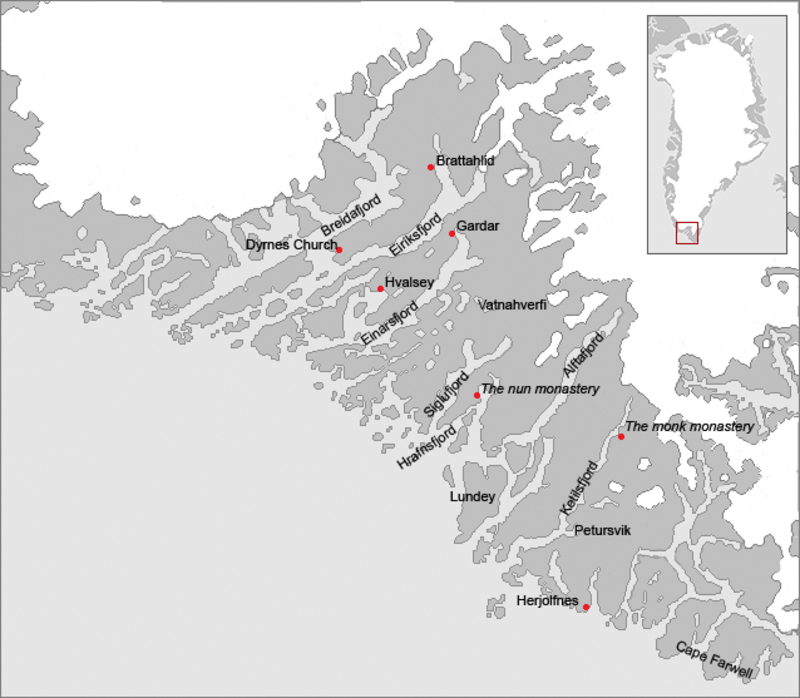
Welcome to Hvalsey, the most magnificent and historically significant medieval Norse archaeological landscape in all of Southern Greenland. You are currently standing at the very heart of the Kujataa World Heritage Site, inscribed by UNESCO in twenty seventeen to recognize this extraordinary subarctic cultural landscape. Here, at the edge of the known Atlantic world, medieval European pastoral farming strategies introduced by Scandinavian settlers coexisted, adapted, and intersected with the resilient maritime hunting traditions of the Arctic Inuit cultures. As you gaze around, absorb the breathtaking physical setting facing the tranquil waters of the Hvalseyjarfjord. This narrow coastal peninsula is sheltered by towering mountain ridges and steep glacial valleys, creating a remarkably favorable microclimate where Norse farmers harvested vital marine resources, collected nutrient-rich seaweed for winter fodder, and pastured their livestock along the fertile lower slopes. Please hold your audio playback device comfortably at chest height and stand near the coastal pathway as we prepare to begin our walking tour through this remarkable preserved landscape. Over the course of this audio guide, we will walk through five distinct archaeological features that collectively reveal how a thriving medieval estate operated. Our journey begins at the towering drystone ruins of Hvalsey Church, known in archaeological surveys as site Oe83. From there, we will move to the central multi-room farm mound where generations of Norse chiefs lived. We will then continue to the impressive circular stone livestock enclosure, ascend toward the high meadow pastoral byres where dairy maids worked long summer hours, and conclude at the extraordinary food storehouse perched precariously atop a giant natural boulder. As demonstrated by similar structures across the peninsula at Kanasut, these perched storehouses represent the pinnacle of Norse adaptation and building genius. Please take a moment to absorb the vastness of the landscape, feel the crisp Arctic wind off the fjord, and follow the path leading directly toward the magnificent stone facade of Hvalsey Church.
02 The Standing Stone Walls of Hvalsey Church
Standing directly before you is the magnificent Hvalsey Church, universally celebrated as the absolute best preserved medieval European building in all of Greenland. As you approach its grand facade, direct your gaze upward toward the massive granite walls, which measure nearly one and a half meters in thickness, and observe the dramatic gable ends rising cleanly toward the subarctic sky. …
03 The Chief's Residence and Farm Mound
Beneath the vibrant green turf stretching around your feet lies an extraordinary archaeological feature known as a farm mound, built up by centuries of continuous human habitation. Direct your gaze downward toward the subtle contours of the ground and notice the alignments of large granite stones emerging through the grass, defining the hidden walls of interconnected residential rooms. …
04 The Circular Enclosure: Assembly and Livestock Gathering
Before you stands an extraordinary architectural monument, a massive circular drystone enclosure designated in archaeological surveys as Ruin fourteen. Raise your eyes and sweep your gaze along the sweeping curved perimeter of this stone wall, which forms a large, continuous ring across the green pasture. Such prominent circular stone enclosures are exceptionally rare in Scandinavian archaeology and are found almost exclusively at high-status regional chieftains' estates in medieval Greenland. …
05 The High Meadow Byres and Summer Pastures
As we reach the upper meadow complex, we encounter the long rectangular stone foundations of the pastoral byres. Direct your attention to the ground where large, flat flagstones stand buried vertically in the turf at regular intervals. During the dark and freezing subarctic winter, cattle were brought inside these thick-walled stone structures, standing packed shoulder to shoulder where their combined body heat served as the sole source of heat keeping them alive. …
06 The High Storehouse Perched on Bedrock
Look up in wonder at this remarkable architectural structure known as a skemma, an elevated drystone storehouse perched high atop a massive natural boulder. Observe how the stone walls, measuring roughly five meters square, were erected directly onto the smooth bedrock outcrop nearly two meters above the surrounding terrain. …
07 Closing
Our audio journey through the magnificent archaeological landscape of Hvalsey now comes to its conclusion. Together, we have walked among the monumental stone walls of Hvalsey Church, explored the multi-room farm mound of the Norse chiefs, admired the sweeping circular livestock enclosure, inspected the high meadow pastoral byres, and marveled at the elevated boulder-perched storehouse. …