 Photo Wikimedia Commons
Contents
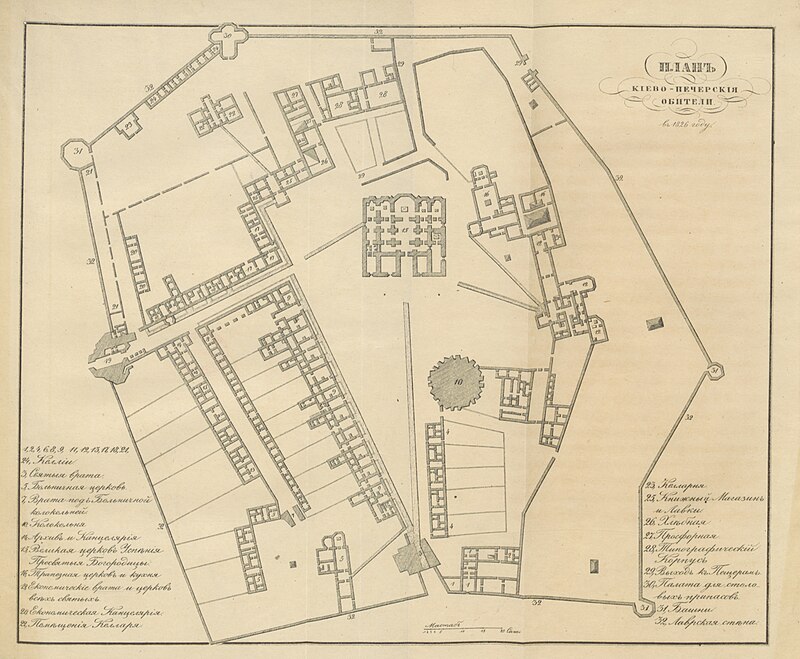
History & cultureBY TELLBY7 sections · numbered as on the map01 Orientation
Standing majestically atop the verdant hills overlooking the sweeping Dnipro River, the Kyiv Pechersk Lavra represents the supreme pinnacle of Eastern Orthodox spirituality and a sacred sanctuary encapsulating a thousand years of rich history. Far more than a mere religious complex, this venerable site served as the cradle of learning, monumental art, chronicle writing, and typography for Eastern Europe, earning its official inscription as a UNESCO World Heritage Site in 1990. The term Pechersk is derived from the local word for cave, while Lavra is an exalted title reserved exclusively for male monasteries of the highest rank within the Eastern Orthodox Church. Thus, the very name of this holy sanctuary testifies to its extraordinary historical trajectory, originating from humble subterranean earthen retreats and ascending to become the premier monastic institution of the region.
The origin of this great monastery dates back to the year 1051, when Saint Anthony, a deeply devout monk who had completed his spiritual training on Mount Athos, returned to his homeland and chose a small natural cave on the Berestov Mount above the Dnipro River for his solitary ascetic retreat. Intensely moved by Saint Anthony's profound holiness, strict fasting, and unwavering devotion, a growing brotherhood of disciples gathered around his cave, establishing a vibrant monastic community bound by shared faith. Deeply impressed by their spiritual discipline, Prince Iziaslav the First donated the entire mountain plateau to the monks, providing them with a permanent territorial foundation. Subsequently, master architects and skilled artisans summoned from Constantinople constructed grand stone cathedrals and monastic residences above the ground, transforming the subterranean seed of faith into a sprawling, awe-inspiring architectural sanctuary.
Throughout centuries of tumultuous history, including devastating foreign sackings, catastrophic fires, and modern wartime conflicts, the dedicated monks of the Lavra tirelessly pursued theological studies, manuscript copying, icon painting, and historical record-keeping, functioning as the intellectual heart of Eastern Europe. Even when contemporary trials led to its placement on the UNESCO List of World Heritage in Danger in 2023, this sacred monument continued to stand as an imperishable bastion of human cultural achievement and spiritual endurance. Today, as you walk through these hallowed grounds, every stone pathway, gilded dome, and subterranean corridor invites you to experience a profound encounter with a living spiritual legacy that has survived the test of time and rejuvenated through every era.
02 Gate Church of the Trinity
Standing majestically directly above the primary Holy Gates of the monastery complex, the Gate Church of the Trinity is an extraordinary architectural monument that has miraculously survived through centuries of relentless warfare, devastating foreign sieges, and catastrophic fires without losing its fundamental historic form. Please raise your eyes and tilt your head upward to examine the upper section of the holy entrance gate. …
03 Great Lavra Belltower
Standing with immense authority and grace in the central plaza of the monastery complex, the Great Lavra Belltower holds the monumental historic distinction of being the tallest free-standing bell tower in all of Eastern Europe at the time of its construction between 1731 and 1745. Please tilt your head far back and gaze upward at the soaring four-tiered structure composed of monumental classical columns and capped by a radiant golden dome that sparkles against the sky. …
04 Dormition Cathedral
First constructed in the early medieval period as the primary sanctuary of the monastery complex, the Dormition Cathedral embodies an extraordinary narrative of tragedy, survival, and continuous resurrection, having been completely blown up during the Second World War in 1941, magnificently rebuilt in 2000, and recently surviving modern wartime damage in 2026. …
05 Refectory Church of Saints Anthony and Theodosius
The Refectory Church of Saints Anthony and Theodosius served historically as the vibrant spiritual heart of monastic communal life where monks gathered for shared silent meals and prayer, while also functioning as a revered necropolis holding the final resting places of prominent historical figures, most notably Imperial Russian Prime Minister Pyotr Stolypin who was assassinated in 1911. …
06 Near and Far Caves
Hidden deep beneath the surface within a labyrinth of narrow, subterranean loess corridors measuring barely a person's width and a saint's height, this underground system houses the imperishable relics of over one hundred venerated Orthodox saints preserved without decay for centuries. Please look closely at the cool loess soil walls, the narrow earthen passageways, and the tiny subterranean chapels excavated directly from the dirt. …
07 Closing
Emerging from the sacred stillness of the subterranean caves to stand atop the high plateau overlooking the sweeping Dnipro River, the magnificent panorama of the Kyiv Pechersk Lavra unfolds breathtakingly before you. Across a thousand years of tumultuous history, this venerable sanctuary has endured countless trials, including foreign invasions, catastrophic fires, world wars, and recent wartime attacks, yet it has continuously risen from the ashes as an immortal bastion preserving the…