 Photo Wikimedia Commons
Contents
History & cultureBY TELLBY7 sections · numbered as on the map01 Orientation
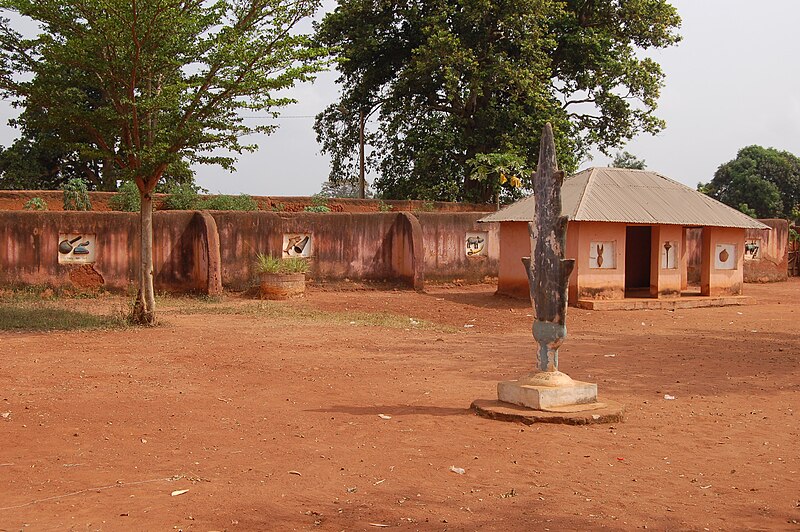
Welcome to the Royal Palaces of Abomey, a monumental testament to African power and architectural creativity located in the heart of Benin. You are standing at the threshold of a historic complex that served as the grand sovereign center of the Dahomey Kingdom from the mid seventeenth century until the turn of the twentieth century. This revered sanctuary is recognized as a UNESCO World Heritage site because it stands as the ultimate surviving physical testimony of the formidable Dahomey Kingdom and its extraordinarily unique tradition of earthen architecture. Without relying on written manuscripts, the Fon people created an advanced civilization whose military power, political sophistication, and artistic brilliance remain forever captured within these massive sun-dried earthen walls. The physical landscape of this royal site encompasses an extraordinarily vast area of forty-seven hectares, surrounded by formidable perimeter walls constructed entirely of traditional earthen cob. Within this expansive enclosure, twelve successive monarchs built their distinct palace compounds across nearly three centuries of unbroken dynastic rule. As each new king ascended to the throne, sacred royal tradition required him to build a completely new palace compound adjacent to or alongside those constructed by his predecessors, thereby preserving the spatial layout and traditional materials of the realm. Consequently, this forty-seven hectare compound evolved into an intricate architectural tapestry of royal dwellings, administrative assembly halls, sacred treasuries, and sweeping ceremonial courtyards where foreign emissaries once gathered to pay homage to the king. The earthen cob walls surrounding you were masterfully crafted by mixing local laterite soil with straw and water, creating a durable structural material that provides exceptional natural insulation against the intense equatorial sun and keeps interior chambers comfortably cool. As you walk along the main earthen avenue today, you can observe how these impressive boundary walls protected the inner life of the court and symbolized the unyielding power of the monarchy. Please prepare to begin your guided walk through this extraordinary cultural landscape. Follow the shaded walkway leading straight ahead into the historic grounds, keeping your eyes on the rich textured earth walls that frame the path. A short walk forward will bring you directly to the foundational courtyard built by King Houegbadja, the legendary ruler who established the core political and legal structures of the kingdom. Take a moment to absorb the quiet majesty of this sacred ground before stepping into the foundational heart of the empire.
02 Foundational Courtyard of King Houegbadja
Welcome to the historic foundational courtyard that marks the historic emergence of the Dahomey Kingdom. As you stand in this expansive open space, consider an extraordinary rule that governed the royal dynasty for nearly three centuries. Every single monarch who inherited the throne was strictly required by royal tradition to construct an entirely new palace compound built directly alongside or superimposed over the compounds of previous rulers. …
03 Two-Story Cowrie House of King Ghézo
Welcome to the palace sector of King Ghézo, where one of the most remarkable and functionally distinct architectural structures of the entire royal enclosure stands before you. Prepare to be astonished by the historical purpose of this unique two-story building, historically called the Cowrie House. This historic structure once served as a literal royal treasury packed from floor to ceiling with millions of cowrie shells, which functioned as the recognized standard international currency across…
04 Ajalala Hall and Earthen Bas-Reliefs of King Glélé
Welcome to the majestic Ajalala Hall located within the grand palace compound of King Glélé. Stand before this historic reception hall and contemplate a fascinating truth about how the Dahomey Kingdom preserved its official memory. In a society that did not utilize a written alphabet for formal record keeping, these brightly colored earthen reliefs inlaid directly into the palace walls served as the official historical record books of the empire. …
05 Djexo Spirit Hut and Sacred Royal Tombs
Welcome to the peaceful and revered precinct housing the royal tombs and spiritual sanctuaries of Abomey. As you step into this quiet and solemn space, prepare to learn a surprising truth that distinguishes this historic site from many other ancient monuments across the world. Local royal descendants and traditional priests continue to perform private sacred rituals inside these exact mud-and-straw structures today, strictly adhering to the spiritual customs established centuries ago. …
06 Historical Museum and Returned Royal Treasures
Welcome to the hall of Singboji Palace within the Abomey Historical Museum, a location that embodies both the poignant historical struggles and triumphant cultural resilience of Benin. As you stand inside this spacious exhibition hall, contemplate an astonishing milestone in modern international restitution history. …
07 Closing
As we conclude our audio guide journey in the serene inner courtyard of the Royal Palaces of Abomey, take a moment to reflect upon the incredible resilience of this extraordinary World Heritage site. From its inception in the seventeenth century through centuries of imperial expansion, war, and environmental challenges, Abomey has stood as an enduring symbol of African sovereignty and architectural ingenuity. …