 Photo Wikimedia Commons
Contents
History & cultureBY TELLBY8 sections · numbered as on the map01 Orientation
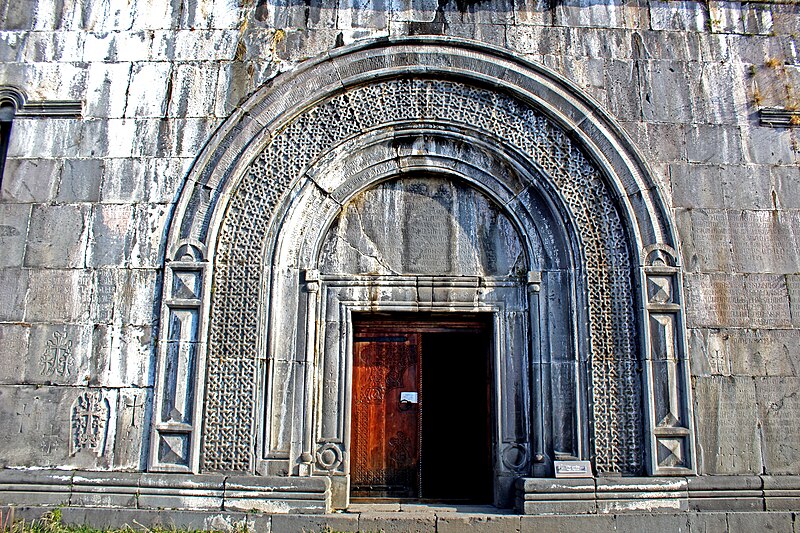
Welcome to Haghpat Monastery, an extraordinary masterpiece of medieval Armenian architecture and spiritual endurance, perched high above the dramatic, winding gorge of the Debed River Canyon in Armenia's northern Lori region. Recognized globally as a UNESCO World Heritage Site alongside its nearby sister complex Sanahin, Haghpat stands as a monumental testament to the artistic peak of medieval Caucasian design. The complex represents a brilliant architectural synthesis, seamlessly harmonizing the traditional ecclesiastical layouts of Byzantine traditions with the robust, sophisticated stone masonry endemic to the Caucasian highlands. The sacred origins of this monastic sanctuary date back to the late tenth century, founded around nine seventy-six under the royal patronage of Queen Khosrovanuysh, wife of King Ashot the Third of the Bagratid dynasty. While its sister monastery Sanahin was established at virtually the exact same moment to foster royal education and scholarship, Haghpat was conceived as a fortified citadel of theological study, intellectual preservation, and sacred artistic creation. Over the centuries, despite facing devastating earthquakes and destructive regional invasions, Haghpat expanded into one of the most prominent cultural centers of the medieval Caucasus, nurturing generations of theologians, scribes, miniature painters, and philosophers. Today, our audio guide takes you on a comprehensive walking tour through six carefully selected stops across the complex. We begin our journey at the Fortified Entrance Gate and Canyon Outlook, examining how medieval master builders strategically utilized the topography to conceal the monastery from approaching enemy forces. From there, we walk to the exterior eastern pediment of the Cathedral of Surb Nshan to admire the iconic royal dedication gable featuring Prince Smbat and Prince Kurike holding a miniature model of the church. Next, we step inside the cathedral's inner sanctuary to discover rare bilingual frescoes and sacred murals that survived beneath centuries of candle soot. We will then transition into the vast, columnless Main Gavit, where four intersecting arches form an architectural marvel spanning medieval noble graves and housing the world-renowned All-Savior Khachkar. Afterwards, we visit the elegant, free-standing three-story Bell Tower erected in twelve forty-five, before concluding our walkthrough inside the subterranean Monastic Library and Scriptorium, where medieval scholars preserved illuminated manuscripts and buried clay vessels beneath the stone floor. Please take a deep breath of the mountain air, step forward at an unhurried pace, and allow the living echoes of Armenia's golden age to guide your path.
02 The Fortified Entrance and Debed Canyon View
As you stand before the fortified entrance gate of Haghpat Monastery and survey the surrounding mountain landscape, consider a highly surprising architectural truth: unlike many prominent medieval religious complexes that were intentionally erected atop the highest mountain peaks to command widespread visibility, Haghpat was strategically constructed partway down a hillside promontory along the fertile Javakheti Range. …
03 Cathedral of Surb Nshan - The Royal Dedication Gable
Having arrived before the magnificent eastern facade of the Cathedral of Surb Nshan, cast your eyes high up toward the triangular gable near the top of the wall to discover one of the most legendary high-relief sculptures in medieval Armenian art. High above the ground, set deep within a protective stone niche, two young princes carved in high relief have stood side by side for over a thousand years, carefully holding between their outstretched hands an intricately sculpted, highly detailed…
04 Inside Surb Nshan - Frescoes of Unity and Power
Step through the western portal into the sacred dimness of the Cathedral of Surb Nshan, where the cool air carries the unmistakable scent of aged basalt and centuries of candle wax. For hundreds of years, the magnificent wall paintings surrounding you lay completely obscured beneath dense layers of black candle soot and grime, rendering them virtually invisible to generations of pilgrims. …
05 The Main Gavit and the All-Savior Cross-Stone
Step into the soaring interior of the Main Gavit, or narthex, attached directly to the western wall of the Cathedral of Surb Nshan, and you will find yourself surrounded by one of the most structurally innovative spaces in medieval Armenian architecture. While this grand hall functioned as an intellectual assembly chamber for scholars and a sacred transitional vestibule for entering pilgrims, it served an equally vital purpose as a consecrated noble mausoleum. …
06 The Three-Story Independent Bell Tower
Standing before the towering, separate Bell Tower of Haghpat, you are gazing at one of the most innovative structural achievements in medieval Caucasian architecture. Built in twelve forty-five, this standalone landmark is recognized by architectural historians as one of the very earliest free-standing, three-story bell towers ever constructed in Armenia. …
07 The Library, Scriptorium, and Clay Vessels
Welcome inside the quiet, low-vaulted sanctuary of the Monastic Library and Scriptorium. In this shadowed stone chamber, medieval scribes spent countless years copying, translating, and illuminating sacred texts by hand. Working by faint oil lamps during harsh winter months, these dedicated scholars produced the famous illuminated Haghpat Gospel of twelve eleven, preserving classical knowledge, philosophy, and Christian theology through centuries of warfare. …
08 Closing
As our audio journey through Haghpat Monastery comes to an end, stand for a moment near the outer courtyard edge overlooking the vast, misty expanse of the Debed River Canyon. The survival of Haghpat is nothing short of miraculous. Having endured catastrophic earthquakes in eleven thirty and nineteen eighty-eight, alongside repeated medieval sieges and regional wars, these stone walls stand today virtually intact in their original design. …