 Photo Wikimedia Commons
Contents
History & cultureBY TELLBY8 sections · numbered as on the map01 Orientation
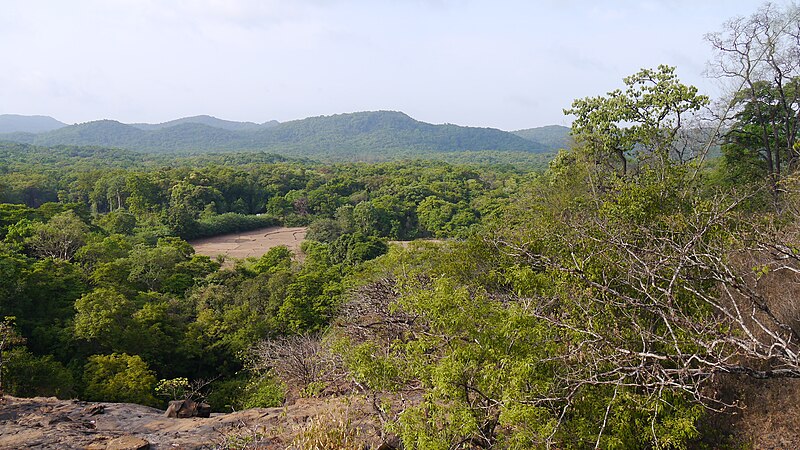
Welcome to the Kali Tiger Reserve, an extraordinary natural sanctuary nestled in the biodiverse heart of the Western Ghats within the Uttara Kannada district of Karnataka, India. Spanning an expansive area of over one thousand three hundred square kilometers, this reserve stands as one of the most critical conservation strongholds in the Sahyadri mountain range. With elevations ranging from twenty-seven meters to one thousand fifty-nine meters above sea level, the reserve joins six adjacent protected areas across the neighboring states of Goa and Maharashtra to form a magnificent, unbroken protected forest network covering more than two thousand two hundred square kilometers. Recognized under UNESCO World Heritage status, this sanctuary shelters endangered ecoregions characterized by dense evergreen and moist deciduous forest canopies, rugged mountain ridges, and an astounding density of biological species.
The conservation history of this protected landscape reflects decades of dedicated environmental stewardship. The area was first protected on May tenth, 1956, when it was designated as the Dandeli Wildlife Sanctuary to shield the ancient Western Ghats forests from overexploitation. On September second, 1987, a section encompassing two hundred fifty square kilometers was carved out to establish Anshi National Park, which was later expanded by an additional ninety square kilometers in 2002 to reach a total area of three hundred forty square kilometers. Recognizing the ecological continuity between these contiguous forest habitats, the Indian government unified Anshi National Park and Dandeli Wildlife Sanctuary under Project Tiger in January 2007, creating the Dandeli-Anshi Tiger Reserve. In December 2015, the reserve was officially renamed the Kali Tiger Reserve JOIDA. This landmark name change was inspired by widespread public and environmental response following the release of the acclaimed film Kali, which focused regional attention on the life-sustaining importance of the Kali River and bestowed a proud, unified identity upon the entire ecosystem.
Flowing directly through the sanctuary, the powerful Kali River serves as the vital lifeline for countless floral and faunal species. Belonging to the critically endangered North Western Ghats montane rain forests and moist deciduous forests ecoregions identified by the World Wide Fund for Nature, the reserve protects apex predators including the Bengal tiger, the elusive black panther—for which this park is Asia's most famous refuge—and the Indian leopard. These carnivores share the wilderness with majestic herbivores such as Asian elephants, gaurs or Indian bison, sloth bears, wild dogs, sambar deer, and spotted deer. Furthermore, over three hundred avian species and rare reptiles like the king cobra thrive within this pristine sanctuary.
During this comprehensive audio tour, you will discover the principal highlights of the reserve, including the forest trails of Kulgi Nature Camp, the exhilarating riverfront of the Kali River, the ancient subterranean formations of Kavala Caves, the massive monolithic cliff at Syntheri Rocks, the scenic river confluence at Sykes Point, and the sacred cave complex of Ulavi. Let us now step together into the wild, timeless heart of the Western Ghats.
02 Kulgi Nature Camp and Forest Trails
Kulgi Nature Camp serves as the primary gateway for environmental education, eco-tourism, and wilderness exploration within the Kali Tiger Reserve. Situated in a tranquil forest environment near the town of Dandeli, this camp is meticulously managed by the Karnataka Forest Department to provide visitors with an authentic wilderness experience while maintaining strict environmental sustainability standards. …
03 The Lifeline Kali River and Water Activities
The Kali River serves as the undeniable ecological spine and lifeline for the Uttara Kannada district, carving its dynamic course through the dense forests, rocky gorges, and rolling terrain of the Kali Tiger Reserve. Originating high in the Western Ghats, this mighty river flows continuously through both the core and buffer zones of the park, nourishing the vast rainforest canopy with essential moisture even during the dry summer months. …
04 Ancient Limestone Formations of Kavala Caves
Hidden deep within the dense, highly humid rainforests of the Kali Tiger Reserve lie the Kavala Caves, an ancient geological subterranean landmark composed of natural limestone. Reaching these remote subterranean chambers requires an adventurous journey down hundreds of steep, narrow vertical stone steps that descend through dense forest undergrowth into a secluded, shadowy ravine. …
05 Monolithic Granite Cliff at Syntheri Rocks
Syntheri Rocks is undoubtedly one of the most visually breathtaking and scientifically fascinating geological landmarks within the Kali Tiger Reserve. Situated deep inside the protected forest, this spectacular destination features an imposing monolithic granite outcrop formed through ancient natural forces. …
06 Confluence Viewpoint at Sykes Point
Perched high on a lofty forest ridge near Ambikanagar, Sykes Point is widely acknowledged as one of the most magnificent panoramic viewpoints in the entire Western Ghats region. This iconic lookout derives its historic name from a British engineer named Sykes, who first uncovered the spectacular vantage point during topographical surveying operations of the region. …
07 Spiritual Heritage and Caves of Ulavi
In the southern reaches of the Kali Tiger Reserve lies Ulavi, a unique destination where deep spiritual heritage seamlessly intertwines with rainforest conservation. Ulavi is famous across Karnataka for the revered Chennabasaveshwara Temple, a major pilgrimage site dedicated to the twelfth-century Lingayat saint Chennabasavanna. …
08 Closing
As our audio tour comes to a conclusion, we reflect upon the profound ecological and environmental value of the Kali Tiger Reserve. Protecting over one thousand three hundred square kilometers of continuous rainforest within the Western Ghats, this sanctuary serves as a vital carbon sink, a regulator of regional monsoons, and an irreplaceable haven for endangered Bengal tigers, black panthers, and Asian elephants. …