 Photo Wikimedia Commons
Contents
History & cultureBY TELLBY8 sections · numbered as on the map01 Orientation
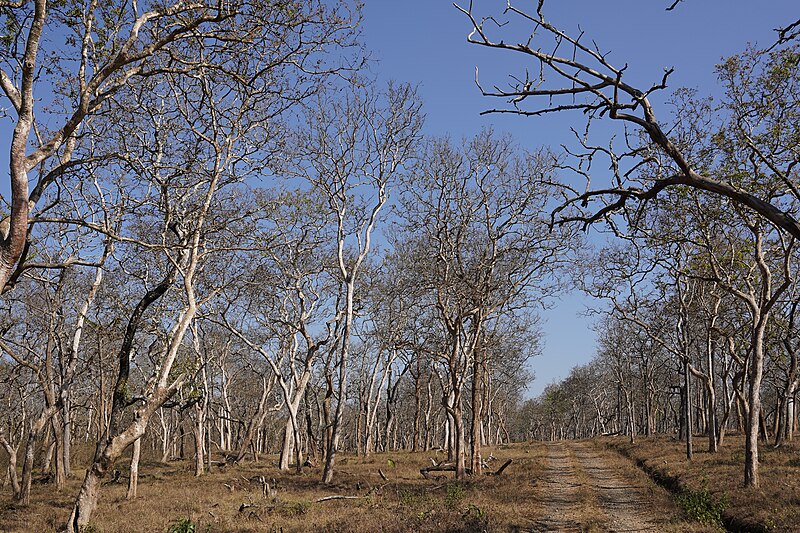
Welcome to Mudumalai National Park, an extraordinary sanctuary where ancient wilderness thrives alongside timeless geological history. As you arrive at this majestic preserve located on the northern slopes of the Nilgiri Mountain range in southern India, you are stepping into one of the most ecologically significant landscapes in all of Asia. The name Mudumalai carries a profound cultural and environmental heritage derived directly from the native Tamil language. The term mutu translates to ancient or original, while mudhukadu signifies an ancient forest, and malai means a hill or mountain. When joined together, Mudumalai literally translates to the ancient hill forest, a perfectly fitting name for a landscape that has sheltered complex living ecosystems for thousands of years. Geographically, this vast sanctuary is situated within the Nilgiri District of Tamil Nadu, precisely at the strategic tri-junction where three southern Indian states converge, namely Tamil Nadu, Kerala, and Karnataka. This exceptional geographical position establishes Mudumalai as a vital cross-border corridor for the continuous movement of wildlife. The park shares direct northern boundaries with the Bandipur Tiger Reserve in Karnataka, western boundaries with the Wayanad Wildlife Sanctuary in Kerala, and eastern boundaries with the expansive Sigur Reserve Forest, while the Singara Reserve Forest borders it to the south. Together, these vast contiguous protected reserves formed the core of the Nilgiri Biosphere Reserve when it was officially established in nineteen eighty-six as the very first biosphere reserve in India. Spanning an area of three hundred and twenty-one square kilometers, the park exhibits a varied topography with elevations ranging between eight hundred and fifty meters and one thousand two hundred and fifty meters above sea level. This dynamic elevation creates diverse microclimates shaped by a distinct rainfall gradient across the region. The sanctuary receives an average annual precipitation of approximately one thousand four hundred and twenty millimeters, driven predominantly by the southwest monsoon that sweeps across the landscape between June and September. However, moisture is distributed unevenly across the terrain. The western and southern borders receive over one thousand one hundred millimeters of annual rainfall, whereas the eastern boundary experiences a much drier climate, receiving only around six hundred millimeters per year. This environmental gradient fosters a mosaic of habitats ranging from moist deciduous forests to dry deciduous stands and thorny thickets. As you begin your journey, prepare to discover how these ancient hills sustain a breathtaking tapestry of life found nowhere else on earth.
02 Theppakadu Heritage & Forestry Logging Station
You are standing at Theppakadu, the historical administrative heart of Mudumalai where the narrative of human forestry transitions into modern wildlife conservation. Long before this forest received formal environmental protection, it served as a primary extraction site for commercial timber. The heavy exploitation of Mudumalai began in eighteen fifty-seven when the British government leased these vast timber reserves from the Raja of Neelambur. …
03 Moyar River Basin & Wildlife Hydrology
Welcome to the banks of the Moyar River, the indispensable hydrological lifeline that sustains the complex ecosystems of Mudumalai. Flowing into the national park from the south, the Moyar River winds through the core of the sanctuary and is joined by five major tributaries that together drain this vast landscape. …
04 Deciduous Canopy & Elephant Grass Ecosystem
Welcome to the heart of Mudumalai's dry deciduous forest zone, an expansive biome defined by majestic tree canopies and towering elephant grass. As you traverse Mudumalai, the forest structure shifts dramatically in direct response to the pronounced west-to-east rainfall gradient. While moist deciduous forests and semi-evergreen patches dominate the wetter western sector, dry deciduous forest constitutes the single largest floral expanse across the central and northern regions, eventually…
05 Mudumalai 50-Hectare Ecological Research Plot
You are entering the site of the famous Mudumalai Fifty-Hectare Forest Dynamics Plot, an internationally acclaimed long-term ecological research station. Located in Compartment seventeen of the Kargudi Range, this rectangular research plot measures one thousand meters in length by five hundred meters in width, with its long axis oriented directly east-to-west. …
06 Elephant Corridor & Carnivore Tracking Ground
Welcome to the Megaherbivore and Big Cat Migration Trail, a dynamic ecological crossroad where South India's most iconic wildlife encounters play out daily. Mudumalai stands as one of the most critical strongholds for the Asian elephant, supporting an estimated population ranging between five hundred and thirty-six and one thousand and one individuals grouped into roughly twenty-five distinct herds. …
07 Moyar River Gorge Vulture Sanctuary & Bird Overlook
Welcome to the Moyar River Gorge Vulture Sanctuary and Bird Overlook, a premier avian observation point suspended above the dramatic cliff faces of the valley. Mudumalai National Park is an ornithological paradise, with extensive field surveys recording over two hundred and sixty-six bird species, including two hundred and thirteen permanent resident species that breed within the sanctuary boundaries. …
08 Closing
As our journey through Mudumalai National Park comes to a conclusion, we are invited to reflect on the delicate balance between human progress and wildlife preservation. While this ancient sanctuary remains a stronghold for extraordinary biodiversity, it faces pressing environmental challenges from human encroachment. One of the most severe threats stems from vehicular traffic on three public highways that cut directly through the core of the park. …