Contents
History & cultureBY TELLBY7 sections · numbered as on the map01 Orientation
Welcome to Toomemägi Hill in the historic university town of Tartu, Estonia. Standing here among the tranquil trees, you are at a sacred place where humanity embarked on a grand scientific journey to discover the true shape and exact dimensions of our planet. The elegant yellow neoclassical building standing before you is the historic University of Tartu Old Observatory. Built directly upon the ruined stone foundations of a medieval bishop's castle, this remarkable facility has witnessed some of the most brilliant and transformative breakthroughs in the history of European science.
The primary reason this site holds such extraordinary global significance is its role as a key station of the Struve Geodetic Arc, a UNESCO World Heritage monument. Created between 1816 and 1855, this vast geodetic measurement network stretched more than 2,820 kilometers from Fuglenæs near Hammerfest in Norway by the Arctic Ocean all the way to Staro-Nekrassowka near Izmail in Ukraine by the Black Sea. Passing through ten modern nations, the arc was established to prove the scientific theory that Earth is not a perfect sphere, but rather an oblate spheroid flattened at the poles. Scientists accomplished this historic feat through precise triangulation, and the observatory before you served as a vital operational center where astronomical coordinates were determined and complex mathematical calculations were performed by master scholars.
As you look at the main facade, observe the central octagonal observation tower rising above the roofline, balanced by symmetrical side wings. Anchored firmly into medieval masonry, the architecture itself symbolizes the bridge between past history and future discovery, connecting the solid earth to the heavens. Beyond its technical triumph, this geodetic survey was a remarkable example of peaceful international collaboration, bringing together scientists and rulers across political boundaries for a shared scientific purpose.
As you step toward the main entrance, imagine the dedicated astronomers who gathered on this hill to gaze into the night sky and measure the Earth. Today this audio guide will lead you through the exterior architecture, the famous scientific instruments inside, and the surrounding courtyard park. Let us step forward and explore this sanctuary of science where Astronomer Friedrich Georg Wilhelm Struve and his colleagues expanded human knowledge of the universe.
02 Built Upon Castle Ruins: The Foundation of Tartu Observatory
You are standing directly before the southern main facade of the University of Tartu Old Observatory. Behind the peaceful and harmonious neoclassical exterior you see today lies a truly surprising and remarkable architectural secret. Between 1808 and 1810, this world-class observatory was erected directly on top of the ruined south-eastern stone walls of a medieval bishop's castle. …
03 The Reichenbach & Ertel Meridian Circle in the Western Hall
You have now entered the Western Hall of the Tartu Old Observatory. Standing before you is one of the museum's most prized historical treasures: the magnificent Reichenbach & Ertel Meridian Circle. Surprisingly, Astronomer Friedrich Georg Wilhelm Struve undertook an arduous journey lasting over five months across Europe to personally secure the delivery of this heavy solid brass instrument from Munich. …
04 Under the Rotating Dome: The Great Fraunhofer Refractor
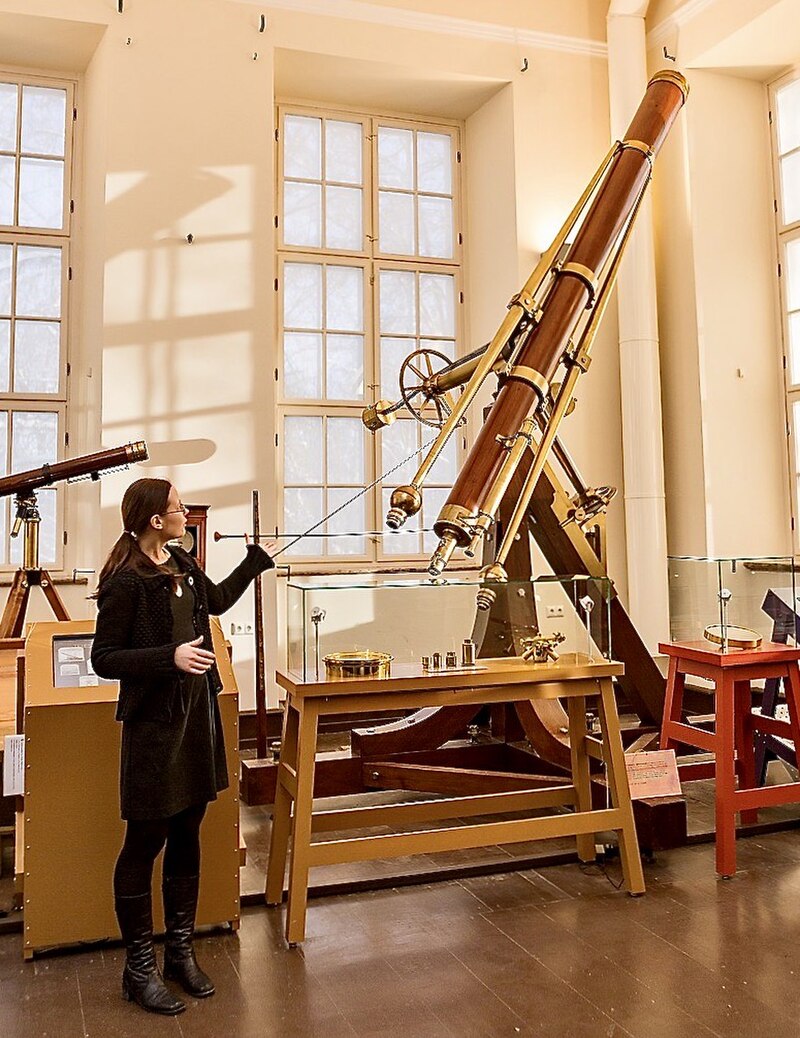
You are now standing inside the rotating dome at the top of the central observation tower. Surrounding you is one of the most historic milestones in astronomical history: the Great Fraunhofer Refractor. Remarkably, when this telescope arrived in Tartu in 1824 and the tower dome was expanded to accommodate it in the following year, its impressive lens aperture made it the largest and finest achromatic refractor telescope in the entire world. …
05 The Struve Monument: Mapping 2,800 Kilometers of the Earth
You are now standing in the quiet, shaded courtyard park directly in front of the observatory facade. Positioned in the center of this garden is a bronze monument honoring the extraordinary astronomer who directed one of the largest geodetic measurement projects in human history. Surprisingly, the baseline survey line guided from this observatory—the Struve Geodetic Arc—stretched over an astounding 2,820 kilometers, running from Fuglenæs near Hammerfest in Norway by the Arctic Ocean all the way…
06 The Slope Pavilion: Tracking Comets and Zone Stars
You have arrived at the small, picturesque observation pavilion nestled along the slope of Toomemägi Hill. Located slightly away from the main observatory building, this secluded wooden pavilion conceals another remarkable chapter in modern astronomical history. Remarkably, the very last scientific photograph of a celestial body taken at this historic site occurred in 1985, when astronomer Hugo Raudsaar calculated the precise position of Halley's Comet from this pavilion. …
07 Closing
Today you have explored the University of Tartu Old Observatory on Toomemägi Hill, tracing the footsteps of visionary astronomers who charted the night sky and calculated the exact dimensions of planet Earth. From its completion in the early nineteenth century, this observatory stood at the very center of European astronomical research, generating discoveries that permanently reshaped human knowledge. …