 Photo Wikimedia Commons
Contents
History & cultureBY TELLBY8 sections · numbered as on the map01 Orientation
Welcome to the sacred ancient site of the Bharhut Stupa, situated in the quiet rural landscape of the Satna district in Madhya Pradesh, Central India. As you stand at the threshold of this revered archaeological ground, you are treading upon one of the most vital cradles of early Indian and Buddhist art. The origin of this sacred sanctuary traces back to the third century before the common era during the illustrious reign of Emperor Ashoka of the Mauryan Empire. Although the unrelenting passage of centuries has eroded the grand physical structure, leaving behind only shallow earthworks and brick foundations set against the backdrop of Lal Pahadi or Red Mountain, Bharhut remains a monument of profound historical importance. Following its initial consecration under Emperor Ashoka, the sanctuary experienced a brilliant artistic golden age during the second and first centuries before the common era under the patronage of the Shunga dynasty and the northern Buddhist kingdom of the Sughanas. During this transformative era of intense religious devotion, royal patrons such as King Dhanabhuti, alongside scores of monks, nuns, and lay worshippers, contributed generously to erect elaborate stone railings and four magnificent torana gateways around the central hemispherical mound. A defining hallmark of the Bharhut monuments is its exquisite representation of the aniconic phase in early Buddhist visual culture. During this early period, artisans consciously refrained from portraying the Buddha in human anthropomorphic form. Instead, his transcendent presence and profound spiritual teachings were communicated exclusively through sacred emblems, including the sacred footprints known as Buddhapada, the empty throne, the sacred Bodhi tree, the wheel of the law known as the Dharmachakra, and the emblem of the Triratna. This artistic restraint reflected a deep doctrinal reverence that sought to elevate the Enlightened One beyond mortal limitations. After lying buried in obscurity for centuries, this historic sanctuary was rediscovered in 1873 by Sir Alexander Cunningham, the founder of the Archaeological Survey of India. In 1874, Cunningham, accompanied by his dedicated assistant Joseph David Beglar, executed systematic scientific excavations. To safeguard these invaluable sandstone treasures from weathering and vandalism, the surviving railings and the magnificent Eastern Gateway were carefully dismantled and transported to the Indian Museum in Kolkata, where they have been faithfully reassembled for posterity. Uniquely distinguished from all other ancient Indian monuments, every narrative panel at Bharhut is explicitly inscribed with label text in the ancient Brahmi script, serving as an irreplaceable historical dictionary of early Buddhist lore. As we begin our journey today, we invite you to immerse yourself in the artistic genius and timeless devotion that birthed this extraordinary monumental heritage.
02 The Eastern Torana Gateway and Foreign Artisans
We now invite you to step forward and stand before the magnificent Eastern Torana Gateway, which represents the sole surviving entrance among the four original monumental gateways that once enclosed the Bharhut Stupa. Sculpted between 100 and 75 BCE, this architectural masterwork was erected shortly after the completion of the inner stone railings, standing as the ultimate symbol of structural and artistic sophistication at the site. …
03 Stone Railings and the Sacred Conception of Maya
We now invite you to walk slowly along the path of the ancient stone railing known as the Vedika, which originally enclosed the sacred hemispherical mound of the stupa. Crafted between 125 and 100 BCE, these stone balustrades predated the erection of the Eastern Gateway, representing the foundational layer of Bharhut sculptural art. As you inspect the sandstone pillars and crossbars, you will notice numerous stonemason marks. …
04 Mahakapi Jataka: The Great Monkey King's Sacrifice
We now invite you to move toward one of the most celebrated narrative medallions on the Bharhut railing, which depicts a famous Jataka tale illustrating the virtues of the Buddha's previous lives. The railings at Bharhut serve as an invaluable visual encyclopedia of early Buddhist moral fables, containing eighty-two descriptive label inscriptions that guide pilgrims through the sacred stories. …
05 The Donation of Jetavana Monastery
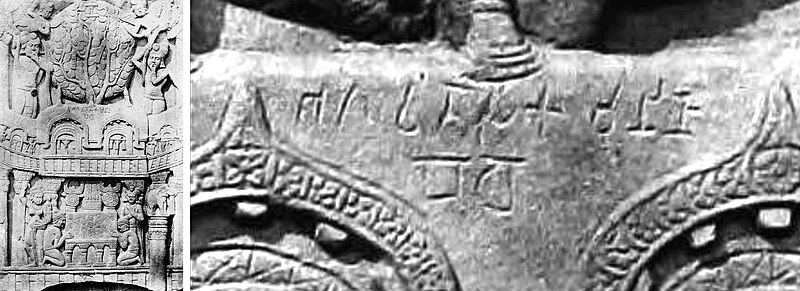
We now direct your attention to an extraordinary rectangular relief panel on the stone railing that illustrates one of the most famous acts of religious philanthropy in Buddhist history, the donation of the Jetavana Monastery. Positioned directly beneath this relief is a remarkably preserved Brahmi inscription that reads Jetavana Anadhapediko deti Kotisanthatena Keta, which translates as Anathapindika presents Jetavana, having become its purchaser for a layer of kotis. …
06 The Bharhut Yavana: A Hellenistic Guardian
We now guide you to one of the most intriguing and culturally significant relief carvings at Bharhut, known as the Bharhut Yavana pillar. This striking panel presents a non-Indian foreign warrior standing as a guardian of the sacred site, offering a vivid testament to the global connections of ancient India. …
07 Medieval Revival: The 11th-12th Century Temple Ruins
We now invite you to leave behind the early roots of the stupa and move toward the area containing the ruins of an eleventh to twelfth century medieval Buddhist temple. While Bharhut is primarily famous for its ancient reliefs from the second and first centuries BCE, archaeological evidence demonstrates that Buddhist practice and monastic life persisted at this site for nearly fifteen centuries. …
08 Closing
Dear visitors, that concludes our audio guide tour of the Bharhut Stupa Archaeological Site. The sacred ground you have visited today holds a monumental place in the annals of ancient Indian history and Buddhist visual culture. Although the physical site at Bharhut today retains only the subtle contours of the stupa's brick foundation set against the backdrop of Lal Pahadi or Red Mountain, the artistic legacy born here remains eternal. …