Contents
History & cultureBY TELLBY7 sections · numbered as on the map01 Orientation
Welcome to the historic At-Turaif District, an extraordinary earthen citadel majestically perched upon a limestone promontory overlooking the fertile oasis of Diriyah. Situated just five kilometers northwest of modern Riyadh, this unique site served as the original home of the House of Saud and the premier capital of the first Saudi state from 1727 until its tragic fall during the Ottoman conquest in 1818. Human presence along the floor of Wadi Hanifah dates back approximately 80,000 years to the Paleolithic era, as evidenced by ancient Acheulean and Mousterian stone tools discovered in the region. Remains of drystone wall settlements dating to the 5th millennium BCE and evidence of early camel domestication from the 3rd and 2nd millennia BCE demonstrate how this valley sustained human activity across millennia. In antiquity, the valley developed into a crucial caravan trade stop along the historic Incense Route. In 1720, Saud bin Mohammed of the Al Muqrin clan assumed leadership in Diriyah, driving out the rival Al Watban clan and establishing the foundations of the Saudi Dynasty. Surrounded by lush palm groves to the north, west, and southwest, and opening directly onto the desert plateau to the east, At-Turaif was masterfully positioned to harness alluvial groundwater while offering formidable defense.
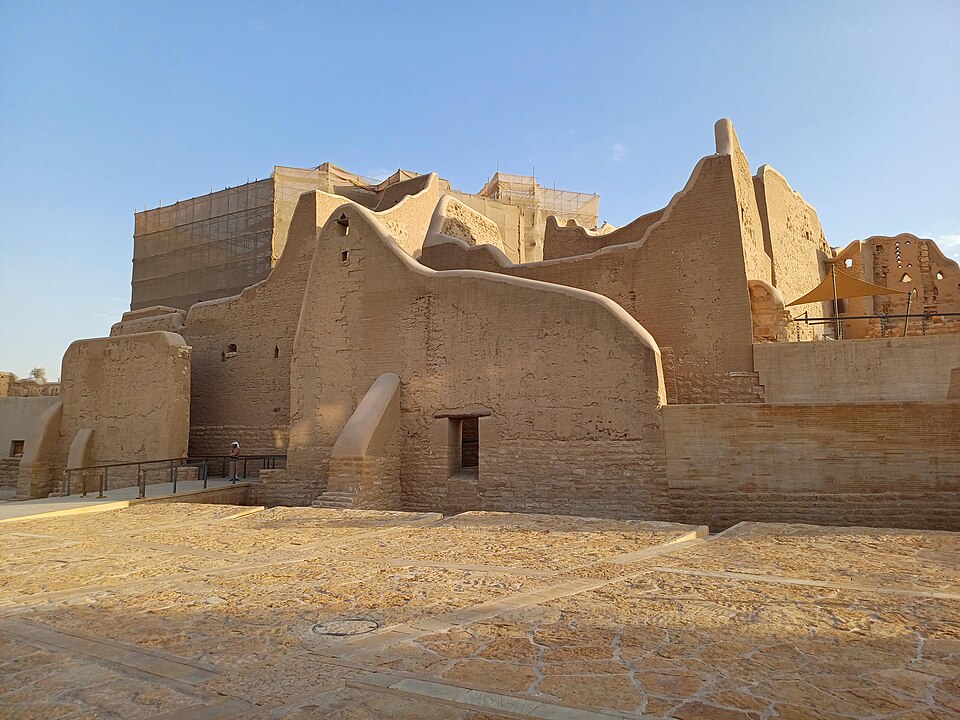
At-Turaif was inscribed as a UNESCO World Heritage site because it represents an outstanding and exceptionally preserved example of Najdi architectural tradition. In a hyper-arid desert environment receiving an average annual rainfall of less than 84 millimeters, local master builders ingeniously utilized locally available raw materials, including unbaked mud bricks, limestone foundations, clay mud plastering, and palm timber, to construct vast multistory palaces, administrative complexes, and defensive fortifications. It stands as a monument to human adaptability, structural coherence, and urban sophistication in harmony with a severe desert oasis setting.
Following its destruction during the siege of 1818, At-Turaif remained largely deserted for over a century. However, after state acquisition in 1982 and comprehensive modern restoration initiatives under Saudi Vision 2030, this iconic citadel was honored with the 2020 MEED Project Award and transformed into a world-class living museum. As you embark on this audio tour, you will walk along historical street networks, exploring ancient royal residences, hot bathhouses, and battle-scarred defense walls. Feel the coarse texture of the sun-dried mud bricks and listen to the whisper of the desert breeze. Let us now begin our walking exploration by stepping toward our first destination, the magnificent Salwa Palace.
02 Salwa Palace: Seat of Royal Power
Welcome to Salwa Palace, the imposing crown jewel of the At-Turaif District. Let us begin with a truly staggering revelation regarding its scale. The magnificent complex expanding before your eyes is not merely a single residential building, but an immense palatial ensemble covering approximately ten thousand square meters. …
03 The Bath House and Guest House: Oasis Hospitality
Welcome to the Guest House and At-Turaif Bath House, an extraordinary architectural complex dedicated to oasis hospitality and personal purification. Let us begin with a truly surprising fact regarding this location. Here on a dry limestone plateau receiving an average annual rainfall of less than eighty-four millimeters, local builders constructed a highly sophisticated, fully functioning hot bathhouse complex complete with steam chambers and water drainage systems. …
04 Omar Bin Saud Palace: Masterpiece of Mud Architecture
Welcome to Omar Bin Saud Palace, an imposing architectural masterpiece of earthen construction perched on the edge of Wadi Hanifah. Let us begin with a truly astonishing fact about this palace. Despite over a century and a half of total abandonment, extreme seasonal temperature swings, and relentless desert winds, the high outer mud walls of this structure remained almost completely intact. …
05 Turki Palace: Scars of the Siege
Welcome to Turki Palace, one of the final royal residences constructed in At-Turaif during the early nineteenth century. Let us begin with a deeply dramatic and surprising fact about this specific location. The wide, gaping breach visible in the southern mud wall before you was not created by natural weather erosion, but by a direct hit from an Ottoman artillery cannonball fired during the catastrophic Siege of Diriyah in eighteen eighteen. …
06 Thunayyan Palace: Architecture on the Edge
Welcome to Thunayyan Palace, an architectural tour de force standing dramatically on the southern edge of the At-Turaif plateau. Let us begin with a truly surprising fact regarding this palace structure. Unlike the rectangular or trapezoidal plans typical of royal residences in At-Turaif, Thunayyan Palace was constructed on an unusually sharp triangular ground plan perched directly over the cliff edge of Wadi Hanifah. …
07 Closing
As we stand on the central viewing terrace looking out across the majestic panorama of Diriyah, our audio guide journey through the At-Turaif District comes to a close. Today, you have walked through the historical birthplace of the Saudi Dynasty and experienced the finest masterworks of Najdi earthen architecture. …