Contents
History & cultureBY TELLBY7 sections · numbered as on the map01 Orientation
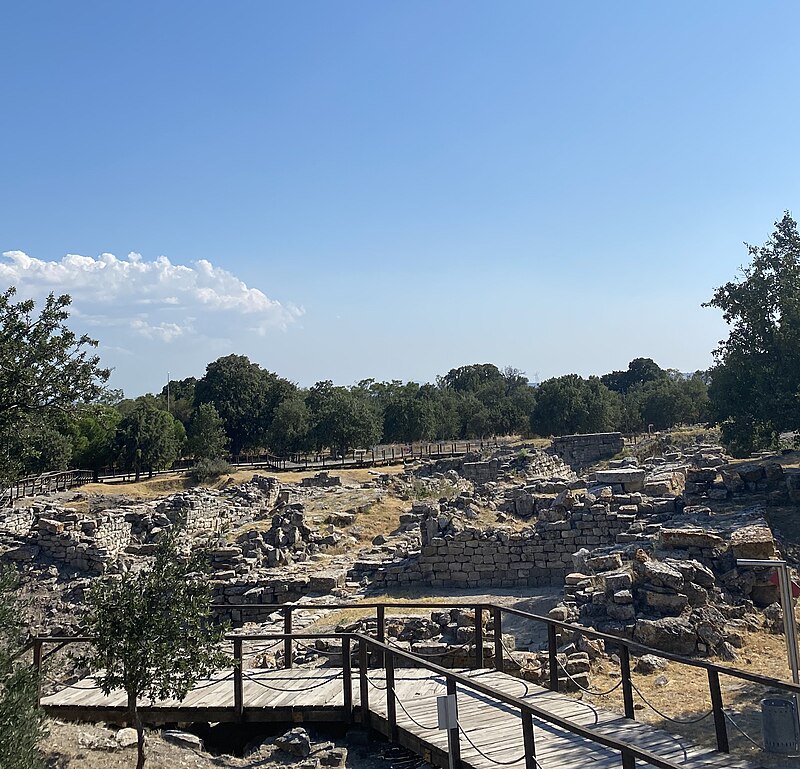
Welcome to the extraordinary archaeological site of Troy, a place where four thousand years of human history merge with the timeless echoes of ancient mythology. As you stand upon the elevated terrain of Hisarlik Hill, you are not merely gazing at a legendary setting immortalized by epic poetry, but at an incredible archaeological crossroads that played a pivotal role in the strategic, commercial, and cultural interactions between Asia and Europe. Positioned near the southern entrance to the Dardanelles strait, historically known as the Hellespont, Hisarlik Hill occupied a vital geographic vantage point overlooking the coastal plains of the Scamander River and the Aegean Sea. During the Bronze Age, the coastline extended much closer to this hill, creating a sheltered bay where ancient merchant ships waited for favorable winds before navigating the treacherous currents of the straits. First settled around thirty six hundred BC, Troy developed from a modest Early Bronze Age stronghold into a prosperous and formidable fortified citadel. Over four millennia of continuous habitation, the city endured catastrophic fires, violent earthquakes, and devastating military sieges. Each time the settlement was destroyed, subsequent generations rebuilt directly upon the rubble of their predecessors. This continuous cycle of destruction and rebirth created a massive archaeological tell containing nine major historical layers, designated by scholars with Roman numerals from Troy I through Troy IX. From the earliest prehistoric stone walls to classical Greek sanctuaries and grand Roman public monuments, the hill preserves a complete stratigraphy of Mediterranean civilization. Recognized for its unparalleled historical testimony and its profound influence on world literature through Homer's epic poems, the Iliad and the Odyssey, Troy was officially inscribed as a UNESCO World Heritage Site in nineteen ninety eight. Today, as you embark on this curated walking tour, you will trace a carefully designed circuit through thousands of years of human endeavor. Your journey begins at the iconic wooden horse monument in the entrance plaza, leads past the monumental stone ramp of Early Bronze Age Troy II, continues along the majestic ashlar fortification walls and watchtowers of Late Bronze Age Troy VI, ascends to the sacred upper terrace of the Athena Sanctuary visited by world conquerors like Alexander the Great, and descends to the elegant Roman Odeon and civic center of Ilium Novum. As you walk along these ancient stone paths, listen closely to the stories preserved within these weathered stones and feel the evocative atmosphere of this legendary landscape.
02 The Symbol of the Trojan War
As you step into the entrance plaza of Troy, the iconic wooden horse immediately captures your attention, standing as a universally recognized symbol of ancient myth and military stratagem. Yet, one of the most surprising facts that astonishingly catches visitors and literature enthusiasts off guard is that Homer's Iliad—the most famous epic poem dedicated to the Trojan War—does not contain a single line describing the Trojan Horse or its deceptive role in the city's fall. …
03 The Stone Ramp and Schliemann's Trench
As you reach this prominent section of the ruins, you encounter one of the most dramatic, compelling, and controversial chapters in the history of world archaeology. In the late nineteenth century, Heinrich Schliemann, a wealthy German businessman turned self-taught excavator, began digging at Hisarlik Hill with immense passion. …
04 The Imposing Walls of Bronze Age Troy
Standing before the monumental East Gate complex and fortification walls of Troy VI, you are looking at the pinnacle of Late Bronze Age military engineering in the Eastern Mediterranean. One of the most astonishing facts about these soaring limestone walls is that they were constructed entirely without mortar, relying on precisely cut ashlar masonry blocks fitted tightly together. …
05 The Sacred Sanctuary of Athena
Perched upon the highest terrace of Hisarlik Hill, the Sanctuary of Athena was one of the most sacred pilgrimage destinations in the ancient Mediterranean world. One of the most extraordinary facts that continuously captivates visitors is that legendary military leaders and world conquerors made personal pilgrimages to this holy ground to offer grand sacrifices before embarking on major military campaigns. …
06 The Roman Odeon and Council House
Welcome to the civic administrative center of Roman Troy, featuring the Odeon theater and the Bouleuterion, or council house. During the Roman imperial period, the city flourished under the name Ilium Novum, experiencing a grand renaissance. One of the most fascinating historical facts about this era is that Roman leaders, including Julius Caesar and Emperor Augustus, poured lavish imperial funding, tax exemptions, and architectural patronage into rebuilding the city. …
07 Closing
This concludes our comprehensive walking tour of the ancient archaeological site of Troy, an extraordinary sanctuary where human history and immortal mythology intertw. Standing upon Hisarlik Hill, where nine distinct civilizational layers accumulated over more than four thousand years of human habitation, you have experienced a profound journey through time, archaeology, and literature. …