Contents
History & cultureBY TELLBY8 sections · numbered as on the map01 Orientation
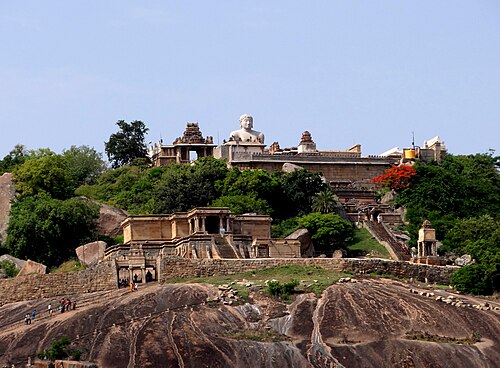
Welcome to Sravana Belgola, one of the most venerable and historically profound sacred centers of Jainism, situated gracefully amidst the undulating landscape of the Hassan District in Karnataka, India. Positioned at twelve degrees fifty-one minutes north latitude and seventy-six degrees fifty-three minutes east longitude, this sanctified geography possesses an extraordinary linguistic and epigraphical heritage recorded across millennia of stone inscriptions. The name Sravana Belgola finds its absolute root in Old Kannada etymology, created by joining the word bel, signifying pure white, with gola or kola, representing a pond or lake. This name directly honors the expansive, serene body of water resting at the center of the historic town. Across passing centuries, orthographic variants such as Belgula, Belagula, and Belugula frequently emerged in historical manuscripts and rock carvings. In formal Sanskrit epigraphs, this holy destination is celebrated under the noble titles of Dhavala Sarovara, Dhavala Sarisa, and Sveta Sarovara, each expressing the pristine radiance of the white lake. In Inscription number one hundred forty-one, the central tank is poetically praised as Bhu Devi Mangaladarsa Kalyani, translating as the auspicious mirror of good fortune to the Earth goddess. Furthermore, the surrounding sanctuary was reverently designated with exalted epithets such as Suranagara and Surapura, meaning the city of gods, as well as Gomatapura, the sacred city of Lord Gomata, and was universally venerated as a paramount tirtha or holy pilgrimage shrine. The topography of Sravana Belgola is defined by two majestic bare granite hills rising dramatically above the surrounding countryside. The smaller northern hill is known as Chandragiri or Chikkabetta, reaching an elevation of three thousand fifty-two feet above sea level. Directly opposite stands the grander southern hill named Vindhyagiri or Doddabetta, reaching three thousand three hundred forty-seven feet above sea level and soaring four hundred seventy feet directly above the plain. While popular usage occasionally misnamed the southern mountain as Indragiri, ancient epigraphical authority clarifies that Vindhya stems from vin, meaning spirit, and dhya, meaning meditation, signifying a sacred peak consecrated by holy rishis absorbed in contemplation of the Supreme Spirit. The primary historical significance of this sanctuary dawned around three hundred years before the Common Era. The exalted Jain preceptor Bhadrabahu, revered as the last of the All-Knowing Sruta Kevalis, foreseen a devastating twelve-year famine in the northern city of Ujjayini. Under his divine leadership, a vast religious community of twelve thousand ascetics migrated southward to preserve the sacred teachings, arriving at Katavapra, now known as Chandragiri Hill.
02 Chandragiri Hill and Bhadrabahu Cave
As you step softly across the bare granite ridge of Chandragiri Hill, you enter a sanctuary of profound antiquity and sacred devotion. Recorded in ancient rock inscriptions as Katavapra, this smaller northern hill serves as the silent refuge where one of the most transformative events in South Indian religious history unfolded. …
03 Chandragupta Basti and The Carved Screens
Standing almost precisely at the geographic center and highest elevation of the temple enclosure on Chandragiri Hill is the Chandragupta Basti, the oldest surviving structural temple on this holy mountain. Facing south and measuring nineteen feet in length by fifteen feet in width, this modest granite sanctuary embodies the profound simplicity of early Dravidian architectural forms. The inner sanctum features a triple-cell plan known as a trikuta. …
04 Ascent to Vindhyagiri and Tyagada Brahma Deva Pillar
Ascending the steep granite slope of Vindhyagiri Hill toward the summit courtyard is a physical journey that mimics a profound spiritual elevation. Reaching an altitude of three thousand three hundred forty-seven feet above sea level and towering four hundred seventy feet directly above the plain, this massive monolith derives its sacred name Vindhya from the combination of vin, meaning spirit, and dhya, meaning meditation. …
05 Akhanda Bagilu and Surrounding Cloisters
At the culmination of the arduous climb up Vindhyagiri Hill, pilgrims reach the majestic threshold of the main sanctuary courtyard, marked by the breathtaking monolithic gateway known as Akhanda Bagilu. The designation Akhanda Bagilu translates literally to the unbroken door or seamless doorway, signifying that this entire massive portal was sculpted directly out of a single, continuous block of natural granite bedrock. …
06 The Colossal Monolithic Statue of Gommateshwara
Stepping into the open-air central courtyard, you stand face to face with the crowning glory of Sravana Belgola, the colossal monolithic statue of Gommateshwara, also reverently known as Lord Bahubali. Commissioned by Chamundaraya, the legendary prime minister and commander of Ganga King Rachamalla the Second, this astounding monument was carved directly out of the mountain peak granite and completed around the Saka year nine hundred five, corresponding to nine hundred eighty-three of the…
07 Gullikayajji Shrine and The Origin of Mahamastakabhisheka
Facing the majestic monolithic statue within the open courtyard stands a charming stone shrine containing a small image of an old woman holding a halved fruit shell. This is the shrine of Gullikayajji, a sacred spot that preserves one of the most beloved legends surrounding the initial consecration ceremony, known as the Mahamastakabhisheka. Following the completion of the giant statue, Minister Chamundaraya organized a grand lustral anointing ceremony, known as abhisheka. …
08 Closing
Standing upon the wind-swept granite summit overlook of Vindhyagiri Hill, gaze out across the breathtaking panorama encompassing the twin sacred mountains and the peaceful white pond resting at the heart of the town below. This timeless landscape preserves an extraordinary historical continuum stretching across more than two thousand two hundred years of unbroken devotion. …