Contents
History & cultureBY TELLBY8 sections · numbered as on the map01 Orientation
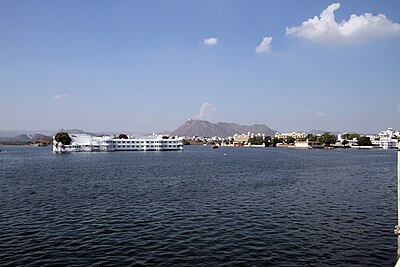
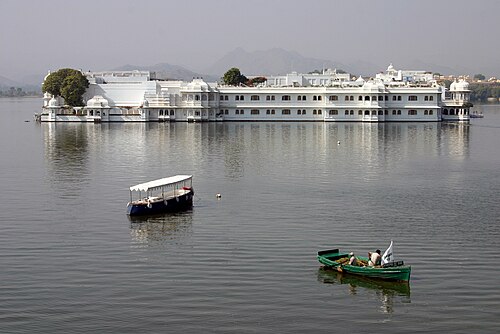
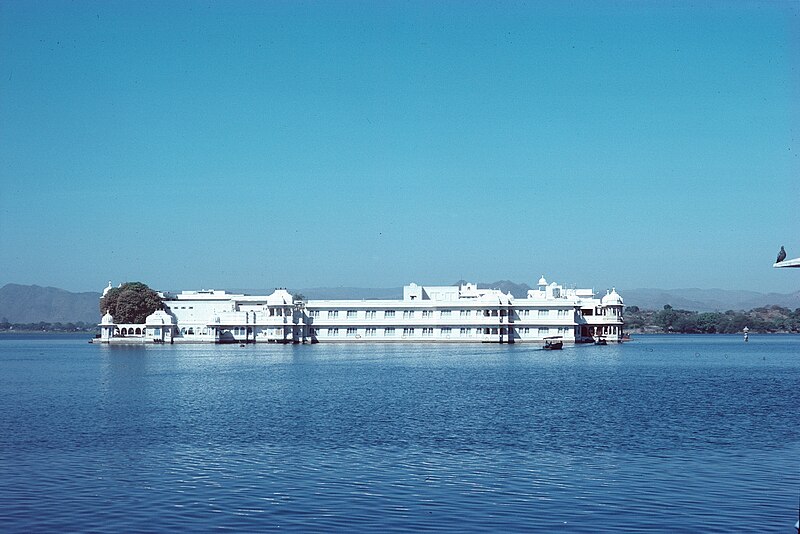
Welcome to Jag Niwas, an enchanting marble mirage floating gracefully upon the tranquil waters of Lake Pichola. Known globally today as the Taj Lake Palace, this extraordinary water palace represents one of the most magnificent heritage treasures of the Mewar dynasty in Udaipur, Rajasthan. As you stand by the water's edge and gaze upon its shimmering white domes, delicate cupolas, and carved marble facades reflected on the lake, you feel as though you are stepping directly into a living fairytale.
The foundation of the environment surrounding this palace dates back six centuries. Lake Pichola was originally created six hundred years ago during the reign of Maharana Lakha, between 1382 and 1421 CE, by a banjara named Chhitar ji. Taking its name from the nearby village of Picholi, the lake is believed to have originated near Dhud Talai. Later in 1560, during the reign of Maharana Udai Singh II, the lake was substantially enlarged by constructing dams across two upper streams. Spanning a total water body area of approximately 6.96 square kilometers with a maximum depth of 10.5 meters, Lake Pichola is intricately interconnected with other vital city lakes, including Goverdhan Sagar, Dudh Talai, Swarup Sagar, Rang Sagar, and Kumariya Talab.
The birth of Jag Niwas itself is rooted in a fascinating royal anecdote from the House of Mewar. In the early eighteenth century, the young Prince Jagat Singh asked his father, Maharana Sangram Singh II, who ruled from 1710 to 1734 CE, if he could reside with his wives at Jagmandir, an existing island palace on the lake. However, due to the strict prevalence of the Pardah system in Mewar at that time, Maharana Sangram Singh II declined the request. The Maharana explained that his frequent visits to Jagmandir would embarrass his daughters-in-law. Instead, he told his young son that if he desired an island pleasure palace, he should build one for himself.
Inspired by his father's words, Maharana Jagat Singh II, the sixty-second custodian of the House of Mewar who ruled from 1734 to 1751 CE, commissioned the construction of a new palace on a four-acre island amidst the Aravalli hills. The foundation stone was laid on May 4, 1743 CE, and the magnificent structure was officially inaugurated on February 1, 1746 CE. Named Jag Niwas after its founder, the palace served as an exclusive, serene summer retreat for the royal family of Mewar for generations.
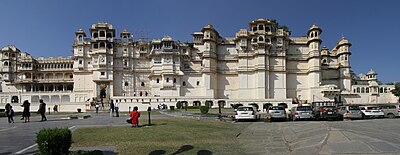
Architecturally, Jag Niwas was built facing east, allowing its royal inhabitants to offer prayers to Surya, the Hindu sun god, at the crack of dawn. While the main City Palace on the mainland was considered too public for quiet, moonlit gatherings, this island sanctuary offered complete privacy and tranquil luxury amidst the cooling lake breezes. As we begin our exploration, let the serene beauty of Lake Pichola and the rich history of Jag Niwas immerse you in an unforgettable journey.
02 Bada Mahal and Khush Mahal: The Foundations and Marble Artistry
Welcome to Bada Mahal and Khush Mahal, the historic core and founding foundation of Jag Niwas. As you step forward, please walk along the marble arcade following the gentle canal at your feet into the shaded courtyard. When Maharana Jagat Singh II initiated the construction of this island palace on May 4, 1743 CE, these very structures, along with the central canal, formed the first phase of an architectural marvel. …
03 Phool Mahal and Dhola Mahal: Royal Celebrations and Splendor
You are now standing in the captivating realm of Phool Mahal and Dhola Mahal. Please pause near the open colonnade and turn your eyes toward the sweeping expanse of the lake outside. Dedicated historically to grand royal celebrations, literary gatherings, and refined relaxation, these spaces were built during the founding phase between 1743 and 1746 CE under Maharana Jagat Singh II. …
04 Chandra Prakash Mahal and the Mirror Staircase: Aesthetics of Light
Welcome to Chandra Prakash Mahal and the Mirror Staircase, a sanctuary where the aesthetics of light, shadow, and reflection reach their absolute pinnacle. As you ascend the stairs, please focus your gaze on the small mirror fragments embedded carefully into the plaster walls around you. Translated as the Palace of Moonlight, Chandra Prakash Mahal was added to the palace complex in 1925 CE by Maharaj Kumar Bhupal Singh, prior to his accession as Maharana. …
05 Sarvritu Vilas and the Royal Suites: Layers of History
Welcome to Sarvritu Vilas and the Royal Suites, a wing of the palace where layers of Mewar history accumulated across the nineteenth and twentieth centuries. As successive Maharanas added new suites, pavilions, and fortified walls, Jag Niwas evolved from a serene private summer retreat into a historic sanctuary that played a vital role in pivotal national events. …
06 Mewar Terrace and Lily Pond: Eternal Gardens and Lake Vistas
Welcome to Mewar Terrace and the central Lily Pond courtyard. Step softly through the shaded walkways and pause beside the tranquil Lily Pond in the center of the courtyard, where marble arcades encircle lush floating lilies and gentle fountain spray. As you walk up onto Mewar Terrace, rest your hand against the marble balustrade and look across the open waters of Lake Pichola toward the majestic mainland City Palace and the surrounding Aravalli mountains, capturing the true floating magic of…
07 Rebirth as a Heritage Hotel: The Legacy of Taj Lake Palace
Welcome to the section dedicated to the modern rebirth of Jag Niwas into the world-renowned Taj Lake Palace hotel. By the late nineteenth and early twentieth centuries, time and lake dampness had taken a severe toll on the structure. French writer Pierre Loti described Jag Niwas as moldering in the damp emanations of the lake, while theater personality Geoffrey Kendal described it in the 1950s as totally deserted, its stillness broken only by the humming of clouds of mosquitoes. …
08 Closing
Our audio guide journey through Jag Niwas, the iconic Taj Lake Palace floating upon Lake Pichola, has now reached its conclusion. What began in 1743 CE as the ambitious dream of Maharana Jagat Singh II has endured through centuries of history, evolving into one of the most celebrated romantic heritage destinations in the world. …